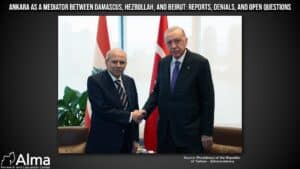
Ankara wants the Ayatollah regime in Iran to continue to exist, not out of sympathy for the Islamic Republic in Iran or the Islamic Revolution, but to avoid dealing with the uncertainty of a new regime and the possible dissolution of the Iranian regime.
Turkish President Recep Tayyip Erdogan eulogized Iranian Supreme Leader Ayatollah Khamenei on March 1, 2026, after learning of his elimination, and expressed his condolences. A day earlier, Erdogan said: “We are very saddened and concerned about the attacks by the United States and Israel against our neighbor Iran… For a long time we have tried seriously to resolve the disagreements through dialogue and talks around the negotiating table. Other countries in our region have also made great efforts to reach a solution. But in the end, the desired result was not achieved, because the lack of trust between the parties could not be overcome, and Israel continued to act to harm the process…”
According to Dr. Hay Eytan Cohen Yanarocak, an expert on Turkey at the Moshe Dayan Center at Tel Aviv University and the Jerusalem Institute for Strategy and Security, the scenario of Iran’s dissolution is perceived as a threat by Erdogan, because a zone of Kurdish autonomy/independence could be created in Iran (similar to the historical Republic of Mahabad), which would undermine Turkey vis-à-vis the Kurdish population in its territory.
Likewise, Turkey fears a mass wave of refugees, similar to the more than 4 million refugees who entered it due to the civil war in Syria.
According to Yanarocak, based on several reports, Turkey is planning a contingency for a military operation in Iranian territory in the event of the regime’s fall, in order to establish a buffer zone similar to the zones it established in northern Iraq (with Turkey already effectively occupying northern Syria), both as a defense against refugees and against Kurdish entrenchment.
Decision-makers in Ankara fear that if a new pro-Israeli regime arises in Iran, it will be perceived as a threat to Turkey’s national interests.
Therefore, it seems that Turkey is interested in the survival of the Islamic Republic in Iran: strong enough to keep Israel and the West occupied, but not too strong regionally.
This way, Israel and the West will be focused on Iran, while Ankara expands its influence in the region and the West’s attention is diverted from internal processes in Turkey of eroding democracy.
As far as Turkey is concerned, as long as Israel and the West are busy with Iran, the Turkish presence in other arenas (Gaza, Syria, Libya, the Caucasus, Africa, the Eastern Mediterranean) can be expanded as part of the neo-Ottoman project.
Meanwhile, Turkey is acting to solidify its status as the central hegemonic power in most of the Syrian arena, and as the patron of the “transitional” government in Damascus, headed by President Ahmed al-Sharaa. For Ankara, the change of government in Damascus represents a historic opportunity to realize two strategic goals: the complete dismantling of Kurdish autonomy in northeastern Syria, and the expansion of neo-Ottoman Turkish Islamist influence and restricting Israel’s steps.