
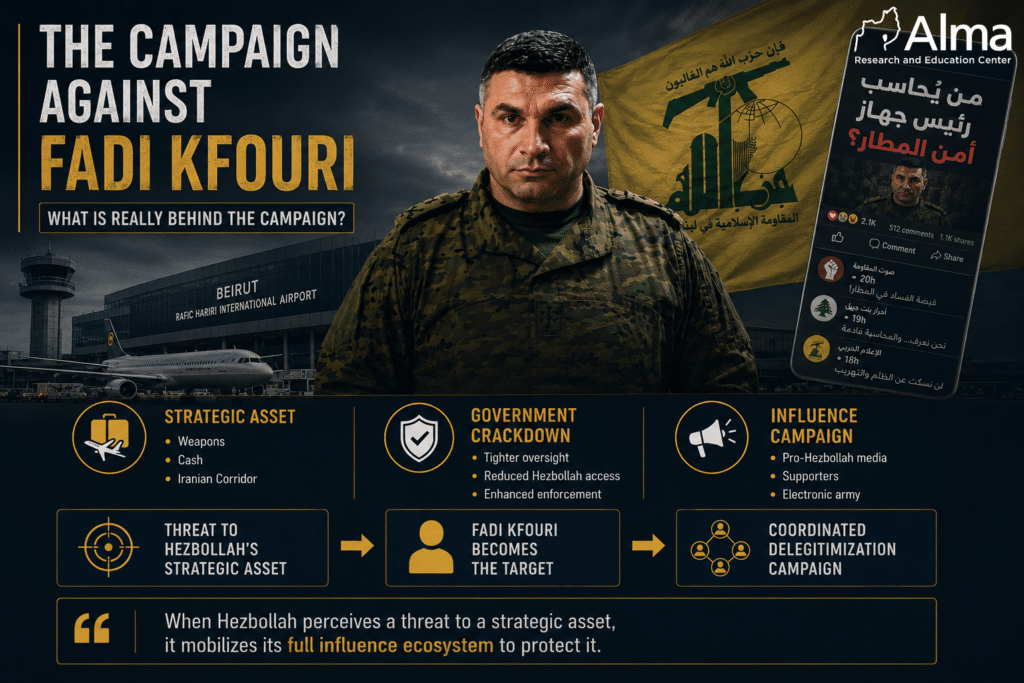
Brigadier General Fadi Kfouri, a Christian officer serving as Head of Security at Beirut-Rafic Hariri International Airport, has become the target of an unusual media campaign[1] in recent weeks led by figures and media outlets affiliated with Hezbollah.
Initially, he was accused of discriminating against Shiite employees and passengers. Subsequently, a series of more serious allegations emerged, including corruption, bribery, and alleged involvement in weapons and drug smuggling.
The campaign against Kfouri is not merely a personal attack. Rather, it reflects a broader struggle over one of Hezbollah’s most important strategic assets: Beirut-Rafic Hariri International Airport.
For Hezbollah, Beirut Airport is far more than Lebanon’s main international gateway. Over the years, it has served as one of the organization’s three principal force-building corridors, alongside the overland route from Iran through Syria and the maritime route.
The airport has facilitated the transfer of weapons, military components, cash, equipment, and Iranian personnel into Lebanon as part of the so-called “Iranian Corridor.”
Beyond its logistical role, Hezbollah has sought to establish deep influence within the airport through infiltration of security and oversight bodies, recruitment of key personnel, access to sensitive systems, and the exploitation of Iranian civilian airlines- including Mahan Air – to transport assets on behalf of the IRGC Quds Force and Hezbollah. (For further details, see Mahan Air – Its Aircraft and Crews as a Key Civilian Platform for Smuggling Weapons into Syria and Lebanon on Behalf of the Iranian Quds Force.)
Control of the airport extends well beyond logistics. It also provides Hezbollah with significant intelligence and security advantages. Through its influence over security screening, border control mechanisms, and sensitive systems, the organization has been able to monitor the movement of individuals entering and leaving Lebanon, protect its smuggling routes, and reduce the Lebanese state’s ability to oversee its activities.
It is also possible that Hezbollah has exploited the airport’s radar systems for intelligence collection and surveillance purposes.
In the years preceding the war, Hezbollah continued to deepen its grip on the airport by promoting the construction of an additional terminal, expanding its infiltration of security institutions, and exploiting officials within state institutions to gain access to sensitive systems and preserve its operational freedom. (For further details, see How Hezbollah Is Attempting to Take Control of Beirut International Airport.)
Hezbollah’s sensitivity to any attempt to undermine its control over the airport is not new. In May 2008, the Lebanese government decided to dismiss Brigadier General Wafiq Shuqair, then Head of Airport Security and widely regarded as close to Hezbollah, while simultaneously declaring Hezbollah’s independent telecommunications network illegal. Hezbollah described the decisions as a “declaration of war,” seized control of West Beirut within days, and ultimately forced the government to reverse both decisions. (For further details, see our related article.)
These events demonstrated that, from Hezbollah’s perspective, control of Beirut Airport is not merely an administrative issue but a strategic interest worth defending by force if necessary. Today, eighteen years later, the core dispute remains largely unchanged, although the methods employed have evolved.
The campaign against Kfouri did not begin with the recent wave of accusations. Already during 2024–2025, his name became closely associated with the changing security policy at Beirut Airport.
In November 2024, he became the central figure in a confrontation involving an Iranian delegation that refused to undergo mandatory security screening- an incident that marked the beginning of stricter enforcement measures against Iranian personnel at the airport. Several months later, around the funeral of Hassan Nasrallah, Beirut Airport once again became the focus of political tensions following the Lebanese government’s restrictions on flights arriving from Iran. Together, these incidents contributed to Kfouri’s image, in the eyes of Hezbollah and its allies, as one of the leading figures implementing efforts to reduce the organization’s influence at the airport.
Since early 2025, the Lebanese government has introduced a series of measures designed to restore state authority over Beirut Airport and reduce Hezbollah’s influence. These measures have included stricter oversight of flights, passengers, and cargo; the deployment of new detection systems; the cancellation of long-standing security exemptions; the suspension of direct flights from Iran; enhanced anti-smuggling enforcement; the removal of employees suspected of ties to Hezbollah; and the introduction of new oversight and monitoring mechanisms. Together, these steps represent a significant departure from the previous situation, during which Hezbollah enjoyed considerably greater freedom of action within the airport.
Within this framework, Brigadier General Fadi Kfouri, who assumed his position in January 2026, emerged as one of the principal figures responsible for implementing these reforms. Under his leadership, security procedures were tightened, access to sensitive security facilities – including the Airport Surveillance Radar (ASR) section – was restricted, and oversight and monitoring mechanisms throughout the airport were significantly strengthened. According to Lebanese media reports, some of these measures were specifically intended to prevent the leakage of sensitive security information and reduce the ability of Hezbollah-affiliated actors to exploit airport infrastructure.
Against this backdrop, the campaign against Kfouri takes on a much broader significance. Media outlets and public figures aligned with the pro-Hezbollah camp initially portrayed him as discriminating against Shiite employees and passengers[2]. They subsequently accused him of corruption, accepting bribes, and alleged involvement in weapons and drug smuggling[3]. Simultaneously, he was depicted as acting against Lebanon’s Shiite community and serving foreign interests.
Although no publicly available evidence has substantiated these allegations, the sequence of publications, the consistency of the messaging, the identities of the actors promoting the campaign, and the timing of their appearance alongside the tightening of airport security strongly suggest a coordinated effort to undermine the public standing and professional credibility of one of the senior security officials leading the government’s reforms at Beirut Airport.
The campaign against Kfouri fits a well-established Hezbollah pattern. Whenever the organization perceives one of its strategic assets to be under threat, it mobilizes its entire influence ecosystem- from affiliated journalists and media outlets, to supporters and activists on social media, and ultimately its so-called “electronic army” of anonymous and fake accounts. Together, these actors work to promote a unified narrative, damage the credibility of the campaign’s target, and generate public and political pressure.
Past experience suggests that information and influence campaigns are often only the first stage. The question remains whether Hezbollah will stop there.
The case of Fadi Kfouri illustrates that Beirut-Rafic Hariri International Airport remains one of Hezbollah’s most important strategic centres of gravity. Over many years, the organization has embedded itself within one of Lebanon’s most critical civilian infrastructures, transforming it into an integral component of its force-building, smuggling, and intelligence architecture. When the Lebanese state attempts to reassert control over this strategic hub, Hezbollah’s response is no longer necessarily military – as it was in 2008 – but increasingly political, media-driven, and cognitive, targeting those identified with implementing the reforms.
The campaign against Fadi Kfouri may therefore indicate that, even today, Beirut–Rafic Hariri International Airport continues to serve Hezbollah as a strategic asset supporting multiple aspects of its activities. Any effort to weaken the organization’s grip over the airport remains a significant threat from Hezbollah’s perspective, even if the methods employed to counter that threat have evolved.
[1] https://x.com/ATTR1313/status/2080650632029950155/photo/1
[2] https://x.com/bintjbeilnews/status/2072278891079573919
[3] https://x.com/Almahatta0/status/2081763038265520238




One Response
Dear Dana,
Hezbollah must be declared Public Enemy #1.
They must be removed from every means of transportation infrastructure to provide the BEGINNING of the recovery of the State of Lebanon. Hezbollah is the parasitic cancer that is extracting all the life blood from the State of Lebanon. Hezbollah, a proven jihaddist infiltration IRGC implant, must be totally removed or Lebanon will die.