
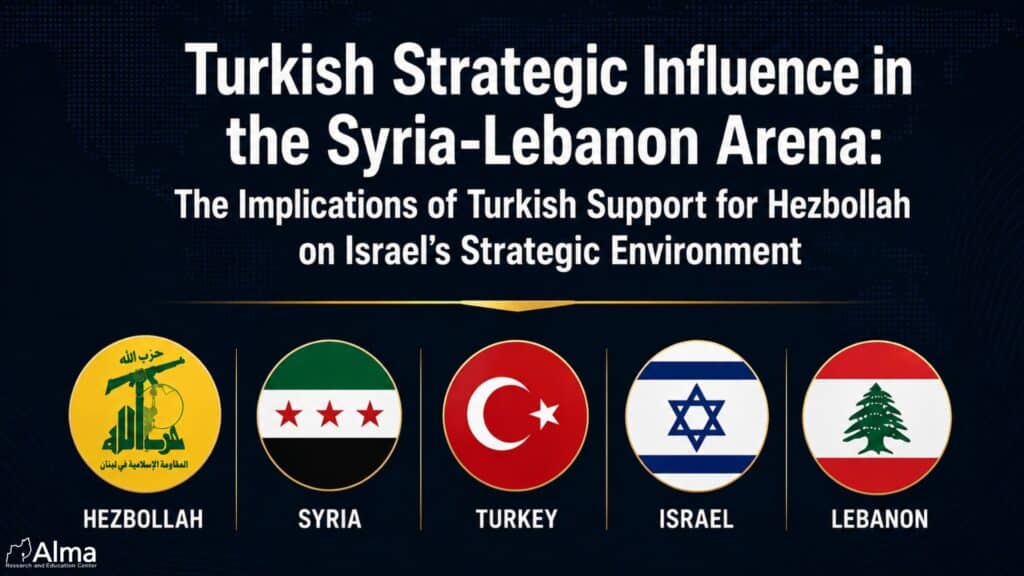
In a video published by Al Mayadeen and translated by MEMRI, Lebanese Hezbollah parliament member Ali Fayyad quoted Turkey’s ambassador to Lebanon as stating that Ankara supports Hezbollah’s “resistance role” in Lebanon and that Syria will not yield to American and Israeli pressure to act against the organization. If these statements indeed reflect Turkey’s position, they provide an important glimpse into how Ankara is seeking to shape the Syrian-Lebanese arena following the fall of the Assad regime, while maintaining channels of influence with all anti-Israeli actors in the region.
At first glance, this appears to be a paradox. For years, Turkey was one of the principal supporters of the Sunni Syrian opposition, while Hezbollah served as one of the main military pillars of the Assad regime and the Iranian axis in Syria. During the Syrian civil war, the two sides stood in opposing camps and even fought each other indirectly.
However, regional developments in recent years indicate that, from Ankara’s perspective, rivalry with Iran or Hezbollah is not absolute. Turkey seeks to establish itself as a leading regional power, expand its influence in Syria and Lebanon, and prevent the emergence of a regional order that would marginalize it. In this context, maintaining ties with Hezbollah provides Ankara with additional levers of influence in Lebanon and allows it to present itself as a central actor in the regional arena.
This means that ideological contradictions are sometimes set aside when there is a shared strategic objective and interest: containing Israel and reducing its regional influence. Despite their historical rivalry in Syria, Turkey and Hezbollah have found themselves on the same side when it comes to opposing Israeli policies and supporting the Palestinian cause.
In the Syrian context, Turkey remains the principal patron of the new order emerging in the country. Nevertheless, it is not necessarily interested in a direct confrontation between the new regime and Hezbollah, which could undermine stability and expand the circles of friction across the region. Hezbollah official Ali Fayyad’s statement that Turkey opposes pressure on Damascus to act against Hezbollah reflects this approach of managing a balance of power rather than pursuing a decisive outcome.
Implications for Israel
From an Israeli perspective, these developments reinforce the assessment that Turkey’s involvement in Syria and Lebanon is aimed not only at expanding its political and economic influence but also at creating strategic leverage against Israel. Even when Ankara supports Sunni forces opposed to the Iranian axis, it may simultaneously preserve channels of communication and cooperation with Hezbollah when doing so serves its broader regional objectives.
If Turkey indeed views Hezbollah as a legitimate actor within the “Axis of Resistance,” Israel faces a more complex regional challenge than it has in the past. Rather than a built-in rivalry between Ankara and the Iranian-Shiite axis, there appears to be potential for cooperation around a shared objective: limiting Israel’s influence and freedom of operation.
At the same time, Turkey’s growing influence in Syria may enable it to provide political backing to actors hostile to Israel and even affect the balance of power along Israel’s northern border. These developments illustrate that Erdoğan’s Turkey is guided primarily by considerations of power and regional influence rather than by traditional distinctions between Sunni and Shiite camps. Consequently, Israel must view Turkey not only as a political rival (and potentially a military one as well), but also as an actor capable of influencing a wide range of hostile forces across the region.



3 Responses
Dear Dr Zoe,
The turkey terror support should not surprise us. Snakes have no moral guidelines. If they can collaborate to consume a weaker snake, after it is digested, they may turn on each other, or find another prey of opportunity. Loyalty is only an opportunistic facade. The muslim brotherhood is pure terroristic evil.
Erdogan has repeatedly proclaimed his support for Hezbollah, and Hamas for decades has used Turkey as its base of operations against Israel. But is Erdogan help Hezbollah drone operations against Israel ? It is obvious, since Erdogan’s recently deployed to Damascus Airport the HTRS-100 Air Defense System, The HTRS-100 system provides an accurate three-dimensional aerial picture within a radius of 80 to 100 nautical miles (approximately 150 to 185 kilometers), a range that covers not only the skies of Damascus but also large parts of Lebanon and even extends into the airspace of northern Israel.
Erdogan has repeatedly proclaimed his support for Hezbollah, and Hamas for decades has used Turkey as its base of operations against Israel. But is Erdogan helping Hezbollah drone operations against Israel ? It is obvious, since Erdogan’s recently deployed to Damascus Airport the HTRS-100 Air Defense System, The HTRS-100 system provides an accurate three-dimensional aerial picture within a radius of 80 to 100 nautical miles (approximately 150 to 185 kilometers), a range that covers not only the skies of Damascus but also large parts of Lebanon and even extends into the airspace of northern Israel.