
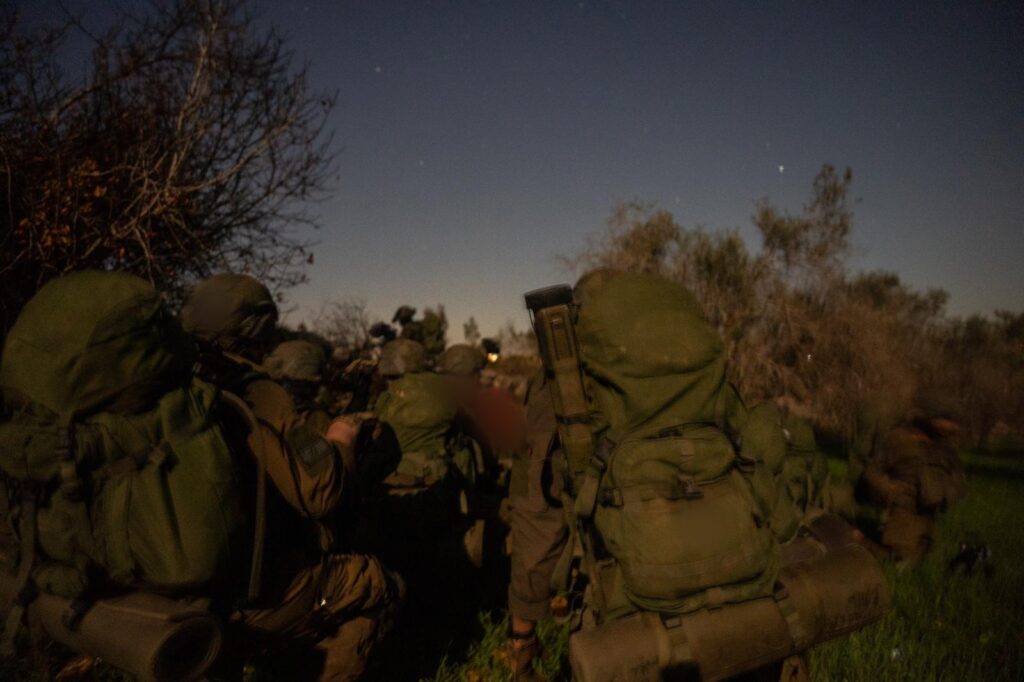
The deployment of IDF forces in recent days in southern Lebanon is intended to fundamentally change the security reality on the northern border and thwart direct infiltration threats by the Hezbollah Radwan forces and other terrorist organizations. According to military sources, the decision to deploy forces to forward defense positions stems from a deep understanding of the enemy’s strategic plans and the complex geography of the region.
On March 4, the IDF Spokesperson announced that forces from the 91st Division were being deployed in the eastern sector of southern Lebanon, while forces from the 210th Division were deployed in the Mount Dov area, and forces from the 146th Division were deployed in the western sector of southern Lebanon. The forces include infantry, armor, and combat engineering, intended to provide an additional layer of security to prevent infiltration threats from Hezbollah into Israeli territory.
At the heart of the deployment stands the determination to avoid the events of October 8, 2023, in the north, when, less than 24 hours after Israel woke up to the atrocities of the massacre carried out by Hamas, the Hezbollah terrorist organization began its attack on the Galilee.
Rockets and UAVs were launched towards northern communities located just minutes away from the border. Within weeks, more than 60,000 Israelis were forced to evacuate their homes, many of them for over a year. However, the rocket fire was only part of Hezbollah’s plan.
For years, Hezbollah worked on its ‘Conquest of the Galilee’ invasion plan, an October 7th-style attack on a much larger scale.
Hezbollah’s Radwan forces, its elite commando units, trained for a large-scale cross-border attack into the north.
The terrorists studied the Israeli communities along the border, mapped streets and neighborhoods, and prepared attack routes, while building a cross-border underground tunnel network similar to Hamas in Gaza.
The goal was to enter Israeli communities, massacre civilians, and take hostages.
Hezbollah did not abandon the plan, but rather the plan was disrupted when Israeli forces acted before Hezbollah managed to launch the attack.
Now, the IDF is determined to prevent the need to evacuate the residents of the north.
Geography explains the need for the current deployment, as many Israeli communities in the north sit directly below elevated terrain in southern Lebanon, from which Hezbollah operatives enjoyed a clear line of sight to the northern communities.
Precisely because of this, additional IDF soldiers have been poured in over the last few days in addition to those who previously manned 5 positions in southern Lebanon. The new forces are currently located at strategic observation points along the border inside southern Lebanon, in forward defense positions that do not constitute a ground maneuver but are intended to prevent Hezbollah operatives from returning to those firing points.
Instead of Hezbollah standing above Israeli towns with a clear line of fire – Israeli soldiers are now standing between Hezbollah and those communities, according to a military source.
These positions protect not only against the threat of ground invasion, but also push back Hezbollah’s anti-tank and mortar squads, and create a protective force so that civilians will not be exposed to these threats (or at least that the threats to the northern home front will be significantly reduced).
In addition to the ground deployment, the IDF is acting intensively to destroy Hezbollah infrastructure, and according to its announcement, the military attacked about 600 Hezbollah targets and eliminated about 200 terrorists in Lebanon as of Sunday.
The IDF called for the immediate evacuation of Lebanese civilians from southern Lebanon up to the Litani River to distance them from the line of fire.
IDF Northern Command took full command of the entire Lebanon sector, and over 600 terrorist targets were attacked from the air, sea, and land using about 820 munitions, including 27 waves of attacks in the Beirut area.
The political echelon in Israel made its determination clear to prevent a situation in which any resident of the north would have to evacuate.
During a situation assessment held by Defense Minister Israel Katz at the underground operations command center at IDF Headquarters, together with the chief of staff and other senior defense establishment officials on Sunday, Katz said: “First of all, I repeat: all residents of the north are remaining in their places, no one leaves their land and homes. We are strong enough; the soldiers protect the civilians, we need to protect the soldiers, and I am sure that all these things are being carried out.”



2 Responses
The geography factor makes sense – holding the high ground changes everything tactically.
This is a significant shift in defensive strategy. The decision to establish forward positions rather than relying solely on border defenses shows they’re taking the Radwan infiltration threat seriously after what happened on October 7th with Hamas. The geographical advantage Hezbollah had from elevated positions overlooking Israeli communities was a real vulnerability. Moving forces into southern Lebanon to deny them those firing positions is logical from a military standpoint, though obviously the political and diplomatic complications are considerable. The comparison to the tunnel networks in Gaza is concerning – it suggests a similar level of preparation for cross-border attacks. Hoping this prevents another mass evacuation situation for northern residents.