The Iranian arena
Waves of strikes across Iran continue. The IDF announced that it destroyed the headquarters of the IRGC Air Force, the IRGC Space and Satellite Command, and 50 bunkers that stored ammunition. In addition, a base of the Basij unit, headquarters of the Internal Security Forces, and a compound belonging to the IRGC Ground Forces were attacked. The fuel depot of the Iranian airport on Kish Island in southern Iran was also struck.
The Iranian navy ship Bandar Lengeh was destroyed in the port of Bandar Abbas.
The Air Force eliminated Abolghasem Babaeian, head of the military office of the Iranian regime’s Supreme Leader and chief of staff of the regime’s emergency command headquarters (Khatam al-Anbiya). Iranian media reported that Haj Ali Hashem, a senior IRGC official, was also eliminated in a strike in Isfahan.
Reports indicate strikes in Kermanshah, Qom, Isfahan, Shiraz, Tabriz, Behshahr, and Khorramabad.
The Assembly of Experts for Leadership officially announced that Mojtaba Khamenei is the third Supreme Leader of Iran.
Since the beginning of the war, 7 American soldiers have been killed.
Iran attacks targets in the Middle East
Over the past day, the pattern of attacks attributed to Iran and its proxies across the Gulf and the region has continued. The attacks included a combination of missiles and UAVs against military and civilian targets, alongside interceptions by regional states.
For the second time, a missile launched by Iran toward Turkey was intercepted by NATO.
Saudi Arabia announced that it intercepted this morning a UAV that was on its way toward the Al-Shaybah oil field. This is one of Saudi Arabia’s strategic energy assets, and damage to it would be expected to deepen the rise in oil prices. Its reserves stand at 14.3 billion barrels of oil and it also contains large gas reserves.
An Iranian UAV struck aviation fuel storage tanks overnight at Kuwait International Airport in the capital.
In Bahrain, an Iranian UAV struck the Bapco national oil company refinery this morning. There are also reports of attacks in Manama.
In Qatar, an Iranian UAV struck Al-Udeid base. There were also attacks in Doha.
In Jordan, the Shiite militia Rijal al-Bas al-Shadid published footage of the launch of suicide UAVs toward the Muwaffaq Salti Air Base in Azraq.
Iraq
A base of pro-Iranian militias in Iraq in the Nineveh province was attacked twice over the past day
The Israeli arena
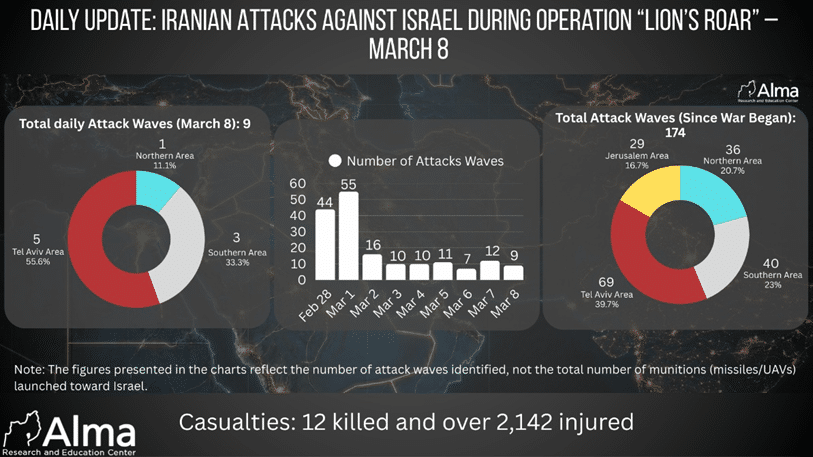
Yesterday (March 8), 9 Iranian attack waves toward Israel using ballistic missiles were identified. Most of the attacks were directed toward the Tel Aviv area (55.6%), while 33.3% of the attacks were directed toward southern Israel and 11.1% toward the northern region.
The data refer to the number of attack waves identified and not to the total number of missiles or unmanned aerial vehicles that were launched.
Since the beginning of the operation (February 28), a total of 174 attack waves using ballistic missiles and UAVs have been identified. Geographically, the central region, and especially the Tel Aviv metropolitan area, was the main target of the attacks (39.7%), followed by the south (23%), the north (20.7%), and the Jerusalem area (16.7%).
The high concentration of attacks on the Tel Aviv area (where about 4 million Israelis live) may indicate a deliberate focus on population centers and Israel’s main urban and economic hubs, with the aim of maximizing psychological impact and civilian harm.
It should be noted that since the beginning of the war, the Iranians have been using missiles carrying small bomblets that disperse over populated areas. These are missiles carrying submunition payloads, each weighing several kilograms, which disperse over a wide area that can reach a radius of several kilometers, thereby increasing the risk of damage in densely populated areas. Iran launches these missiles mainly toward the Tel Aviv area, where population density is high.
In terms of the number of daily attack waves, examining the previous days shows a gradual decline in the scale of attacks after the peak recorded at the beginning of March. On February 28, 44 attack waves were recorded, and on March 1 the number reached a peak of 55 waves. After that, there was a decline to 16 waves on March 2, followed by 10 waves on March 3 and 4, 11 waves on March 5, 7 waves on March 6, 12 waves on March 7, and 9 attack waves on March 8.
Damage in the civilian area in Israel:
• Since the beginning of the war, 12 civilians in Israel have been killed. 2,142 have been injured to varying degrees. In the past day alone, about 181 civilians were injured.
• Yesterday there were several impacts in the central region that caused casualties and property damage.
• More than 3,000 residents have been forced to leave their homes due to missile impacts and interceptor debris.
• The main cities where impacts from Iranian missiles were recorded are: Tel Aviv, Bnei Brak, Ramat Gan, Petah Tikva, Beit Shemesh, and Be’er Sheva.
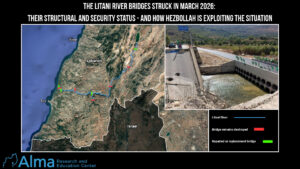
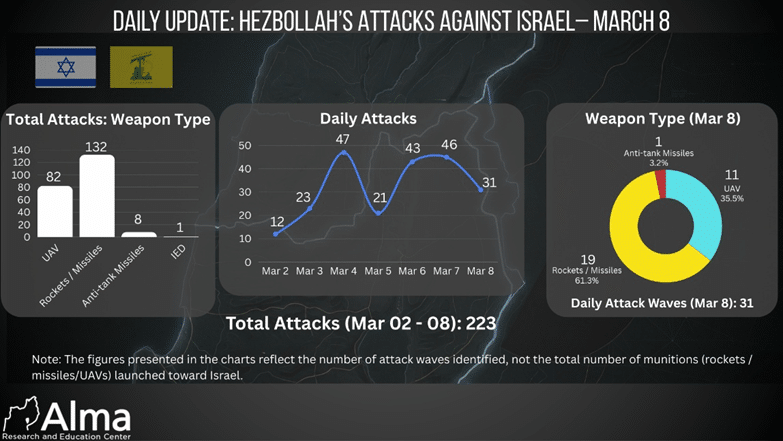
Since Hezbollah joined the war (March 2), it has carried out a total of 223 attack waves toward Israeli territory, including launches of rockets, missiles, and UAVs (the number refers to the number of attack waves, not the amount of munitions fired toward Israel). Hezbollah’s fire is carried out both from south of the Litani and from north of the Litani.
During March 8, Hezbollah carried out 31 attack waves toward Israel, using rockets, UAVs, and anti-tank missiles.
The main areas targeted by Hezbollah are the frontline communities, the Galilee communities, the Krayot, and Haifa. Hezbollah is also carrying out attacks against IDF forces operating in southern Lebanon, and yesterday it was reported that two IDF soldiers were killed in Lebanon.
In terms of attack patterns, Hezbollah’s primary weapons are rockets and missiles, which yesterday (March 8) accounted for most of the attacks (about 61.3%), while about 35.5% of the attacks were carried out using UAVs, and in one instance an anti-tank missile was used against IDF forces. This trend indicates continued extensive use of UAVs alongside massive rocket fire.
Examining the daily trend shows fluctuations in the scale of the attacks: on the first day of Hezbollah’s entry into the war (March 2), 12 attack waves were recorded. On the second day (March 3), 23 attack waves were recorded; on the third day (March 4), which was the most intense so far, 47 attack waves were carried out; on the fourth day (March 5), 21 attack waves; on the fifth day (March 6), 43 attack waves; on the sixth day (March 7), 46 attack waves; and on the seventh day (March 8), 31 attack waves.
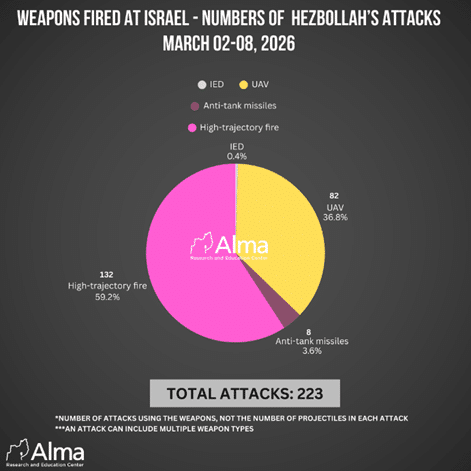
An examination of the weapons used by Hezbollah in the recent rounds of fighting – the “Swords of Iron” war and the campaign in the north compared to the current round in Operation “Roar of the Lion” – indicates continuity in operational patterns alongside a certain change in the composition of the weapons used.
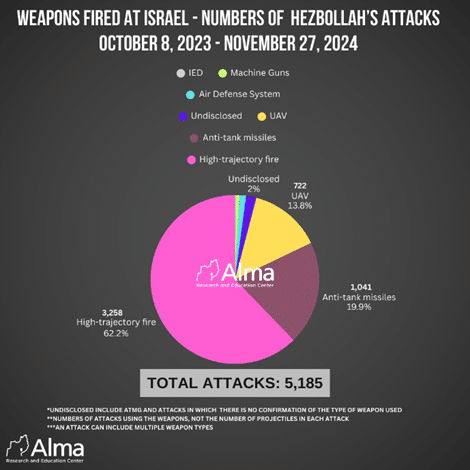
Between October 8, 2023 and November 27, 2024, Hezbollah carried out 5,185 attacks against Israel. The majority of the attacks were carried out using indirect fire weapons (rockets and missiles), which accounted for 62.2% of the attacks (3,258 incidents), alongside 1,041 anti-tank missile launches (19.9%) and 722 UAV launches (13.8%).
In the current round of Operation “Roar of the Lion” (March 2–8), out of 223 attack waves, rockets and missiles remained the main means with about 59.2% of the attacks. However, there has been a significant increase in the use of UAVs, which accounted for about 36.8% of the attacks.
This trend indicates that alongside continued reliance on rockets and missiles, Hezbollah is expanding its use of UAVs. This corresponds with our assessment that after the 2024 war the organization defined the UAV array as a central effort and invested in rebuilding Unit 127 and in force development in this field.
Lebanon and Hezbollah
Lebanese President Joseph Aoun announced that Lebanon is ready to renew negotiations in order to stop the Israeli escalation. Aoun emphasized that Lebanon is committed to the declaration of the cessation of hostilities from November 2024 and demanded that Israel stop its strikes throughout Lebanese territory. Prime Minister Nawaf Salam said that there are “ideas on the table,” mainly from France, but it is still not possible to speak about a consolidated initiative.
According to reports, France is currently leading international mediation efforts, while the United States is not showing similar effective involvement. It was reported that Lebanon is open to discussion in any framework, agenda, or location for talks, but there has so far been no Israeli response to the Lebanese proposals. Ideas have been raised regarding direct negotiations with Israel, possibly through Cyprus and under international sponsorship, but according to the reports these are currently only ideas, without real progress. Salam emphasized that the only guarantees Lebanon has received so far relate to avoiding strikes on Beirut International Airport and the road leading to it.
Aoun emphasized that the government’s decision regarding the dismantling of weapons will be implemented in accordance with the plan prepared by the army command, when security conditions allow it. Salam reiterated the government’s position that Hezbollah’s military and security activity is illegal. Various Lebanese reports emphasized that Hezbollah is in practice ignoring the state’s decisions and continues to operate as if they had not been adopted at all.
According to Lebanese Prime Minister Nawaf Salam, Lebanon has no direct or indirect interest in being dragged into the American-Israeli conflict with Iran. No one in Lebanon will accept peace on Israel’s terms, but that does not mean that we do not want peace. Hezbollah’s military activity has become illegal, and this is the government’s position that must be implemented.
The Arab League welcomed the Lebanese government’s decision to prohibit Hezbollah’s military and security activity. In its decision, the League emphasized its support for Lebanon’s sovereignty, the strengthening of state institutions, and the exclusivity of weapons in the hands of the Lebanese army and the official security forces. The ambassadors of Denmark, Sweden, and Norway expressed solidarity with Lebanon and readiness to assist the displaced.
Following Cyprus accusation that unmanned aerial vehicles that struck British bases in Cyprus had departed from Lebanon, Lebanese Foreign Minister Youssef Raji was quick to clarify that Hezbollah’s actions do not represent the Lebanese state or the Lebanese people. Reports in Lebanon expressed concern over the deterioration of relations with Cyprus and the possibility that the development could also worsen the crisis with Europe. In this context, Lebanese voices in the reports accused Hezbollah of expanding the war and deepening Lebanon’s isolation.
According to reports in the Lebanese media, it has recently been observed that Hezbollah has adopted a different method in its statements related to thwarting operations and strikes, as the organization no longer publishes official mourning announcements for its operatives who were eliminated, as it did in the past. It has been argued that the change may stem from several considerations, including a desire to reduce the public attention surrounding the number of Hezbollah operatives eliminated, to make it more difficult for Israel to collect intelligence on the identities of the dead, and to reduce internal public pressure in Lebanon as casualties increase.
Demonstrations of support for Hezbollah were documented, including a march on Hamra Street in Beirut.
According to a report by the Saudi channel Al-Hadath, the Lebanese military court released several Hezbollah detainees who had been arrested in recent days by the Lebanese army for illegal possession of weapons. According to the report, they were released on bail of 20 dollars. It was also reported that the president of the Lebanese military court was under heavy pressure to secure their release. Justice Minister Adel Nassar ordered the public prosecutor to open an investigation against Judge Abbas Jouha, who released them.
The official Lebanese news agency reported that the Lebanese parliament voted by majority to postpone the elections that were scheduled to take place in May 2026 and to extend the term of the current parliament by two additional years.
Intensive Israeli strikes continue in southern Lebanon, the Beqaa, Dahiya, and the Beirut area. Among other targets, strikes were carried out against branches of the Al-Qard al-Hassan bank in Dahiya (March 9). According to the IDF spokesperson, more than 100 strikes were carried out across Lebanon in the past day. Among the targets were weapons storage facilities and dozens of military sites. In Dahiya in Beirut, a headquarters and training compound of the Radwan Unit were struck.
The commander of the Nasr Unit (the western geographic unit south of the Litani), Abu Hussein Ra’ghab, was eliminated in an IDF strike overnight.
Mustafa Ahmed al-Zein, a Hezbollah operative with ties to the Quds Force, was also eliminated.
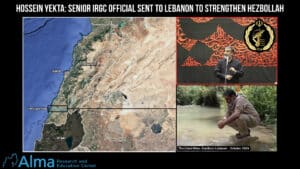
On March 7, the IDF eliminated five senior commanders in the Lebanon Corps of the IRGC Quds Force, including three central commanders:
Majid Hosseini – was responsible for transferring funds to the regime’s proxies in Lebanon to finance the activities of the Hezbollah terrorist organization.
Ali Reza Bi-Azar – served as head of the intelligence branch of the Lebanon Corps in the Quds Force. Bi-Azar was considered a significant knowledge center in the field of intelligence research.
Ahmad Rasouli – served as the intelligence chief of the Palestine Corps of the Quds Force.
In addition, Hussein Ahmadlu, who was an intelligence operative involved in collecting intelligence on the State of Israel for terrorist purposes, and Abu Muhammad Ali, who was the Hezbollah representative in the Palestine Corps and responsible for the organization’s ongoing coordination with the Palestine Corps, were also eliminated.
About 650,000 residents have evacuated from Dahiya and about half a million from southern Lebanon, a total of approximately 1,150,000 displaced persons.
The international arena
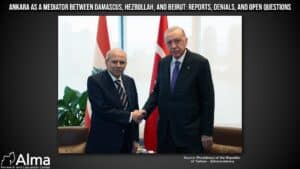
Turkey deployed 6 F-16 aircraft and air defense systems in northern Cyprus. In response to the second missile fired toward its territory, Turkey reiterated its warning to all parties, foremost Iran, to avoid steps that endanger regional security.
Ukrainian President Zelensky announced that Ukraine sent a team of UAV interception experts to protect U.S. military bases in Jordan. According to him, Ukraine has received requests from 11 countries in the Gulf, Europe, and the United States regarding assistance in dealing with Iranian UAVs, some of which have already been answered with practical and specific decisions.
French President Macron spoke with the President of Iran.
Macron stated that when Cyprus is attacked, Europe is attacked. According to him, French forces in the Middle East, the Red Sea, and the Strait of Hormuz will include 8 warships, an aircraft carrier, and two helicopter carriers.
The President of Iran spoke with the President of Azerbaijan and claimed that Iran had no connection to the UAV that struck the airport in Nakhchivan on Thursday. Azerbaijan announced this morning (March 9) that it has reopened its border crossings with Iran for all cargo traffic.
The Prime Minister of Qatar said that Iran “betrayed us” but also called for calm and de-escalation.