
A Hezbollah victory narrative on the Ali al-Taher Ridge “the day after” would be a mirror image of Israeli and American weakness. It could undermine counterterrorism efforts worldwide in general, and the struggle against the terrorism of the Shiite axis in particular.
On August 8, Prime Minister Benjamin Netanyahu stated: “Israel has recently operated forcefully in Lebanon and eliminated Hezbollah operatives, including in a highly significant operation on the Ali al-Taher Ridge, about which no further details can be provided…”
The prime minister’s remarks come against the backdrop of several public reports from recent weeks, as well as more recent reports of incidents in the ridge area, including air and artillery strikes, ground exchanges of fire with Hezbollah operatives, several operatives being hit, the tightening of the encirclement around the ridge complex, the thwarting of Hezbollah resupply attempts, and two incidents in which Hezbollah launched explosive drones, one of which struck an IDF engineering vehicle.
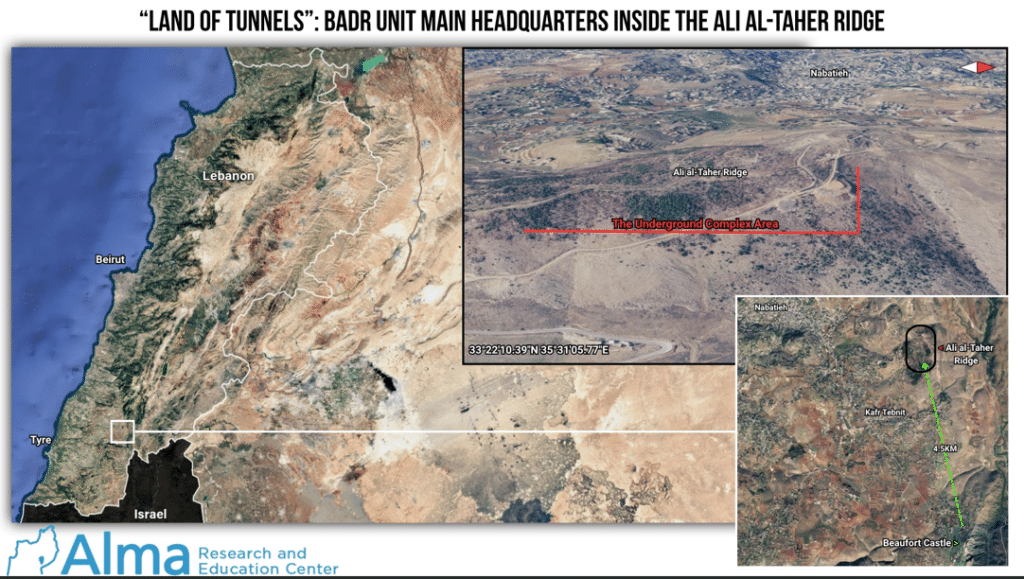
The ridge, which forms a topographical continuation of the Beaufort Castle area toward the northwest, is not merely another high ground area in southern Lebanon. Hezbollah spent years constructing a strategic asset beneath it: an underground network more than a kilometer long that served as a central headquarters for the Badr Unit—currently Hezbollah’s main territorial unit on the southern front in general, and in the area north of the Litani River in particular. The complex includes headquarters and command-and-control rooms, storage facilities, spaces that enabled a large force to remain underground for extended periods, and concealed launch shafts.
According to published information, dozens of Hezbollah operatives were trapped inside the underground complex during the Israeli operation. At this stage, those operatives cannot be conclusively linked to the prime minister’s statement regarding the elimination of Hezbollah operatives in Lebanon. Nevertheless, the proximity of the reports underscores the intensity of the pressure Israel is exerting on the organization and the importance of the campaign being conducted over this area.
The Ali al-Taher area is also important because of its location. To its west lies the Nabatieh area, which constitutes an operational center of gravity for Hezbollah in southern Lebanon. Together with the Beaufort Ridge, this is an area in which the organization invested for years in the construction of command systems, combat positions, and underground infrastructure as part of the “land of tunnels” it established in southern Lebanon.
The infrastructure in the Ali al-Taher area has been attacked from the air several times in the past, but Hezbollah managed to restore it. Denying the organization that capability required a ground operation—physically reaching the complex, clearing it, and thoroughly destroying the infrastructure built inside it.
That is precisely why the question of what will happen at Ali al-Taher “the day after” is not a tactical question concerning one more ridge or a few more kilometers inside Lebanon. It is a strategic question.
The combination of Hezbollah’s loss of control over the Beaufort and Ali al-Taher areas and the damage to its underground infrastructure constitutes a blow to a major center of power that the organization, with Iranian assistance, invested years and considerable resources in constructing and defending.
Should dozens of Hezbollah operatives trapped in the Ali al-Taher underground complex ultimately be allowed to emerge, and should Hezbollah be permitted to return to this strategic underground infrastructure, Israel would risk transforming a significant military achievement into an enormous symbolic and propaganda victory for the enemy.
A Hezbollah victory narrative on the Ali al-Taher Ridge “the day after” would be a mirror image of Israeli and American weakness. It could undermine counterterrorism efforts worldwide in general, and the struggle against the terrorism of the Shiite axis in particular.
Hezbollah does not need a victory ceremony. It does not have to raise a flag over the ridge on the day after the IDF withdraws. From its perspective, it would be enough to tell the Lebanese public, its supporters, and Iran: Israel entered, fought, paid a price, and ultimately withdrew; our operatives “stood firm,” survived, and we resumed operations from the infrastructure.
This would become Hezbollah’s principal image of victory in the war.
More seriously, in the case of Ali al-Taher, the line between a propaganda achievement and military recovery is extremely thin. Hezbollah has already demonstrated that it knows how to rebuild damaged infrastructure. Its return to the area could gradually enable it to reconstruct command-and-control networks, weapons depots, launch shafts, and underground facilities.
What may initially be presented as the return of civilians, or perhaps as the transfer of responsibility to another Lebanese actor—such as the Lebanese Armed Forces—will eventually become the return of Hezbollah itself. We are already seeing this in the first pilot area in Zawtar al-Gharbiyah, with the return of Hezbollah’s Islamic Health Organization and the “Cooperate with One Another” Association.
Therefore, any future arrangement in Lebanon must be assessed not only according to whether the IDF remains at a particular location, but according to a far more important test: whether credible mechanisms and capabilities exist that can prevent Hezbollah from returning to the assets it has been deprived of, while also providing clear evidence that it has not returned.
As of this writing, no such credible mechanisms or capabilities appear to exist.
Israel does not necessarily have to—and does not wish to—hold every area in southern Lebanon indefinitely. But it must ensure that achievements secured through military action are not erased by a political decision that lacks an effective enforcement mechanism.
The Ali al-Taher area is a clear test of this principle. If Hezbollah has lost a strategic asset that it spent years constructing and is unable to return to it, that would constitute a military outcome with long-term significance. But if Israel withdraws, the Hezbollah operatives trapped in the underground complex survive, and the organization returns, rebuilds, and reestablishes itself, Hezbollah will be able to transform its defeat on the ground into a “heroic” propaganda narrative of survival and victory.
Israel must not allow Hezbollah to obtain that image of victory. This is also a clear interest of the Lebanese state and the United States.




2 Responses
Dear Tal,
We agree! My father did not deploy through the rubble of Europe into Nazi Germany in the US Army during WWII just to say mission accomplished, and leave the nazi youth indoctrination camps with the genocidal furnaces intact for use against the coming generations of Jews! I never in my entire life heard him say it is not my war. It was my father’s war then. It is my war now. The US Army occupied both Germany and Japan to clean out evil and deradicalize the societies. We can do no less today. The grand mufti escaped justice then. We must finish the work against all the current fronts of radical jihaddist terrorism and rid the world of their evil oppression, genocidal murder and tyranny.
Tal,
You leave me asking whether Israel has learned anything over the last several decades of allowing tactical gains to turn into strategic losses?