
The Trump administration has reached secret understandings with Israel and Syria’s new government, under which the International Atomic Energy Agency (IAEA) is expected to remove nuclear material stored at a secret site in Syria, referred to in the report as “Site 99.” This is according to an Axios report based on information provided by U.S. and Israeli officials. According to those officials, the understandings are intended to secure the material and prevent a possible escalation between Israel and Syria, and potentially Turkish involvement as well. The material has not yet been removed, but the process is expected to begin soon, with the aim of completing it by the end of 2026.
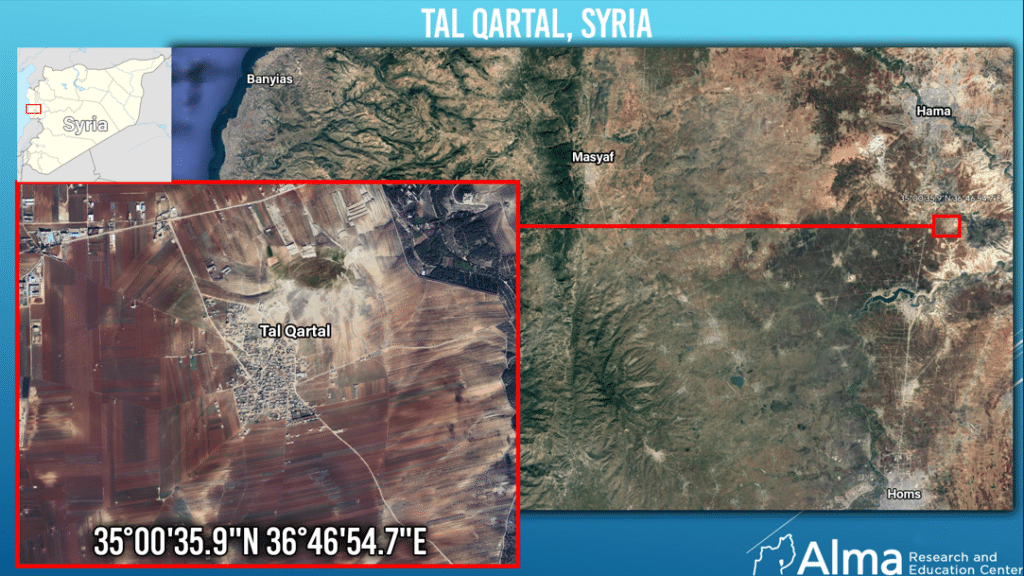
In this context, materials collected and analyzed by the Alma Center in August 2023 identified “Project 99,” whose operational site is located in the Tell Qartal area, approximately 35 kilometers north of Homs and 18 kilometers south of Hama. During the Assad regime, the project operated under Institute 4000 (“Sector 4”) of the CERS Center—the Syrian body responsible for scientific research and weapons development. Based on the open-source information available to us as of August 2023, the “Project 99” site hosted activities related to the production of ballistic missiles in cooperation with Iranian and North Korean scientists.
It is important to emphasize: At this stage, we do not have information that would allow us to determine that “Site 99,” as mentioned in the Axios report, is the same site in the Tell Qartal area known to us as the “Project 99” site.
According to the report, the Assad regime stored “yellowcake” at the site, uranium concentrate extracted from ore and used as an intermediate material in the nuclear fuel cycle, as well as remnants and other materials left over from the al-Kibar reactor project. The reactor, which was at the center of Syria’s covert nuclear program, was struck and destroyed by Israel in 2007. According to the officials cited, the material at the site cannot, by itself, be used to produce a standard nuclear weapon, but it could serve as a component in a “dirty bomb”—a conventional explosive device designed to disperse radioactive material and contaminate its surroundings.
Storing yellowcake does not necessarily require a facility resembling a nuclear reactor or a heavily fortified structure. The material is generally stored as a dry powder in sealed, durable metal drums, inside a roofed and secured structure that protects the containers from the elements and allows their condition to be monitored. Although the risk of external radiation from the material is relatively low, the dispersal, inhalation or ingestion of dust, as well as uncontrolled contact, must be prevented because of uranium’s radiological risk and chemical toxicity. Safe storage also requires access control, inventory management, container inspections, appropriate monitoring and protective equipment for workers.
The report contains no information that would make it possible to determine under what conditions or in what type of containers the material was stored at the Syrian site.
According to the Israeli officials, shortly after the fall of the Assad regime, the IDF struck the entrances to the site to prevent access to it. Israel and the United States discussed how to address the facility for more than a year, and Israel made clear that it would not agree to leave the material in place. Movement was subsequently detected in the area, raising concerns that Syrian actors were attempting to reach the site and that Turkey might be assisting them. In response, the Trump administration asked Israel to refrain from military action and brought the IAEA into the process. According to Axios, an agreement between the agency and the Syrian government to remove the material was signed approximately three weeks ago.
The affair illustrates the risks arising from the strategic legacy left by the Assad regime, infrastructure, knowledge and sensitive materials, and the potential for their use by actors that are problematic, to say the least. Removal under IAEA supervision could reduce a potential security risk that could pose a clear and immediate threat to Israel.



One Response
Dear Dr Zoe,
Thank you for your good article and all the Alma work to expose the dark evils present all around Israel that threaten all good people everywhere. These jihaddist weapons developments are a clear and present danger to healthy civilization itself. We only need to look at Iran for an example. The current IRGC is not even a legitimate government. It is an islamic jihaddist cancerous evil infiltration force of destabilization and terror against Iran itself, with global ambitions of world domination. The radical sunni muslim brotherhood of Turkey, Egypt, Pakistan and Qatar is equally evil. These evil jihaddists must be confronted and defeated with all their terror branches and propaganda roots.