By: Tal Beeri and Dr. Zoe Levornik
On March 24, it was reported that the Director General of the Lebanese Ministry of Foreign Affairs, Abd al-Sattar Issa, summoned the chargé d’affaires of the Iranian embassy in Beirut and announced the withdrawal of Lebanon’s approval for the appointment of Iran’s designated ambassador, Mohammad Reza Shibani, declaring him “persona non grata” and demanding that he leave the country. At the same time, Lebanon’s ambassador to Iran was recalled to Lebanon “for consultations,” against the backdrop of what was defined in Lebanon as a violation by Tehran of diplomatic norms and accepted rules of conduct between states.
Subsequently, the Lebanese Ministry of Foreign Affairs issued an official clarification stating that the withdrawal of approval for the continuation of Ambassador Mohammad Reza Shibani’s tenure was carried out in accordance with Article 41 of the Vienna Convention on Diplomatic Relations, which prohibits diplomats from interfering in the internal affairs of the host state. According to the statement, the ambassador made remarks regarding internal Lebanese politics and expressed positions on government decisions. It was also noted that he held meetings with unofficial Lebanese actors without coordinating through the Ministry of Foreign Affairs.
However, the background to the decision is deeper and more complex. Reports in the Lebanese media point to claims raised by Lebanon’s Prime Minister, Nawaf Salam, regarding the presence of Quds Force operatives in Lebanon using forged passports, operating to advance security and military activity in support of Hezbollah.
The Israeli ultimatum regarding the activity of Iranian Revolutionary Guard personnel in Lebanon (with an emphasis on the Lebanon and Palestine Corps), the hasty departure of dozens of Iranians from Lebanon, and the eliminations in Beirut of senior figures in the Lebanon and Palestine Corps, illustrated and demonstrated the reality that formed the background to the decision.
The Lebanese step can be seen as an attempt—albeit a limited one—to respond not only to diplomatic violations, but also to the broader Iranian involvement in the country’s security and political system.
However, alongside the firm declaration, the Lebanese government was quick to clarify that this does not constitute a severance of relations with Iran. The Ministry of Foreign Affairs emphasized Lebanon’s commitment to maintaining friendly relations, as long as they are based on principles of mutual respect and non-interference. Lebanon’s Minister of Economy, Amer Al-Bisat, also reiterated the principle of sovereignty, which includes the state’s monopoly over security decision-making and the possession of weapons, but stressed that this does not mean Lebanon is freezing relations with Iran, but rather that it seeks “normal” relations with all countries in the region, including Iran.
This duality reflects the structural tension that characterizes Iran–Lebanon relations. On the one hand, there is an aspiration among elements within the Lebanese government to strengthen state sovereignty and reduce external interference. On the other hand, the political and security reality in Lebanon—particularly Hezbollah’s status as a dominant military and political force supported by Iran—significantly limits the government’s ability to fully implement this approach.
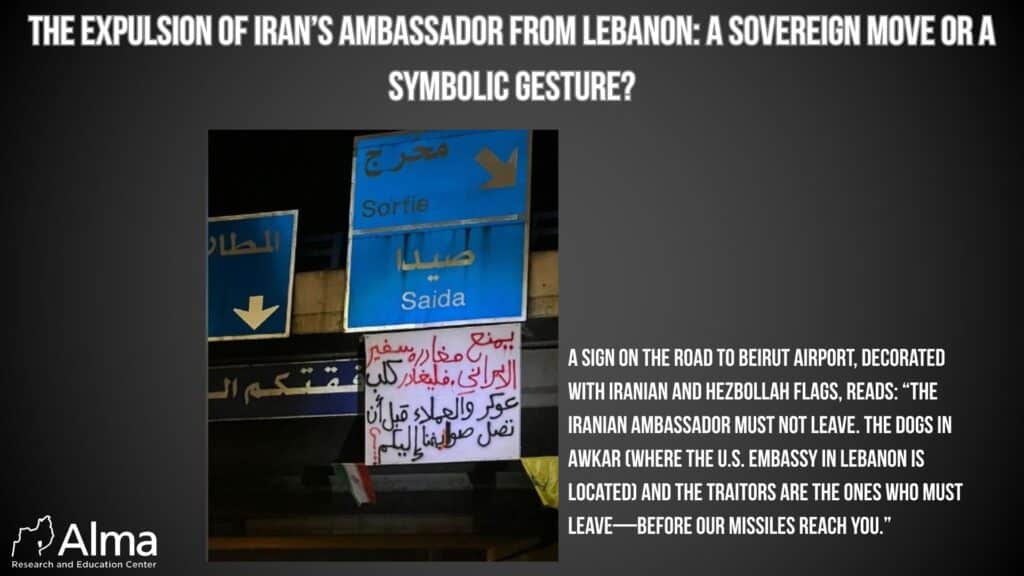
The response from the Hezbollah camp clearly illustrates this limitation. According to reports, Speaker of Parliament Nabih Berri is attempting to reverse the decision and even asked the Iranian ambassador not to leave the country. Hezbollah itself sharply criticized the move, describing it as illegal and a capitulation to external pressures, and warned of its implications for Lebanon’s internal unity.
This development highlights that centers of power in Lebanon do not operate as a single unit, and that key actors within the political system continue to view the preservation of ties with Iran as a vital interest. The expulsion of the ambassador is therefore an expression of an ongoing struggle over the nature of Lebanon: a sovereign state with formal institutions, or an arena in which non-state forces backed by regional actors operate in parallel.
Therefore, although the current move constitutes an important signal at the declarative level, it does not fundamentally change the balance of power. As we have previously published, in the absence of a deeper dismantling of Iranian influence mechanisms—particularly those operating through Hezbollah—Tehran is expected to continue maintaining its involvement in Lebanon, both through political influence and through efforts to rehabilitate and strengthen the organization. In this way, Lebanon continues to operate within an ongoing paradox: declarations of sovereignty on the one hand, and structural dependence on external influence on the other.
The Lebanese state must demonstrate resolve. Not only must it expel the Iranian ambassador, it must also sever its diplomatic relations with the Islamic Republic of Iran. It is unacceptable for the embassy of a state that, through Hezbollah, undermines the Lebanese state in order to take control of it and fully export the Islamic Revolution into it, to continue operating and functioning in Lebanon.
The Iranian embassy compound in Beirut serves as a cover for a command-and-control base of the Islamic Revolutionary Guard Corps in Lebanon, for the purpose of carrying out local and regional terrorist activity. The Iranian ambassador in Lebanon is the senior representative of the Revolutionary Guards in the country.
It is no coincidence that the previous Iranian ambassador carried a Hezbollah pager (which exploded and injured him on September 17, 2024). Why would a senior diplomat carry a pager belonging to a terrorist organization?
The Islamic Revolutionary Guard Corps is a terrorist organization, recognized as such by dozens of countries around the world. A state that respects itself cannot allow such activity on its territory.
The terror embassy of the Islamic Republic in Lebanon is a legitimate target for the immediate cessation of its activity.