One of the prominent operational trends that has sharpened in Hezbollah’s activity following the lessons of the 2023–2024 fighting is the relocation of part of its infrastructure and operational assets outside the “natural zone” of the Shiite base. This trend includes the transfer of command-and-control activity, meetings, and residences of senior figures to areas populated by Christian and Druze communities, such as Mount Lebanon and various neighborhoods in Beirut that are not part of the Dahieh.
This shift reflects the organization’s strategic adaptation to an operational reality in which its assets at the heart of the Shiite concentration have become more vulnerable to precise Israeli strikes. The geographic dispersal of infrastructure and operational hubs is perceived as a tool for risk reduction, survivability, and the disruption of intelligence monitoring capabilities. However, alongside the operational advantage, this move generates deep social and political consequences within Lebanon.
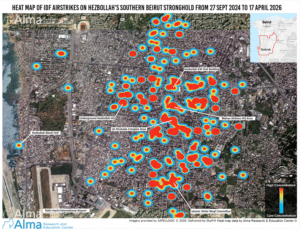
A clear indication of this is the increase in targeted strikes carried out in these areas, pointing to the penetration of Hezbollah activity into spaces that were not previously identified with it. At the same time, growing resistance is evident among the local population, which views Hezbollah’s presence and activity—even when conducted with a low profile and in secrecy—as a risk factor that draws fire into their residential areas.
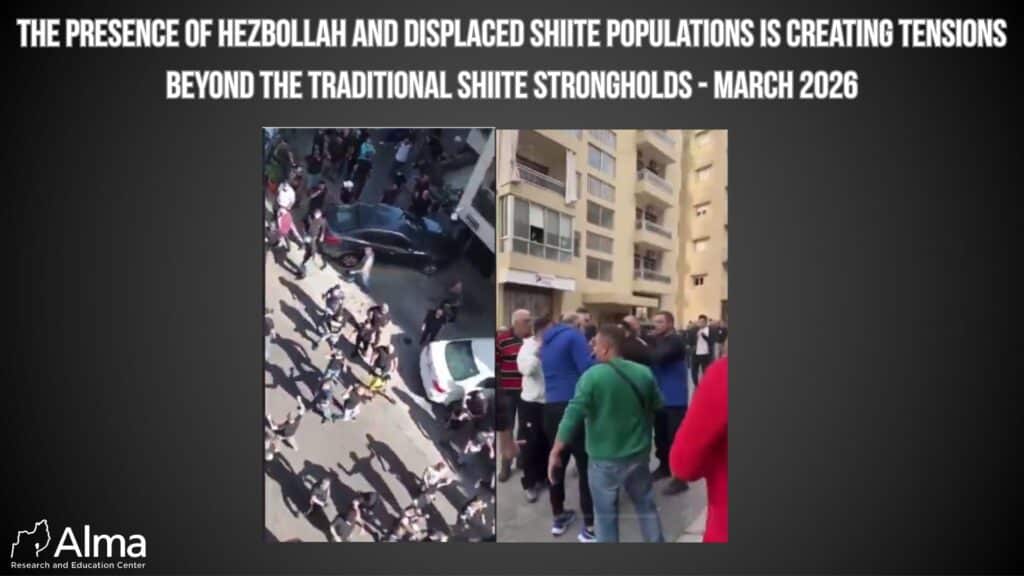
The impact of an Iranian missile in the Jounieh area (March 24) served as an intensifying trigger for these sentiments and led to clashes between local residents and displaced Shiites.
This tension does not develop in a vacuum. The widespread displacement crisis in Lebanon deepens friction between populations, as communities that are not part of the Shiite base experience a de facto imposition of a new security reality. Unlike the Shiite population, which has largely internalized over the years the role of a “human shield” as part of Hezbollah’s strategic framework, other communities refuse to accept this role. For them, Hezbollah is an organization that represents foreign—Iranian—interests at the expense of their own—Lebanese—interests. The entry of Hezbollah activity into residential neighborhoods that do not belong to its base is perceived as a blatant violation of the delicate balance between civilian space and warfare.
Hezbollah, for its part, attempts to restrain criticism through the use of pressure, threats, and even violence, but these measures only contribute to intensifying unrest.
In a broader context, this trend sharpens the inherent gap between the “State of Lebanon” and the “State of Hezbollah.” The Lebanese government’s ongoing fear of a direct confrontation with the organization—among other reasons, due to the risk of deteriorating into civil war—limits its ability to enforce sovereignty in these areas. However, the attempt to avoid a comprehensive confrontation may lead to the opposite outcome: accelerated erosion of the social fabric and the intensification of inter-sectarian divides.
In conclusion, the shift of Hezbollah’s activity beyond Shiite base areas is not merely a tactical adjustment, but a process with broad strategic implications. While it may improve the organization’s survivability in the short term, it further amplifies internal instability in Lebanon and raises questions regarding the state’s ability to contain the duality between formal sovereignty and a non-state military force operating within it.