
General
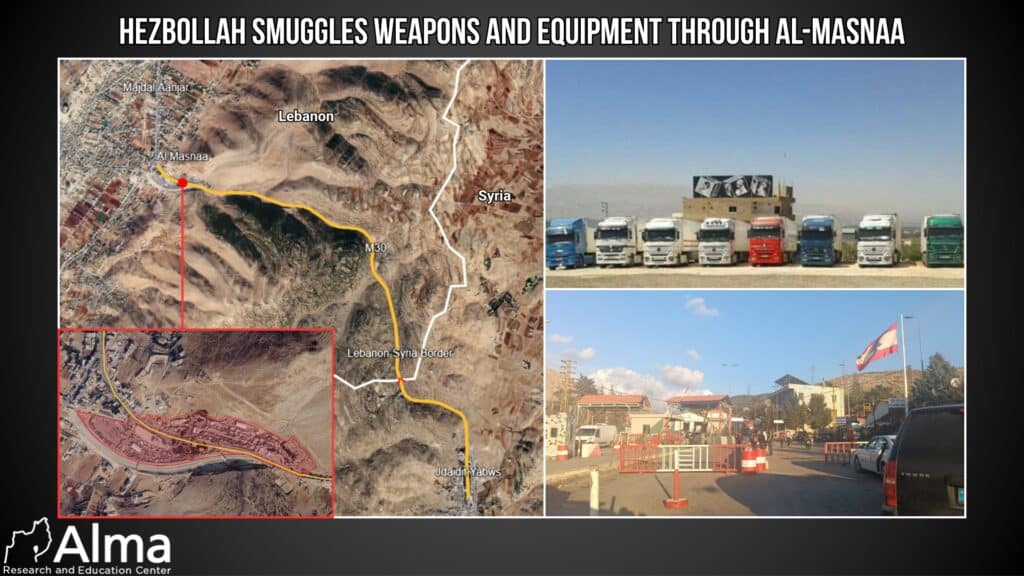
On Saturday, April 4, the IDF’s Arabic-language spokesperson issued an evacuation warning for the al-Masnaa crossing and the road connecting to it from the Syrian side—via the Jdeidet Yabous crossing (M30 highway), stating that Hezbollah is currently using the crossing to smuggle weapons.
Hezbollah’s military supply chain, which combines continued smuggling of weapons and equipment through every route with domestic production capabilities in Lebanon (“bringing the factory home”), is critical for Hezbollah’s recovery and buildup in the present and for the “day after.”
The IDF Spokesperson’s announcement led to an almost complete paralysis of movement at the al-Masnaa crossing. The movement of vehicles, passengers, and trucks stopped, and people, offices, and equipment were evacuated. On April 8, the crossing reopened, and as of the time of writing, it has not yet been attacked.
This is not a new phenomenon: the al-Masnaa crossing, situated on Lebanon’s eastern border near the town of Majdal Anjar in the central Beqaa, has long been used for smuggling activities in general—and by Hezbollah specifically for the transfer of weapons and equipment. Since the 2006 Second Lebanon War, Hezbollah has employed a range of vehicles and civilian-covered transport platforms to move weapons and materiel through the crossing. Since that time, and possibly even earlier, the crossing has functioned as a key route in Hezbollah’s ongoing weapons and equipment smuggling operations.
In addition, attempts are made through the al-Masnaa crossing to smuggle general goods, food, drugs, and more.
An Unusual Announcement
However, the IDF Spokesperson’s announcement is unusual for the current time and effectively turned assessments that Hezbollah is currently smuggling through the Al-Masnaa crossing—even under the al-Sharaa regime—into an established fact. Hezbollah is smuggling weapons and equipment also through the official crossings between Syria and Lebanon. This is in addition to smuggling through informal border crossings along the porous border between the two countries in the northeastern Beqaa region.
Who Holds Security Responsibility for the al-Masnaa Crossing?
There are six formal crossings between Syria and Lebanon. The largest and most central among them is the al-Masnaa crossing. The security organization responsible in Lebanon for all border crossings is the “General Security” organization (General Directorate of General Security – GSGD). General Security operates under the Lebanese Ministry of Interior and was previously called the “First Bureau.” Its current Director-General is Hassan Shuqeir, a Shiite affiliated with the Amal Movement, Hezbollah’s “Shiite duo.” Shuqeir was appointed to his position on March 13, 2025.
As early as March 2025, in a document titled “Appointments to Lebanese Security Organizations and Their Implications in the Context of the General Security Organization” we posed two key questions: What level of cooperation and linkage would emerge between the General Security Organization and Hezbollah? And how would Shuqeir’s appointment influence Hezbollah’s freedom of action across the various border crossings?
“Internal Cooperation” and “Spirit of the Commander”
The execution of weapons smuggling through a formal, major, and central border crossing like al-Masnaa cannot take place without cooperation from “within,” namely: cooperation from General Security personnel manning the crossing. The same assumption applies to the Syrian side, Jdeidet Yabous, which is manned and operated by Syrian Internal Security Forces.
The question arises whether those same officials from the Lebanese General Security personnel who manned the al-Masnaa crossing during the Assad regime era remain in their positions today. As they cooperated with Hezbollah then—motivated by financial incentives and benefits—they likely continue to do so now. The remaining requirement is to secure similar cooperation on the Syrian side. As is well understood, financial incentives align interests.
It should be noted that, with high probability and regardless of the Director-General of the General Security organization, Hezbollah controls collaborators within the ranks of General Security and can receive relevant assistance from them. However, the “Spirit of the Commander” or in other words the tone set by the commander, has special significance, as it permeates the entire organization and directly affects its functioning.
Even if the “commander” does not directly cooperate with Hezbollah, he can adopt a posture that accommodates its interests and ensure that his subordinates act accordingly… and that alone is sufficient. A clear example of this can be seen in the conduct of the army commander (Heykal) and the commander of the southern sector (Thabet).
The Civilian Transport Platform – How Is Smuggling at the al-Masnaa Crossing Carried Out?
The tactic known to us is the use of an existing civilian transport and logistics platform, operating routinely in the smuggling area, with proven freedom of movement within it, owned by a well-known and influential figure.
In November 2021, in a special report we published regarding the drug industry network of the Shiite axis and Hezbollah in southern Syria, we referred to the tactic of drug smuggling at the al-Masnaa crossing via well-known civilian transport companies, owned by well-known and influential businessmen (see Appendix G in the report).
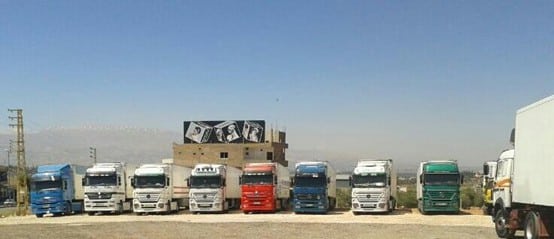
Container trucks, refrigerated trucks, tankers, and commercial vehicles can serve as smuggling platforms. A well-known transport company, holding a fleet of such vehicles (dozens of trucks and vehicles moving back and forth constantly at the al-Masnaa crossing), operating under well-known owners with influence and connections in the right places, constitutes an ideal infrastructure for Hezbollah for the purpose of smuggling weapons.
All that remains is to receive assistance from cooperating security personnel at the crossing (on both sides), falsify cargo records if necessary, and ensure that trucks and vehicles are not inspected, or are only inspected superficially.
Reactions in Lebanon: Minister of Transport, Head of the Refrigerated Truck Union, and a “Show of Presence” by Hassan Shuqeir – Director of General Security
In addition to the paralysis of the crossing, the IDF Spokesperson’s announcement caused media commotion in Lebanon.
On April 5, the Lebanese Minister of Public Works and Transport, Fayez Rasamny, (Druze, Socialist Party), denied the claims.
In an official statement, Rasamny noted that “the crossing is not used for smuggling weapons, and these are unfounded claims… the crossing is under supervision… strict inspections of all trucks using advanced scanning means, as well as security coordination with Syria.”
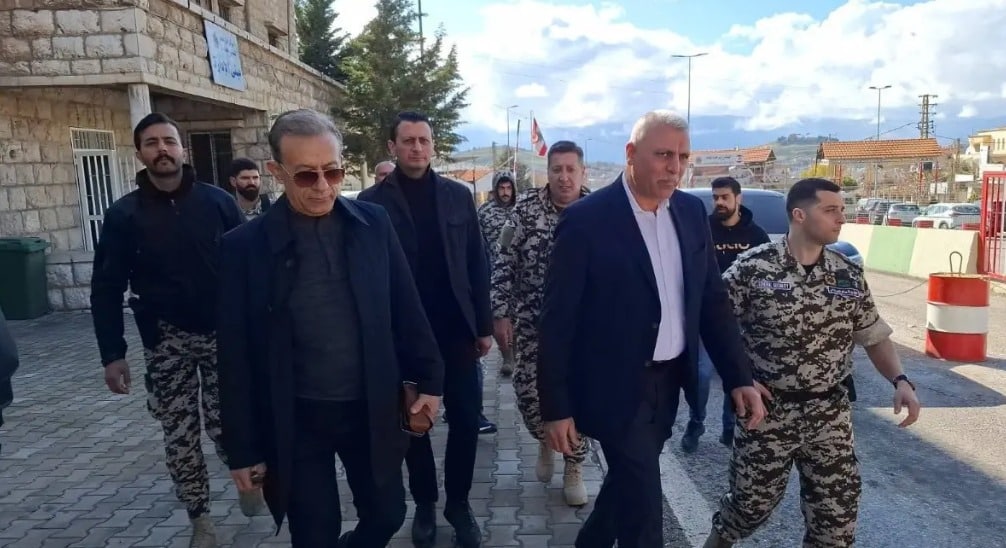
On April 6, in the morning hours, the Director of General Security—Hassan Shuqeir—arrived at the al-Masnaa crossing. The purpose of his visit was to demonstrate presence. During the visit, Shuqeir stated that the security measures are “under control,” while denying claims of weapons smuggling through the crossing. According to him, all trucks are carefully inspected, and efforts are being made to restore activity at the crossing.
Ahmed Hussein, head of the Refrigerated Truck Union in Lebanon, responded on April 5 to the IDF Spokesperson’s statement, saying that this is a humanitarian passage of goods and food, that it is not connected to any party, and that the crossing is under supervision.
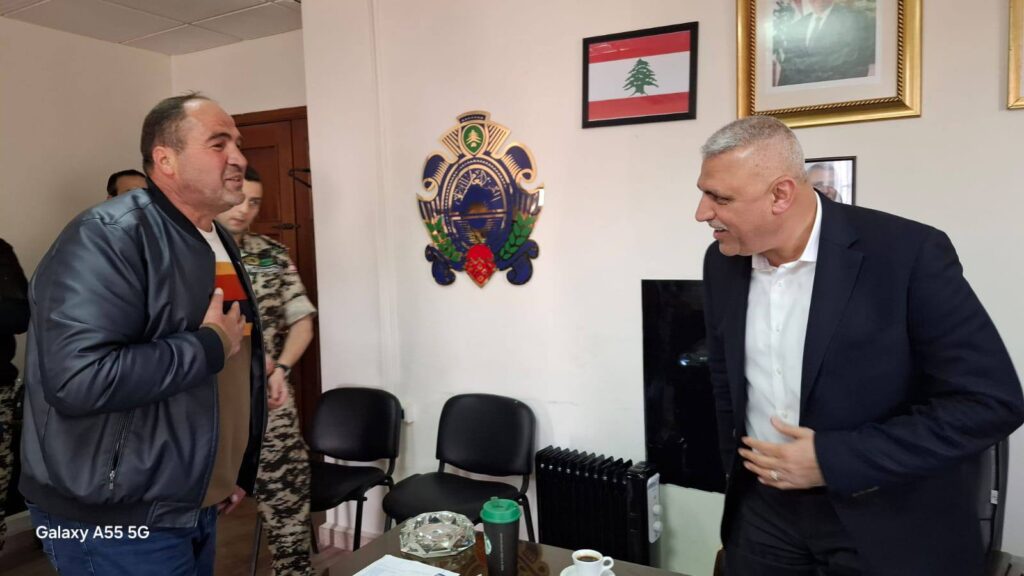
Hussein, nicknamed “Kazouza,” is a prominent figure in Lebanon. He lives in Majdal Anjar, owns a fleet of roughly 90 trucks and transport vehicles operating at the al-Masnaa crossing, and maintains connections and influence within the Lebanese Ministry of Transport and its leadership.
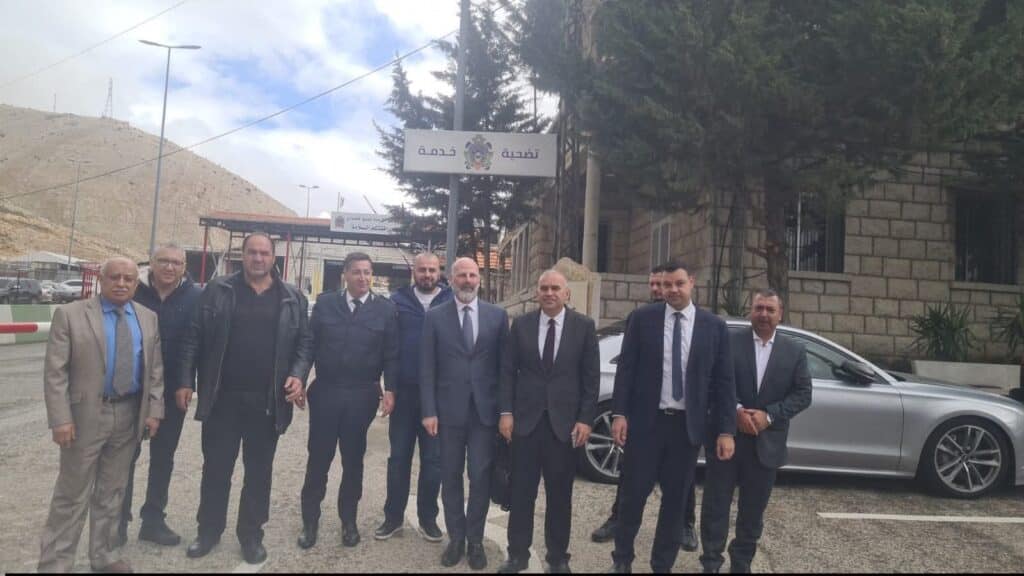
The image above was taken near the al-Masnaa border crossing on February 11, 2026. Ahmad Hussein (third from the left) appears in the image alongside a delegation headed by the Director-General of the Ministry of Maritime and Land Transport, Ahmad Tamer.
When Hassan Shuqeir, Director of General Security, visited the al-Masnaa crossing (April 6), he met with Ahmad Hussein.
The Last Attack on the Crossing – Oct 2024
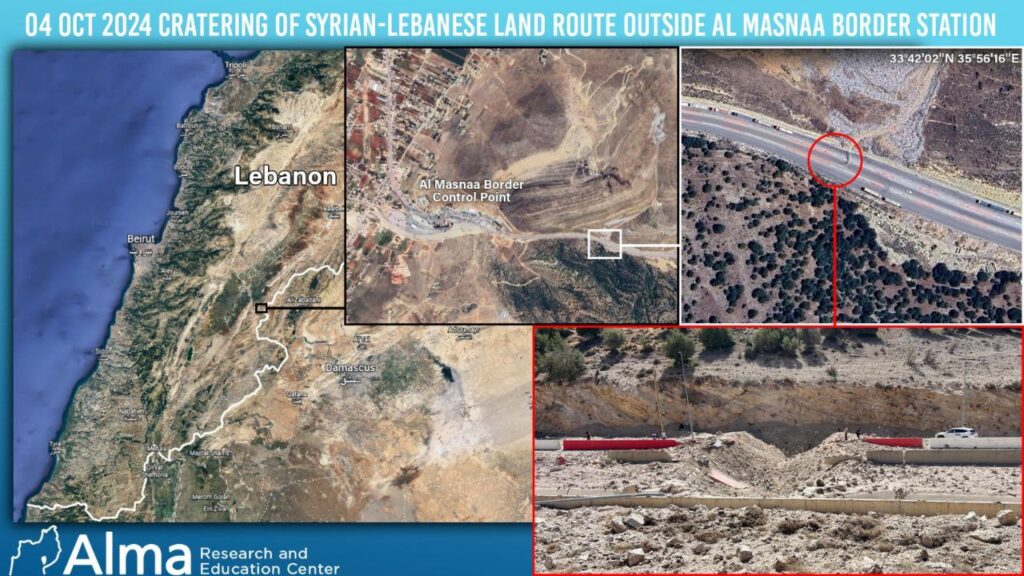
A similar attack (and the most recent on the crossing, as of the time of writing) to the one that was meant to be carried out but has not yet occurred took place on October 4, 2024. During the night, the M30 road leading from the Syrian land border crossing (Jdeidet Yabous) to the Lebanese border crossing—al-Masnaa was attacked. In the bellow illustration, the location of the attack can be seen.
Summary
The events surrounding the al-Masnaa crossing in early April 2026 illustrate that even today, and under the new political conditions in Syria, Hezbollah continues to exploit the official crossings between Syria and Lebanon for the purpose of smuggling weapons and equipment.
This activity is not carried out solely through the network of informal crossings along the porous border, but also through the most central and supervised crossing, while relying on internal cooperation, influence over Lebanese security mechanisms, and the use of presumably legitimate civilian platforms.
Denials by Lebanese officials do not change the overall picture: the official crossings continue to function as a central component in Hezbollah’s military supply chain.


2 Responses
Erdogan, a long-time supporter of Hamas, and openly proclaims support for Iran and Hezbollah has established a new overland trade route. This route flows through Syrian and Jordan. Will this new route benefit Hamas & Hezbollah ?
Turkey the winner in the Iran War, Launches of New Trade Corridor to the Gulf
Amid escalating instability in the Strait of Hormuz, Turkey has launched a new overland trade corridor through Syria and Jordan to Saudi Arabia to ensure the continued flow of goods to Gulf countries.
Minister of Trade Ömer Bolat stated that the initiative, supported by an agreement with Saudi Arabia to facilitate transit visas for truck drivers, enables uninterrupted delivery of goods that can no longer pass through the maritime route. He noted that this corridor marks a strategic shift in regional logistics and strengthens Turkey’s position as a key supply bridge.
The corridor builds on a transit liberalization agreement with Syria initiated in August, allowing Turkish trucks to reach Jordan, Saudi Arabia, and other Gulf states more efficiently. Turkey’s logistics sector, valued at approximately $112 billion, is expected to benefit significantly from this development.
The “Erred-again” turkish caliphate is as equally insidious as their competitors in crime in the IRGC. The muslim brotherhood is also a genocidal terrorist ideological evil that is working as a subversive force in Turkey and throughout the region. There must be a focused effort to trace and end all terrorist funding throughout the region. Financial corruption feeds their terror infrastructure.