
Executive Summary
The month of April and the beginning of May 2026 were marked by a significant acceleration of activity along the Ankara–Damascus axis, against the backdrop of the Second Iran War and the escalating tensions between Israel and Turkey.
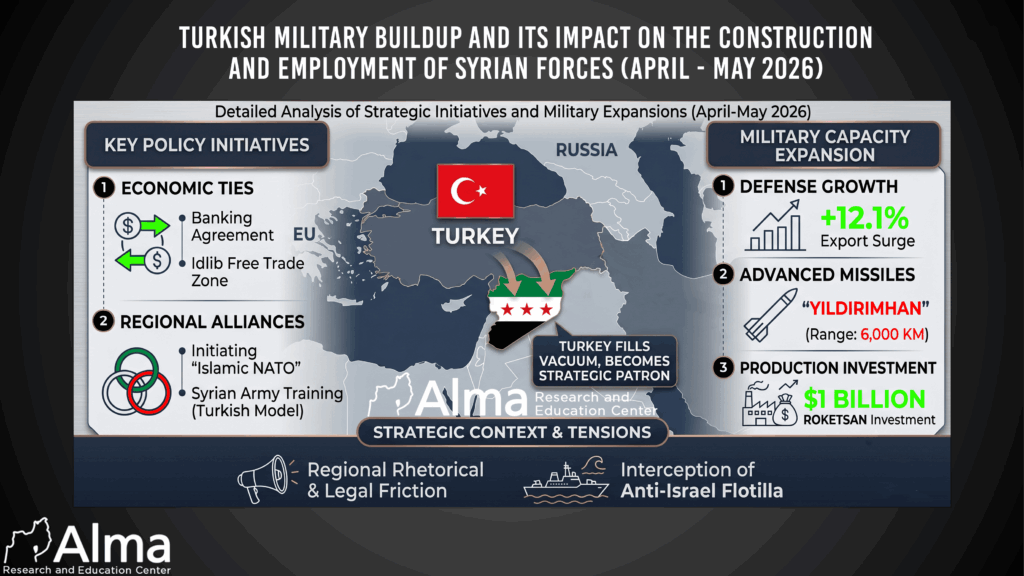
During this period, Turkey continued to strengthen its position as a dominant security and political actor in the new Syria – two meetings took place between the two countries’ leaders at the Antalya Diplomacy Forum (April 16–19), the signing of a banking framework, the advancement of a joint free trade zone in Idlib, and a 12% jump in Turkey’s overall defense exports in the first quarter of the year.
Turkey is establishing itself in Syria not as an equal partner but as a strategic patron, exploiting the weakening of Iran in order to fill the vacuum that has opened up — a move that the Turks hope will limit Israel’s freedom of action over the medium term.
In parallel, Turkey unveiled for the first time a new surface-to-surface missile at a defense conference, with a declared range of 6,000 kilometers, named “Yıldırımhan” (meaning “Lightning of the Khan” in Turkish) — the first ballistic missile developed and produced in its entirety by the Research and Development Division of the Turkish Ministry of Defense.
In addition, Erdoğan inaugurated new production facilities of “Roketsan” — a Turkish company that manufactures missiles and munitions — with an investment of one billion dollars.
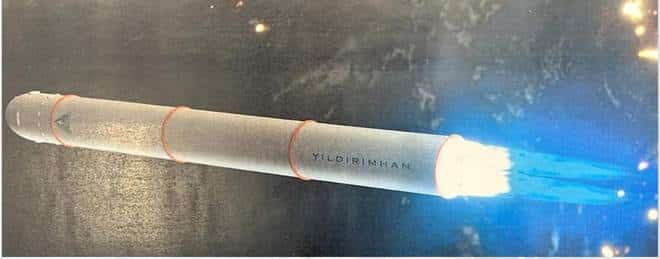
The missile as displayed at the Turkish SAHA defense conference in Istanbul, May 5, 2026.
Meanwhile, an anti-Israel flotilla, intended to generate provocation and to bolster Erdoğan’s image as the “protector of the Palestinians,” set out on May 14 from the coast of Turkey toward the Gaza Strip. The Israeli Navy intercepted dozens of vessels — the bulk of the flotilla — by May 19. The flotilla was organized in part by the Turkish IHH organization, banned as a terrorist organization in Israel and which also organized the Mavi Marmara flotilla in 2010.
Turkey’s Military Buildup
Turkey’s overall defense exports jumped by 12.1% in the first quarter of 2026 compared with the same period in the previous year, reaching 1.9 billion dollars.
This follows 2025, a record year in which Turkey’s overall defense exports rose by approximately 48% to around 10.56 billion dollars. During April, Erdoğan stated that Turkey aims to enter the top ten global defense exporters by 2028, with a target of 11 billion dollars.
In April, President Erdoğan personally inaugurated the new facilities of the Roketsan defense company in Ankara — including Europe’s largest warhead facility, a research and development center with 1,000 engineers, the “Kırıkkale” facility dedicated to missile-propellant technology, and new infrastructure for the mass production of ballistic and cruise missiles.
The investment in this undertaking was assessed at one billion dollars, with the company planning to inject an additional two billion dollars to expand mass-production capacity.
Erdoğan stated at the event: “The main objective of the defense industry in the coming period is to produce high-technology products faster, more efficiently, and in larger quantities.”
Turkey’s fifth-generation fighter jet, KAAN, has entered a new flight-test stage: a first prototype was scheduled to fly at the end of April 2026, and a second prototype in the May–June 2026 window.
On May 5, at the SAHA defense conference in Istanbul, Turkey presented for the first time the first ballistic missile to have been designed by the Turkish Defense Ministry, named Yıldırımhan, with a range of approximately 6,000 kilometers.
According to an investigation by “Nordic Monitor” published in April 2026, Erdoğan has built a global arms network through approximately 100 defense agreements — a strategic move enabling Turkey to leverage its defense industry to generate regional dependence, including vis-à-vis countries in the Middle East, Central Asia, and Africa. As of April 2026, Turkey is ranked 11th in the world in defense exports, on the threshold of the top ten.
The Fidan – Al-Sharaa Meeting, April 16
On April 16, 2026, a meeting was held in Antalya between Syrian President Ahmad al-Sharaa and Turkish Foreign Minister Hakan Fidan, on the eve of the opening of the Fifth Diplomacy Forum. The meeting included the Syrian Foreign Minister Asaad al-Shaibani and the head of Syrian intelligence Hussein al-Salama, opposite his Turkish counterpart İbrahim Kalın — a lineup that hints at an in-depth discussion of shared security and intelligence matters.
Al-Sharaa stated at the meeting that Syria’s transition from a period of crisis to a period of opportunity “depends to a large extent on cooperation with Turkey.”
The following day, April 17, Erdoğan and al-Sharaa met on the margins of the Forum and discussed bilateral relations, the current situation in Syria, and regional issues.
At the Forum, which was held under Erdoğan’s patronage on the theme “Mapping Tomorrow, Managing Uncertainties,” al-Sharaa delivered a speech in which he presented Syria as a “neutral link” that has no interest in a war with Israel but does aspire to lead “regional supply routes” — a narrative that directly serves the Turkish–Qatari–Syrian axis – the Sunni Islamist axis.
During the visit, al-Sharaa announced that the new Syrian parliament would convene for the first time at the end of April, thereby cementing the message of “Syrian regime stabilization” that Turkey seeks to project to the West. In practice, the first session of the new Syrian parliament did not take place on the date al-Sharaa had declared in Antalya, but was postponed against the backdrop of internal disputes around the composition of the parliament and the procedure for appointing its members.
The Emerging Sunni-Islamist Axis – the “Islamic NATO”
An article published by the MEMRI institute in January 2026 provides an analytical framework for describing the steps Turkey is taking in the context of a trilateral defense agreement with Saudi Arabia and Pakistan — in what is referred to as the “Islamic NATO.”
This step complements Turkey’s overall effort: economic integration of Syria (banking, free trade), military integration (the aspiration to establish itself at air bases, the installation of air defense systems, drones), and diplomatic integration (the Antalya Forum, mediation in the Iran war).
Ankara views Syria not solely as an arena of influence, but as a cornerstone of a broader regional architecture in which it can generate an anti-Israel, anti-Western axis with a Sunni-Islamist hue, while at the same time preserving its NATO membership and its relations with Washington.
The Economic Arm: Banking, Trade, and Free Zones
The president of the Syrian Central Bank, Abdul Qader al-Hasriya, stated during a visit to Istanbul on April 10 that Syria is in the final stages of establishing a correspondent account at Turkey’s central bank (this refers to an arrangement in which a bank in one country holds an account on behalf of a bank in another country, thereby enabling Syrian banks to carry out international clearing and payments through the Turkish banking system). The two sides are also examining a currency-swap agreement aimed at boosting bilateral trade.
The account will facilitate cross-border payments and trade financing, which today are conducted primarily in cash through traditional money-transfer offices.
The Turkish banks Ziraat (state-owned) and Aktif (private) are expected to begin operating in Syria soon.
In April, a joint Syrian–Turkish project to establish a free trade zone in Idlib was advanced: the Syrian chairman of the General Authority for Ports and Customs, Qutaiba Badawi, met with representatives of the Turkish company “Bomako” to discuss a construction and development partnership.
The project includes the establishment of a dry port, the upgrading of the Bab al-Hawa crossing, and the reshaping of the northern logistics infrastructure.
The Idlib free trade zone will link the Aleppo–Latakia–Damascus axis to the Turkish industrial network.
Strategic Significance
The combination of a banking agreement, alongside a free trade zone, Turkish construction companies, and infrastructure projects renders the Syrian economy dependent on the Turkish economy. This dependency, in terms of force buildup, is not only economic — it translates into Ankara’s ability to influence the pace at which the Syrian army is rebuilt, the type of armaments to which it is exposed, and the degree of sovereignty it can exercise vis-à-vis other actors (including Israel).
Turkey Continues to Maneuver Between the Second Iran War and Its Strategic Objective
On April 8, 2026, Erdoğan welcomed the ceasefire declared in the Second Iran War and called for its full implementation. On April 15 he stated that Turkey was working to extend the ceasefire, defuse tensions, and secure the continuation of the ceasefire.
In parallel, Erdoğan declared that “Israel’s attacks in Lebanon are damaging the hopes for peace.” The Turkish president is in effect reviving the line according to which “Israel is the problem, Iran is the victim.”
On April 20, the FDD research center in Washington published an analysis according to which developments in the Iran war have pushed Israel–Turkey relations into a more dangerous stage. An indictment filed by an Istanbul court against Prime Minister Netanyahu and 34 other senior Israeli officials on charges of “genocide and crimes against humanity” fits into a broader Erdoğan pattern: a combination of legal, rhetorical, and diplomatic measures, while preserving an implied military tension with Israel.
On April 19, it was reported on the Military.com website that Israel has flagged Turkey as a source of strategic concern against the backdrop of expanding regional tensions.
Summary
The months of April and May 2026 marked a transition to the execution of a series of significant actions aimed at strengthening the new Sunni-Islamist Syrian–Turkish axis. Banking agreements, a free trade zone, prominent international meetings — alongside the reinforcement of Turkey’s position as an independent producer of developing military capabilities — indicate that Turkey is not merely supporting Damascus but is planning to build the new Syrian army in Turkey’s image.
The weakening of Iran in the wake of the Second Iran War (February–April 2026) has cleared ground that in practice had already been seized: Ankara is filling the vacuum the Iranian axis is leaving behind.
The implication is that an Israeli operation in Syria could trigger an incident with Turkey, and Israel must take such scenarios into account seriously, particularly in light of Erdoğan’s intentions to build an “Islamic NATO” in order to encircle Israel.
The combination of these agreements with the Turkish training program and the equipping of forces with Turkish weaponry — including the option of acquiring Bayraktar TB2 UAVs — fundamentally changes the character of the force buildup of the Syrian army.
On the one hand, Erdoğan continues to present himself as a mediator of peace (in the Iran war). On the other hand, in parallel, he is an adversary of Israel both in rhetoric and through legal measures. This is a sophisticated tactic that allows him to accumulate global prestige, to claim leadership of the Sunni-Islamist world, and to accelerate the buildup of the Turkish military.
Sources
https://www.paturkey.com/news/2026/turkey-syria-banking-deal-currency-swaps-on-the-horizon-29896
https://finance.yahoo.com/news/turkeys-ziraat-proposed-launching-banking-161639846.html
https://www.trtworld.com/article/248abd180c24
https://levant24.com/news/international/2026/04/syria-and-turkey-deepen-ties-at-antalya-forum-talks/
https://www.agbi.com/defence/2026/04/turkish-defence-exports-jump-12-to-2bn-in-2026
https://turdef.com/article/tuerkiye-s-defence-and-aerospace-exports-hit-10-56bn-in-2025
https://restproperty.com/news-en/turkiye-defense-production-2026
https://www.timesofisrael.com/israeli-strikes-hit-syrian-airbases-that-turkey-scoped-out-sources
https://www.chasetactical.com/intel/turkey-to-deploy-air-defense-systems-drones-at-syrias-t4-base
https://www.jpost.com/middle-east/article-884125
https://israel-alma.org/syria-turkish-presence-in-military-airports-and-aerial-friction-with-israel/
https://www.jpost.com/middle-east/article-893469
https://www.specialeurasia.com/2026/04/25/turkey-israel-military-risk/
https://www.stimson.org/2026/turkey-israel-rivalry-in-the-new-syria/
https://levant24.com/economy/2026/04/syria-and-turkey-advance-idlib-free-zone-project/
https://en.axar.az/news/world/1082515.html
https://www.fdd.org/analysis/2026/04/24/americas-ambassador-to-turkey-is-undermining-u-s-interests


3 Responses
Not that Israel doesn’t have it hands full, but the question must be asked:
1) How closely is Israel monitoring Turkey’s actions
2) Does Israel have a contingency plan in place as Turkey pursues it malign goals?
Dear Yaakov,
Thanks for the latest Turkey gobble!!!
The self appointed “caliphate” imperialist “erred again” is continuing his imperial, fanatical rants as though he rules in glory over the former ottoman empire. Someone needs to awaken him with the truth: the ottoman empire died, and he cannot revive it from the dead. Their genocidal terror has ended by Divine intervention to destroy their evil deeds, and no one is capable to revive it.
Syria is critical for Turkey’s Erdogan war with Israel. Syria, has key border areas, Turkey to the north, Iraq to the east and southeast, Jordan to the south, and Israel and Lebanon to the southwest. Additionally, it is bordered by the Mediterranean Sea to the west. From Jordan’s border Turkey and other countries Israeli hostile entities like Iran can build-up, supply Arab terrorist operations in Judea & Samaria (Westbank). Jordan covert bases operations and supply lines are expanding against Israel. Jordan has the longest continuous border with Israel. Jordan’s Gulf of Aqaba, water border with Egyptians’ Sinai desert, supply line for Hamas. Turkey is actively backing the Sudanese Armed Forces. A newly unsealed US federal indictment has revealed how Turkey emerged as a critical financial and logistical hub in a sprawling Iranian weapons-trafficking network that supplied drones, ammunition and bomb components to Sudan’s military. Financial Action Task Force (FATF) about Turkey’s persistent shortcomings in combating terrorism financing and illicit money flows through Sudan and its financial system. These Sudanese Iranian arms finds there way to Houthis in Yemen, Hamas, and Hezbollah. Erdogan is expanding its covert military intelligence operations through building of Mosques and Humanitarian aid stations. A prime example is in Gaza, The Abdullah Azzam Mosque in the Al-Sabra neighborhood of Gaza City was funded by the Turkish Diyanet Foundation and inaugurated in February 2026. The mosque was named after Abdullah Azzam, a Palestinian cleric and founding figure of al-Qaeda.