
Executive Summary
- The Quds Force is the external operations branch of Iran’s Islamic Revolutionary Guard Corps (IRGC) and functions as the regime’s principal mechanism for exporting the Islamic Revolution, projecting regional influence, and supporting military, political, and terrorist proxy networks worldwide. Its activities are not limited to the Middle East but also span Africa, Europe, Latin America, Asia, and North America.
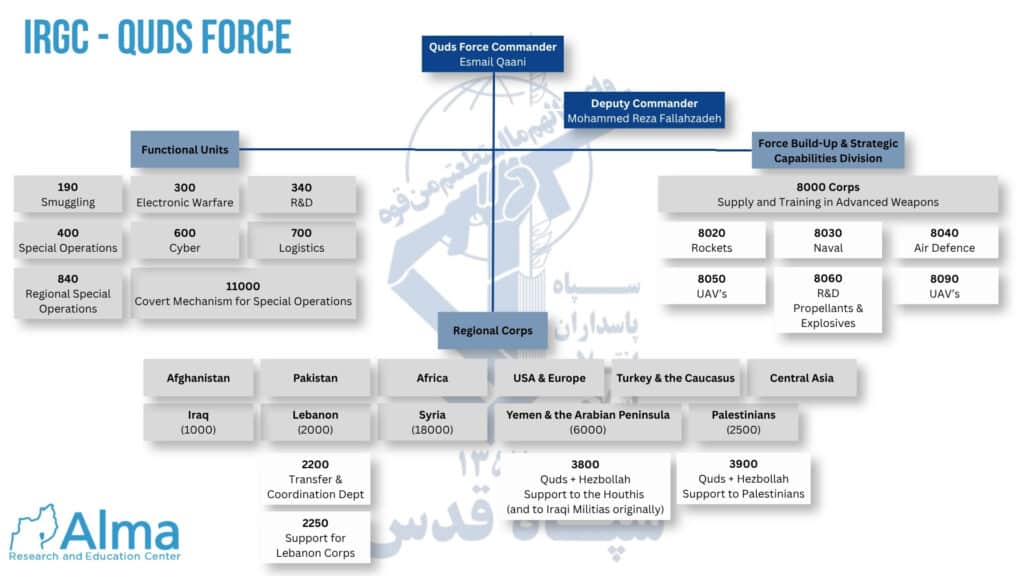
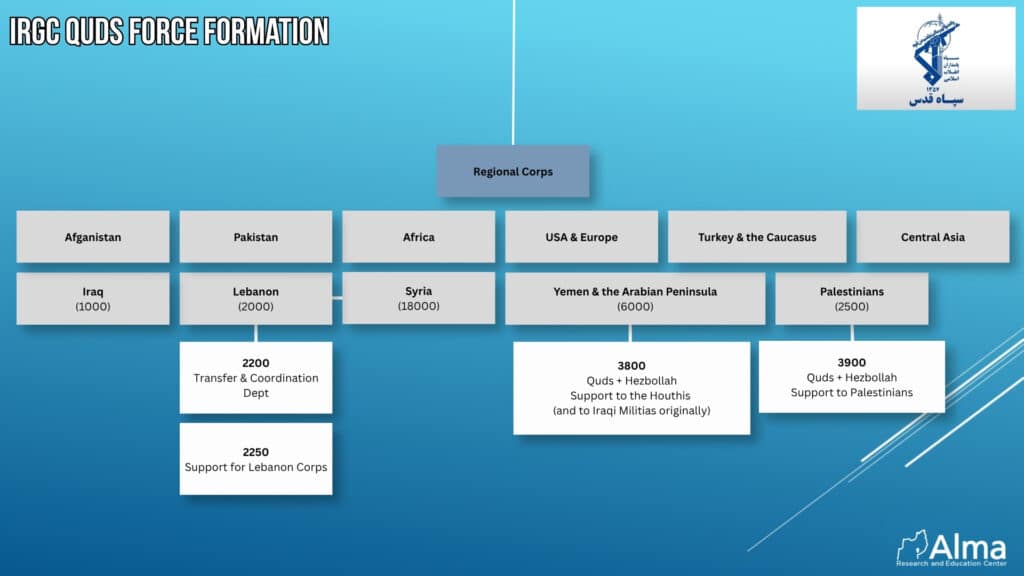
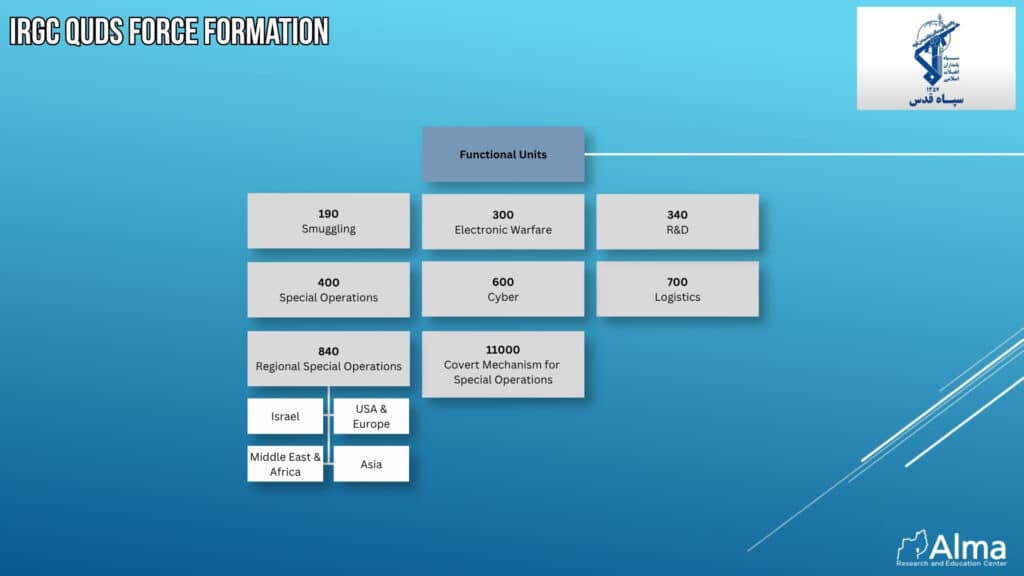
- The force operates in a hierarchical-networked structure which, based on publicly available information, can be understood as divided into three main components:
- Regional Corps – which manage Iran’s activities in various theatres and operate local proxy forces;
- Functional Units – specializing in fields such as smuggling, cyber operations, electronic warfare, special operations, and research and development;
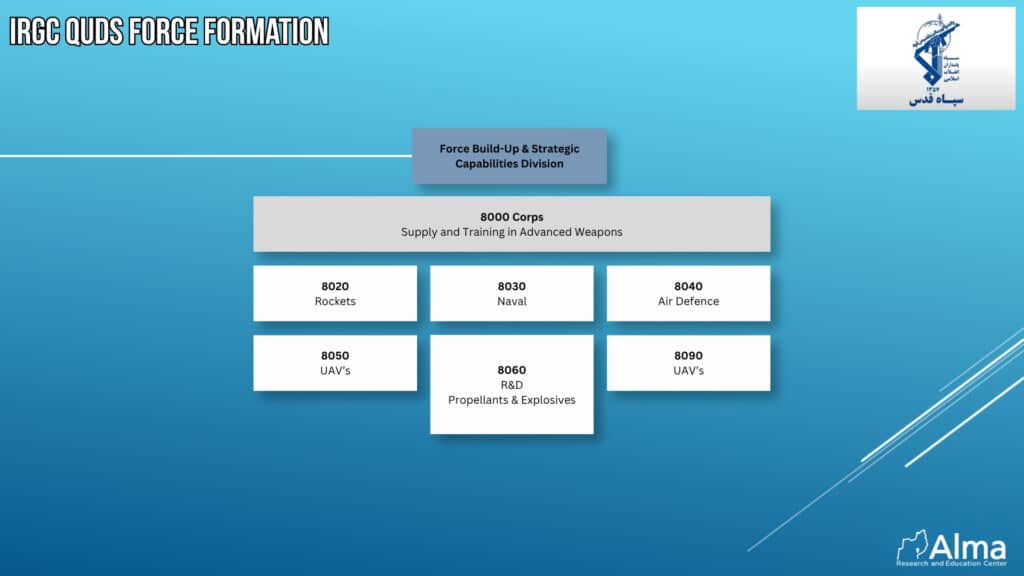
- Force Build-Up and Strategic Capabilities Corps (8000 corps) – a branch responsible for strengthening Iran’s proxies through the development, procurement, and production of advanced weapons systems and the transfer of knowledge.
- Functional units such as Units 190, 300, 400, 840, and 11000 illustrate the transformation of the Quds Force from a classical military model into a global system of terrorism, smuggling, cyber activity, and organized crime. The Quds Force frequently uses local criminal organizations and “plausible deniability” mechanisms to conduct terrorist operations in Europe, South America, and other theatres.
- Corps 8000 emerges as the center of military force development for Iran and its proxies, with direct responsibility for missile capabilities, UAVs, naval warfare, air defense, and cyber domains. The research indicates that through this corps, Iran has built a systematic framework for training and transferring knowledge to Hezbollah, the Houthis, Hamas, Palestinian Islamic Jihad, and Shiite militias in Iraq and Syria.
- The Lebanese theatre continues to constitute the strategic center of gravity of the Quds Force outside Iran. The Lebanon Corps is responsible for Hezbollah’s military buildup and for maintaining it as Iran’s principal proxy against Israel. At the same time, Iran is working to strengthen the Houthis in Yemen as a model of a “Southern Hezbollah,” thereby establishing a direct threat to maritime trade routes in the Red Sea and Bab al-Mandeb.
- The fall of the Assad regime in December 2024 and the disruption of the Iran–Syria–Lebanon land corridor forced the Quds Force to make operational adjustments and develop alternative smuggling routes through Iraq, Africa, the Red Sea, and maritime domains. This change increased the importance of smuggling and transportation units as well as cooperation with international criminal networks.
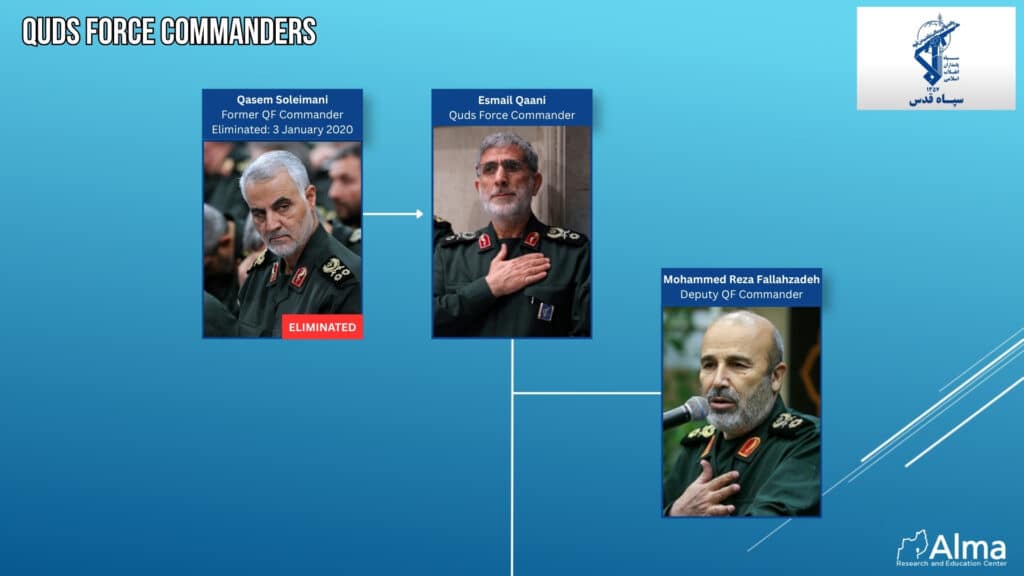
- Despite the damage suffered by the Quds Force in recent years—including targeted eliminations, attacks on infrastructure, sanctions, and losses among senior commanders—the research indicates that the organization has continued to demonstrate high operational flexibility, rapid recovery capabilities, and a decentralized global mechanism that enables it to continue advancing Iran’s strategic interests even under sustained pressure.
- It should be noted that because of the indirect and direct campaign against Iran in general and the IRGC / the Quds Force in particular over the past two and a half years, there is no complete certainty regarding parts of the current status of the Quds Force, its structure, the identities of commanders, and the activities of its units. This challenge is compounded by the fact that the research is based entirely on open sources and deals with a clandestine organization.
- We thank Boaz Shapira for his contribution to this research.


One Response
Dear Dvir,
Thanks to you and Boaz for lifting some of the mask of “humanitarian” lies that hide the pure evil destabilization, subjugation, domination and exploitation of everything and everyone unwilling to fight to preserve their Liberty against the IRGC and their entire hezbollah global network of terrorist operations.