
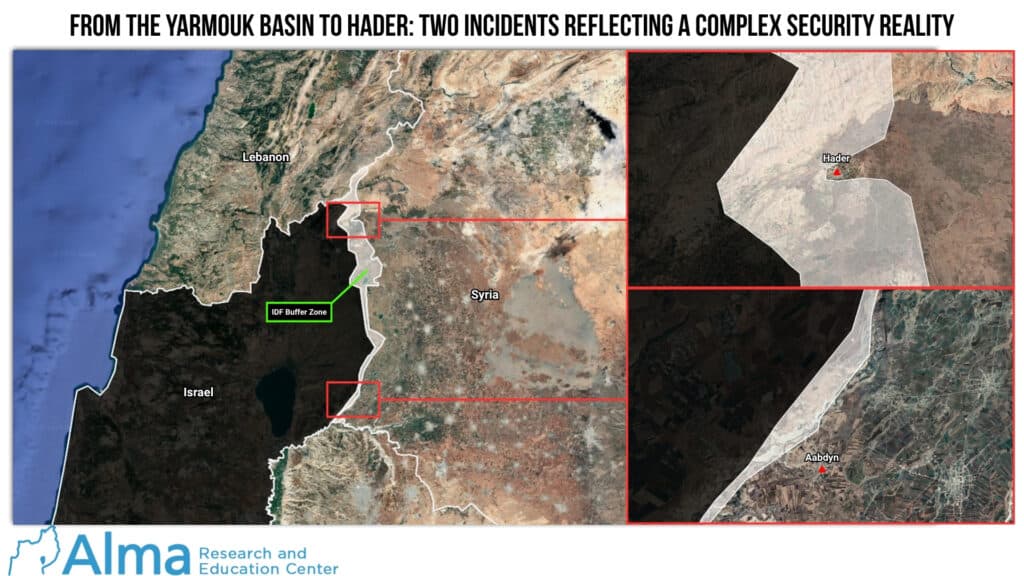
Over the past 24 hours, two unusual incidents were reported in southern Syria, once again illustrating the evolving security challenge facing Israel along the Syrian border.
On the morning of June 28, IDF eliminated two-armed operatives near Khader, close to the buffer zone in the Syrian Golan. Their identities and organizational affiliation remain unknown. In our assessment, several possibilities exist regarding their affiliation: they may have been local Syrian operatives (Syrians or Palestinians) acting on behalf of Iran, Hezbollah, or Palestinian terrorist organizations (Hamas, Palestinian Islamic Jihad, or al-Jama’a al-Islamiyya), or alternatively operatives who entered the area from Lebanon, possibly Palestinians.
In our assessment, their presence in this area and their elimination indicate an intention to carry out terrorist activity against Israel—whether through an infiltration into Israeli communities, attacks on IDF forces using gunfire or explosive devices, or preparations for future attacks through intelligence collection and infrastructure development.
Later that day, on the evening and night of June 28, according to local reports, incidents occurred in the town of Aabdyn in the Yarmouk Basin, near the Israel–Jordan–Syria tri-border area. According to reports, local residents blocked roads, threw stones, and even opened machine-gun fire at IDF forces, which responded with artillery fire and helicopter strikes.
Aabdyn is not a random location. It lies in an especially sensitive area near the tri-border region that previously served as a stronghold for ISIS’s affiliate in the Yarmouk Basin (Hauran Province). Even after the fall of the Assad regime, the area has remained unstable. A combination of local armed groups, legacy terrorist infrastructure, smuggling networks, and the interests of the Iranian-led axis continues to make it a particularly problematic region.
Southern Syria—particularly the Yarmouk Basin and the tri-border area—serves as a potential platform for terrorist activity against both Israel and Jordan: directly through the Syrian border and indirectly through weapons smuggling routes into Jordan and onward to Judea and Samaria. The region contains numerous local terrorist cells operating across dozens of villages, supported by Iran, Hezbollah, and Palestinian terrorist organizations. The Yarmouk Basin has already witnessed attacks against IDF forces, including the shooting incident near Koaviah on March 25, 2025, located very close to Aabdyn.
The incidents in Khader and Aabdyn underscore that the IDF’s presence and operations in the buffer zone are not merely tactical responses to isolated events. Rather, they are part of a broader preventive effort aimed at pushing threats away from the border, disrupting terrorist networks, and preventing the reestablishment of terrorist infrastructure in southern Syria.



2 Responses
A probing attack, indirectly supported by Turkey ?
Dear Dana,
The entire region surrounding Israel is still a hotbed snake den of the remnants of the ring of fire islamonazi jihaddist genocidal maniacs. They are like wounded desperate poisonous hissing vipers, striking at anything within reach. They need to be eliminated, their heads crushed, and the land Liberated from venomous terrorist threats.