
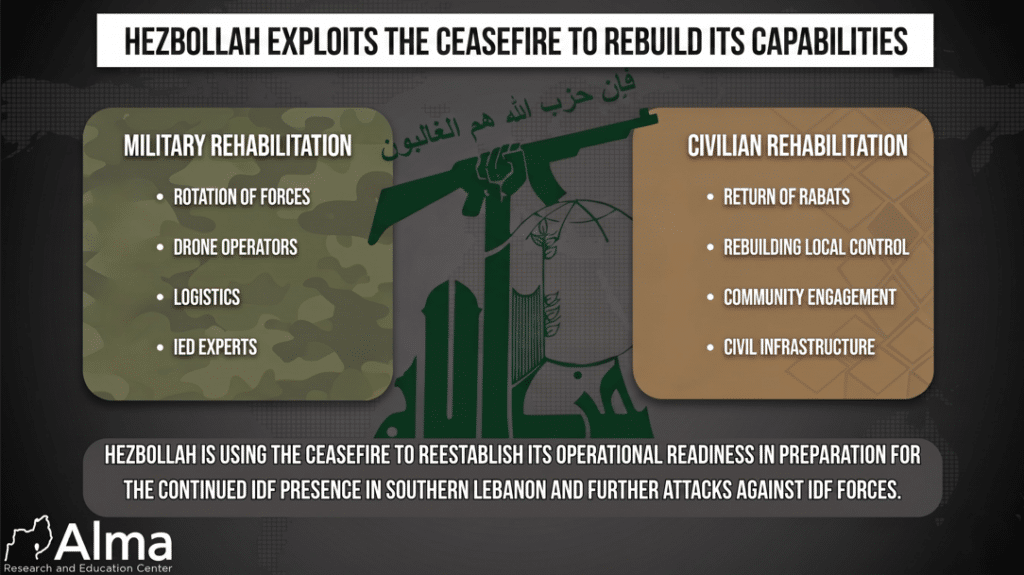
While the ceasefire is publicly perceived as a measure to reduce tensions, Lebanese reports published in recent days indicate that Hezbollah is using this period to rebuild its presence in southern Lebanon, both militarily and civically.
According to the available information, Hezbollah has completed a rotation of its forces in southern Lebanon. As part of this effort, operatives deployed along the southern front were replaced with fresh personnel. The rotation reportedly focused primarily on the Nabatieh sector, the operational center of gravity of Hezbollah’s Badr Unit on the southern front. This area includes the Ali al-Taher Ridge, which currently constitutes the primary zone of potential friction with the IDF.
According to the reports, the rotation involved not only combat operatives but also logistics personnel and key specialists, including IED experts and drone/UAV operators. Assuming the reports are accurate, such a move enables Hezbollah to refresh forces that have suffered heavy casualties and significant attrition, restore and maintain operational readiness, and continue preparing for a prolonged confrontation.
At the same time, Hezbollah’s Rabat (local liaison operatives) have reportedly returned to several locations across southern Lebanon. A Rabat serves as Hezbollah’s local representative in a village, acting as the organization’s link to the civilian population. His role extends far beyond social activities: he is responsible for distributing aid, managing the organization’s relations with local residents, coordinating logistics, and simultaneously supporting Hezbollah’s operational requirements—from identifying assets and infrastructure to facilitating the organization’s deployment on the ground.
The return of the Rabats, alongside the rotation of operational forces, reflects Hezbollah’s broader concept of recovery: military rehabilitation and civilian rehabilitation are not separate processes but rather two components of a single integrated effort. While military operatives prepare for the next round of fighting, the Rabats rebuild Hezbollah’s control mechanisms within the Shiite villages—the same infrastructure upon which the organization’s military entrenchment is built. Hezbollah is exploiting the ceasefire to restore its operational readiness in preparation for the continued IDF presence in southern Lebanon and further attacks against IDF forces. In our assessment, it is no coincidence that this effort includes reinforcing the ranks of drone/UAV operators and IED specialists. These capabilities are specifically suited for targeting ground forces operating and manoeuvring in the field and indicate that Hezbollah is preparing for continued friction with IDF forces in southern Lebanon.




One Response
Dear Dana,
Every effort must be made to identify and destroy ALL hezbollah infrastructure, both civil and military as one would stomp a snake about to strike a child in its crib. Track every terror dollar and destroy both root and branch. Evil must be confronted and destroyed without compromise. We must stop the islamonazi genocide of this generation.