
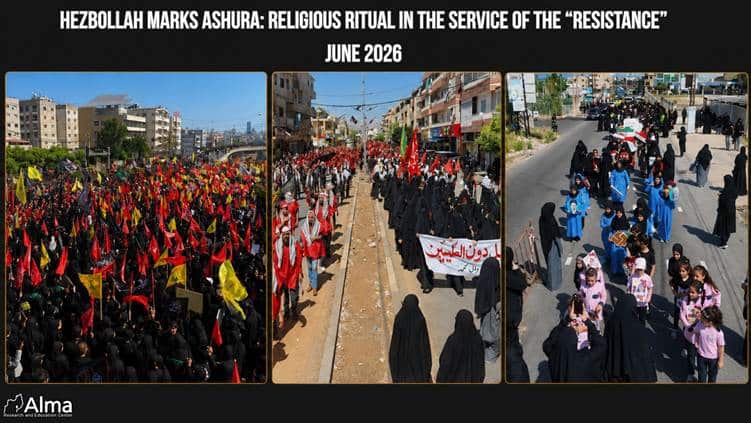
Between June 26–27, Hezbollah led Ashura commemorations across Lebanon, marking the tenth day of the month of Muharram, the day on which Shiites commemorate the killing of Imam Hussein at the Battle of Karbala in 680 CE.
For Hezbollah, Ashura is not merely a religious event or a historical memorial ceremony, but one of the organization’s most important public activities. Through it, Hezbollah reinforces its ideological identity, strengthens social cohesion within the Shiite community, preserves the public legitimacy of the “Resistance,” and conveys political and strategic messages directed at Israel, the United States, and the domestic Lebanese arena.
This year, the events took place against the backdrop of the new security reality that emerged following the recent war with Israel, the ceasefire, and the significant blow suffered by the organization, which lost many senior officials, commanders, and fighters.
Despite these challenges, Hezbollah invested considerable organizational resources in organizing the events and made a concerted effort to project broad popular participation. This formed part of a broader effort to demonstrate that, despite the damage it has sustained, the organization continues to exhibit continuity and resilience, that its public support base remains intact, and that its institutions continue to function fully.
Throughout the week, and particularly on June 26–27, Hezbollah held dozens of processions, rallies, mourning gatherings, and religious ceremonies across Lebanon, attended by tens of thousands of supporters. Beyond their religious character, these events served as a platform for conveying political messages, reinforcing solidarity within the Shiite community, and emphasizing continued commitment to the “path of the Resistance.” In doing so, Hezbollah continued its long-standing tradition of combining religious ritual with cognitive, social, and political activity as an integral part of its overall operational concept.
Interestingly, the events coincided with the signing of the framework agreement between Israel and Lebanon, an agreement that Hezbollah considers a “red line” and another layer in the ongoing internal struggle within Lebanon over the identity of the Lebanese state.
Mass Processions Across Lebanon
The focal point of the Ashura commemorations was the main procession in Beirut’s southern Dahiyeh, attended by tens of thousands of participants, including Hezbollah members, families of eliminated and wounded operatives, clerics, members of the Imam al-Mahdi Scouts movement, women’s organizations, students from the organization’s educational institutions, representatives of Hezbollah’s welfare and healthcare institutions, and activists from local authorities affiliated with the organization. In addition to the central procession, other large-scale events were held in Baalbek, Hermel, the Beqaa Valley, the city of Tyre, villages across southern Lebanon, and the Mount Lebanon region.
In southern Lebanon, processions took place in the towns of al-Housh, al-Abbassiyah, Deir Qanoun al-Nahr, al-Khulousiyah, Deir Kifa, Bafliyeh, and Jouaiya, with the participation of clerics, members of parliament, families of eliminated operatives, Hezbollah members, and thousands of local residents. At the same time, events were also held in Joun, al-Jiyyeh, Wardaniyeh, Sibline, and Kfoun in the Mount Lebanon region, an area to which Hezbollah expanded its Ashura commemorations this year.
The broad geographic scope of the events and the involvement of all the organization’s institutions demonstrate that the Ashura commemorations are not merely isolated religious initiatives, but rather a large-scale civilian-organizational operation. As part of these events, Hezbollah mobilizes its civilian infrastructure, including educational, welfare, healthcare, youth, and women’s institutions, local authorities, and volunteer organizations, in a manner that strengthens the bond between its support base and the organization while demonstrating its ability to continue providing services and leading the Shiite community’s daily life even during periods of conflict and crisis.
Ashura as a Tool for Shaping the “Resistance” Narrative
As in previous years, Hezbollah used the Ashura commemorations to draw a connection between the story of the Battle of Karbala and the concept of the “Resistance” that it promotes. Through this narrative, its military and political struggle against Israel is presented as a direct continuation of Imam Hussein’s struggle against tyranny and injustice, while Israel and the United States are portrayed as the modern-day successors of the historical enemy. In this way, the conflict with Israel is imbued with a religious and moral dimension, transforming sacrifice, casualties, and armed struggle into expressions of both religious and national duty rather than merely a political or military confrontation.
The processions and ceremonies served as a central platform for conveying the organization’s messages. Alongside the traditional black Ashura flags, Hezbollah flags, Iranian flags, and Palestinian flags were displayed, while portraits of the organization’s fallen commanders and fighters were exhibited. Chants against Israel and the United States were heard alongside expressions of support for Iran and its leadership. At the same time, participants reiterated messages emphasizing continued commitment to the “path of the Resistance,” opposition to any attempt to disarm Hezbollah, and rejection of the framework agreement signed between Lebanon and Israel.
The keynote speech delivered by Hezbollah Secretary-General Naim Qassem formed an integral part of the organization’s broader messaging campaign. Qassem stressed that the “Resistance” is the sole guarantor of Lebanon’s security, rejected any linkage between an Israeli withdrawal and Hezbollah’s disarmament, and portrayed Iran as a key partner in the achievements of the “Axis of Resistance.” As a result, the Ashura commemorations became not only a religious observance but also a platform for public messaging and propaganda designed to strengthen the organization’s position within the Lebanese domestic arena and to convey deterrent messages to its regional adversaries.
At the same time, the events played a significant role in restoring the organization’s morale and internal cohesion following the war. By commemorating its fallen members, highlighting the role of their families, and placing them at the center of the ceremonies, Hezbollah sought to portray these losses as an integral part of the Shiite tradition of sacrifice and as an expression of the continuity of the “path of the Resistance.” In this sense, Ashura serves not only as a mechanism of commemoration but also as a tool for preserving ideological commitment, strengthening collective identity, reinforcing Hezbollah’s narrative of a culture of martyrdom, and encouraging the next generation of the organization’s members.
More broadly, the Ashura commemorations illustrate how Hezbollah integrates religion, civilian activity, and public consciousness as part of its broader strategy of influence. By mobilizing its religious, educational, welfare, women’s, youth, and media institutions, the organization transforms the religious calendar into a permanent platform for reinforcing the public legitimacy of the “Resistance,” deepening the connection between the Shiite community and its institutions, and conveying political and strategic messages to diverse target audiences.
Throughout the Ashura commemorations, several key messages were consistently emphasized:
- Continued loyalty to the path of Imam Hussein.
- Presenting the struggle against Israel as a direct continuation of the legacy of Karbala.
- Reinforcing the values of sacrifice, steadfastness, and perseverance.
- Reaffirming commitment to the continued “path of the Resistance.”
- Commemorating Hezbollah’s fallen members and portraying their families as an integral part of the “Resistance” community.
- Conveying hostile messages toward Israel and the United States.
- Presenting the mass participation in the events as proof that the military blows suffered by the organization have not undermined its public support base.
The Ashura commemorations once again demonstrate that Hezbollah continues to view religious and civilian activity as a strategic component of its operational concept rather than as merely a complementary function. By integrating its religious institutions with its welfare, education, youth, media, and local government networks, the organization transforms religious events into a multidimensional platform that reinforces its ideological identity, preserves internal cohesion, and reestablishes the public legitimacy of the “Resistance.”
Following the recent war, during which Hezbollah’s military capabilities and public image were significantly damaged, the importance of its civilian and cognitive dimension has grown. In this context, the Ashura commemorations are not merely a traditional religious observance but also a political and social demonstration of recovery, intended to convey that despite its losses and the internal and external pressures it faces, Hezbollah continues to present itself as the dominant force in Lebanon, the organizer and leader of the Lebanese Shiite community, and the principal bearer of the banner of the “Resistance.”


One Response
Dear Dr Zoe,
We are witnessing the next generation of islamonazi propaganda lies that are being promoted around the world. The DEI lie falsly described as “diversity, equity and inclusion” is a race based victim incitement tool designed to decieve and radicalize societies. Terrorism is disguised as resistance, lies as truth, oppression as freedom. DEI in reality is Delusional Egotistical Insanity promoted by Despotic Elitist Intellectuals to produce societies of Dumb Evil Idiots for the purpose of Doing Everything Incorrectly until Death Extinguishes Intelligence. Then evil elitists can control the ignorant masses. This DEI lie must also be confronted and defeated.