
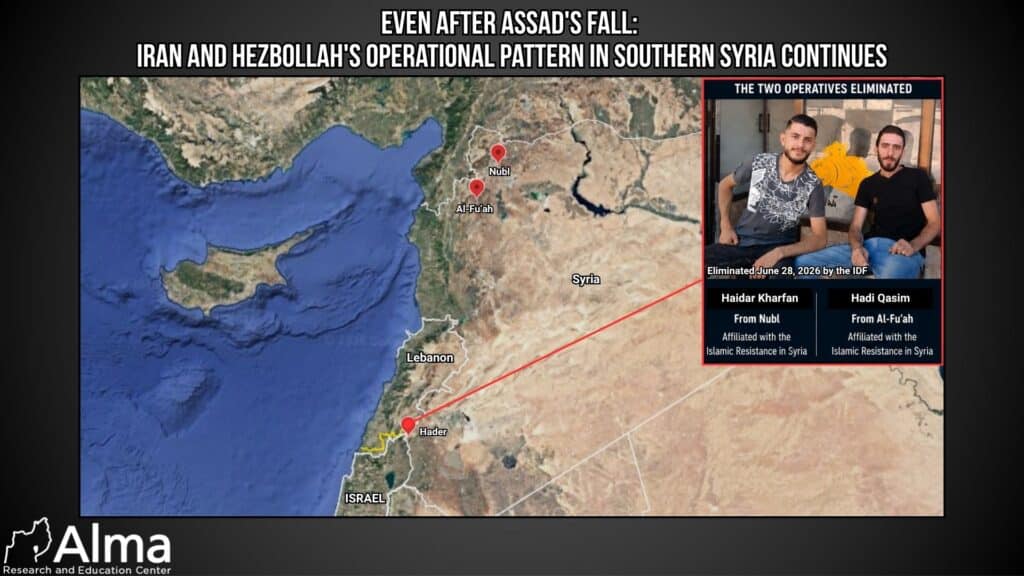
Local Syrian reports identifying the two operatives eliminated by the IDF on June 28 in the Hader area of Quneitra Governorate, southern Syria, most likely provide further evidence of a well-established operational pattern employed by Iran and Hezbollah in southern Syria-a pattern that appears to have persisted even after the collapse of the Assad regime and under Syria’s new government.
The two men, Haidar Kharfan, a resident of the Shiite town of Nubl in the northern Aleppo countryside, and Hadi Qasim, a resident of the Shiite village of Al-Fu’ah in Idlib Governorate, were eliminated by the IDF while armed in the Hader area of southern Syria, near the buffer zone in the Syrian Golan.
Their presence in this area, together with the circumstances surrounding their elimination, strongly suggests that they were engaged in preparations for terrorist operations against Israel. Such activity could have included an attempt to infiltrate Israeli territory, attacks against IDF forces using small arms or explosive devices, or preparatory actions for future attacks, including intelligence collection and reconnaissance of the operational environment.
The two operatives most likely operated under the banner of the Islamic Resistance Front in Syria (Awli al-Ba’s – Jabhat al-Muqawama al-Islamiyya fi Suriya), a framework associated with the pro-Iranian axis. It is neither a new independent organization nor a structured entity with its own headquarters, command hierarchy, or unified organizational apparatus.
It may instead function primarily as a name and media platform intended to brand and publicize anti-Israel operations under the guise of a “Syrian resistance.” In practice, however, the activity carried out under this banner appears to be conducted by local Syrian actors who rely on the guidance, funding, training, and logistical support of the broader pro-Iranian axis.
This arrangement enables Iran and Hezbollah to advance hostile activity against Israel through proxies and militias operating under a Syrian identity, while obscuring the extent of Tehran’s and Hezbollah’s direct involvement.
The identities of the two operatives further illustrate that this framework is not composed solely of residents of southern Syria. Both originated from Shiite communities in northern Syria – longstanding strongholds associated with Iran and Hezbollah and were deployed to southern Syria to participate in operations against Israel. This reflects a familiar operational model employed by the pro-Iranian axis, combining the recruitment and deployment of Shiite populations from across Syria with the development of local terrorist infrastructure in the country’s south.
This pattern is not new. In 2022, we published research showing that Hezbollah and the IRGC Quds Force’s Unit 840 were simultaneously recruiting Shiite families in Quneitra Governorate-including the Khidr, Hamada, and Baghdadi families – in an effort to establish a local infrastructure capable of supporting terrorist activity along the Israeli border. The current incident indicates that, alongside continued recruitment of local residents, Iran and Hezbollah continue to rely on transferring operatives from other Shiite areas of Syria to the southern theater.
Despite the fall of the Assad regime and the emergence of a new government in Syria, the operational infrastructure that Iran spent years building appears not to have disappeared. The terrorist infrastructure established over many years by the Shiite axis remains relevant. Even under Syria’s new political reality, networks associated with the pro-Iranian axis continue to emerge, relying on Shiite communities throughout Syria and frameworks such as the Islamic Resistance Front in Syria to facilitate terrorist activity against Israel in the country’s south.
Accordingly, the security challenge in southern Syria cannot be understood solely through the prism of local actors. It remains part of a broader Iranian and Hezbollah effort to preserve and expand their operational capabilities against Israel.
The very fact that these operatives travelled from northern Syria to southern Syria and reached the vicinity of the Israeli border-most likely in preparation for carrying out a terrorist attack-highlights the limitations of the new Syrian regime’s security forces in preventing terrorist activity against Israel originating from southern Syria.
This raises a fundamental strategic question: Given Syria’s current level of stability and governance, can Israel realistically afford to relinquish its control of the buffer zone in the Golan Heights? The present tactical incident, which reflects a broader Iranian strategic-operational pattern, suggests that the answer is no.





One Response
Dear Dana,
I completely agree that Israel must retain the buffer zone and continue to eliminate all terrorists: they must be destroyed completely like cancer cells until every cell is gone. There must be consequences for terrorists: We will find you and we will kill you. The execution of Justice has arrived. G-d Bless the IDF!!!