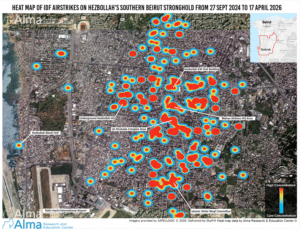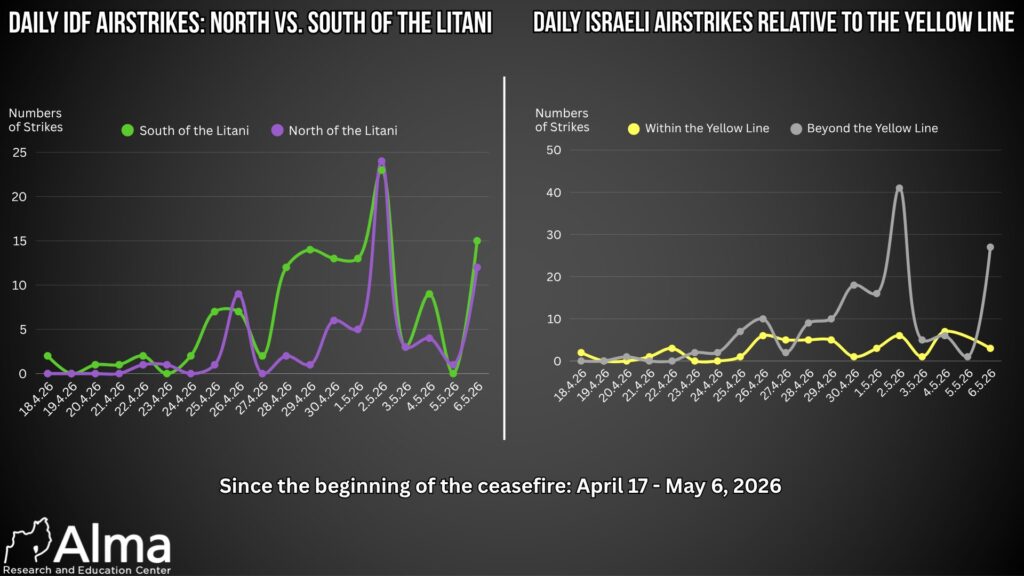
Since the beginning of the ceasefire, fluctuations have been evident in the pattern of IDF airstrikes in Lebanon. At the beginning of the post-ceasefire period (which began on April 17), the number of Israeli airstrikes in Lebanon remained relatively low. This was followed by a gradual increase in the scope of strikes, which peaked on May 2. A temporary decline in the number of strikes was then recorded; however, on May 6, there was another relatively high-volume day of airstrikes, marking a renewed increase, particularly in strikes conducted outside the Yellow Line and in areas north of the Litani River. At the same time, Hezbollah has recently increased the scale of its attacks against Israel and against IDF forces operating in Lebanon. On May 3, the organization carried out 12 attacks; on May 4, it conducted another 12 attacks; and on May 5, a peak of 20 attacks in a single day was recorded — the highest figure during the examined period. High operational activity also continued on May 6, when Hezbollah carried out 18 additional attacks against Israel and IDF forces in Lebanon. The left graph, comparing IDF airstrikes north and south of the Litani River, shows that the majority of activity was concentrated south of the Litani from the beginning of the ceasefire. Nevertheless, several significant increases were also recorded in the number of strikes north of the Litani, particularly in early May and again on May 6, indicating a temporary expansion in the geographic scope of Israeli strikes. The right graph, which examines IDF airstrikes in relation to the “Yellow Line,” indicates that most strikes were conducted outside the Yellow Line, with a notable peak recorded on May 2. In contrast, the number of airstrikes inside the Yellow Line remained relatively low and stable throughout the period. Following the decline recorded in the days after the early May peak, a renewed increase in strikes is evident on May 6, particularly outside the Yellow Line. The May 6 airstrike in the Haret Hreik neighborhood of Beirut’s Dahieh, eliminating a high-value figure identified as Ahmad Ghaleb Ballout, commander in Hezbollah’s Radwan Unit, was the first strike in Beirut since the beginning of the ceasefire. Note: The data presented in the graphs refers solely to IDF airstrikes and does not include ground operations, artillery fire, or other military activity conducted during the examined period