By: Tal Beeri and Dana Polak
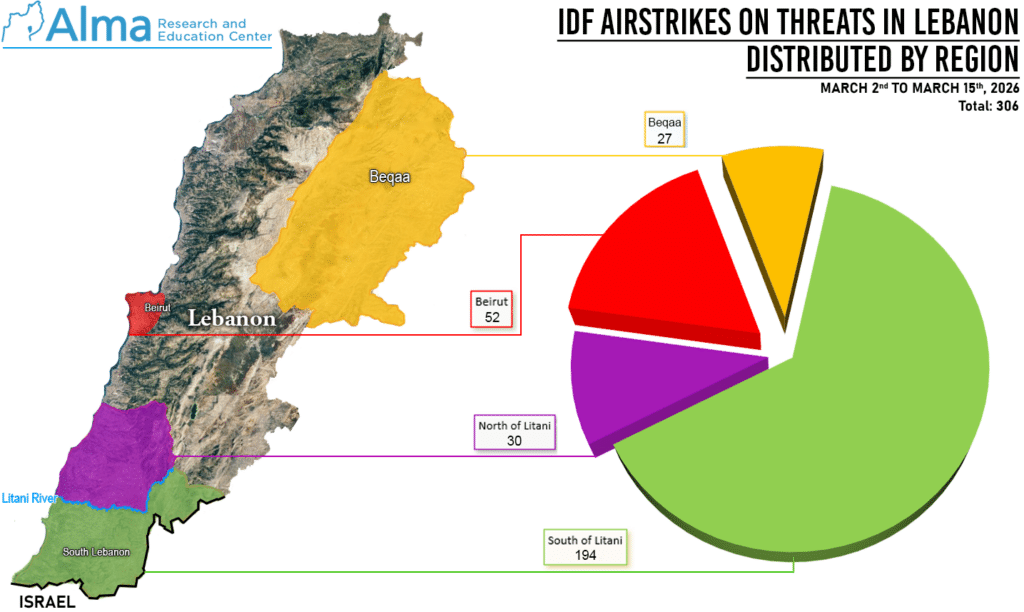
During the period between March 2 and March 15, 2026, as part of Operation “Roaring Lion,” the Israeli Air Force conducted 306 waves of airstrikes against Hezbollah targets in Lebanon (each wave included a varying number of targets). An analysis of the geographic distribution of the strikes indicates a clear concentration of activity in southern Lebanon (both south and north of the Litani River), along with deeper strikes in Beirut and the Beqaa Valley.
The area with the highest number of strike waves was south of the Litani River, where 194 waves of strikes were recorded, accounting for approximately 63% of all strike waves during the period examined in this document. In other words, despite the deployment of the Lebanese Armed Forces since November 2024 and the declarations by the Lebanese government and army regarding the disarmament of Hezbollah south of the Litani, the data clearly indicates extensive Hezbollah activity in this area.
The high number of strike waves in this region is also reflected in data collected by the Alma Research and Education Center during the ceasefire period (November 2024 – March 2026), which indicated the continued presence and activity of Hezbollah in southern Lebanon. This activity included the rehabilitation of military infrastructure, the reorganization of operational formations, and the transfer of weapons.
The large number of strike waves in this area may also stem from the potential preparation for a possible ground maneuver in the region.
In the area north of the Litani, 30 strike waves were conducted (9.8%). This is a relatively low number considering the current importance of the area. This region corresponds to the Badr Unit sector, which has become Hezbollah’s operational center of gravity during the ceasefire period, serving as the primary hub for the organization’s activities in terms of firepower deployment, defense, and weapons storage along the southern front.
In the Beirut area, 52 strike waves were carried out, representing 16.9% of all strikes. This area, particularly the Dahiya district, serves as Hezbollah’s main command and control center. Beirut is also the location for the organization’s strategic infrastructure, including facilities used for the storage and production of advanced weaponry. Due to the high civilian density in the city, and despite evacuation warnings issued by the IDF, the number of strike waves in this area is relatively limited. Nevertheless, these strikes carry significant operational importance due to the strategic and organizational role of this area.
In the Beqaa Valley, the lowest number of strike waves was recorded – 27 strikes (8.8%). Despite the high operational importance of the Beqaa region for Hezbollah, the scope of strikes there remains relatively low. The Beqaa serves Hezbollah’s for its strategic depth, both operationally and logistically. It hosts training infrastructure, weapons production and storage facilities, and key smuggling routes from Syria into Lebanon. Despite this importance, the proportion of strikes in this area is significantly lower compared to the southern front.
Strikes in the Beqaa region should therefore be intensified given its strategic importance. Increasing pressure on this area could significantly disrupt Hezbollah’s operational balance and military capabilities.
Note: The data also include three additional strikes that are not part of the geographic breakdown—two strikes in northern Lebanon and one strike at an unknown location.