
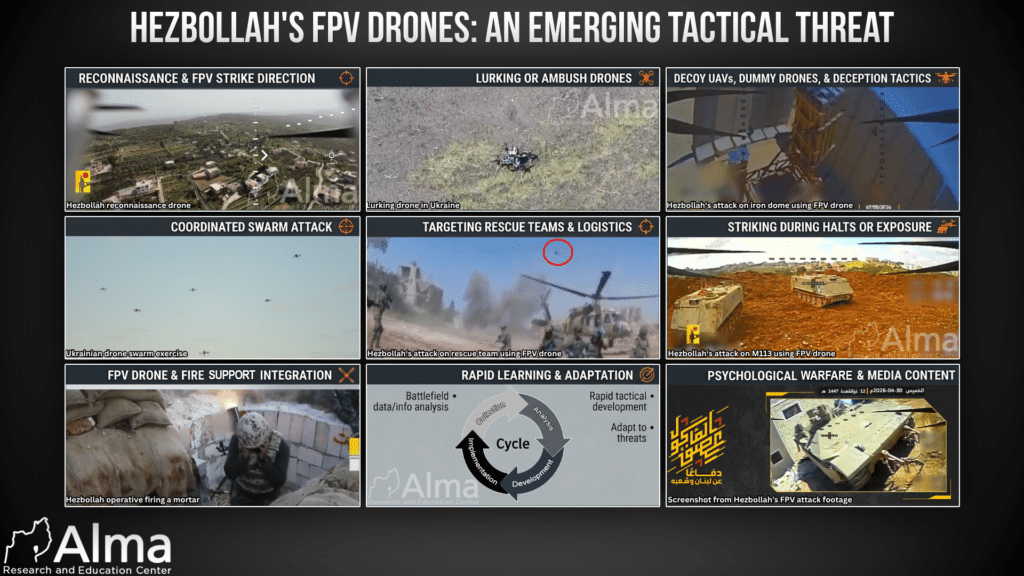
Hezbollah is intensifying its use of FPV drones against Israel, with these systems emerging as one of the most significant tools employed in its attacks along the northern border.
Recently, we published a report regarding Hezbollah’s FPV explosive drone threat, in which we detailed the nature of the threat and measures against it. As we noted, although this is not a strategic threat or a substitute for the organization’s traditional firepower arrays, lessons from the war in Ukraine illustrate that FPV drones may also provide a non-state actor with a significant tactical capability: inexpensive, precise, accessible, and relatively difficult to thwart.
Below are several tactical patterns and potential operational concepts derived from the war in Ukraine, some of which may also be employed by Hezbollah in the northern arena, and some of which are already in use as part of integrating FPV drones into the organization’s firepower and combat array.
An Observation Drone “Inviting” an FPV Drone – Intelligence Gathering
One of the central lessons from the war in Ukraine is the integration between observation drones and attacking FPV drones. The first drone is not necessarily intended to strike the target, but rather to identify movement, locate forces, track vehicles, or expose vulnerabilities in real time. Once the target is identified, an FPV drone is launched for a rapid and precise strike. This pattern enables even a non-state organization to create a kind of “short fire cycle” in which only a brief period separates target detection from the strike itself. For IDF forces, this means that any visible movement in the border area — even if not offensive — could become a target within minutes.
A “Waiting” Drone / “Ambush” Drone
Unlike the perception of a drone as a tool that flies directly toward its target, another possible threat is the use of a “waiting” drone — a device programmed to reach a certain point, land, and remain in standby mode until a target appears, functioning as a kind of “aerial ambush.” The drone may wait along movement routes, near outposts, adjacent to logistics sites, or at points known to be regularly traversed by forces. Once movement is identified, it can take off again to attack or serve for real-time intelligence collection. This pattern resembles, to some extent, a roadside bomb, but one capable of “deciding” when to act while changing its route according to developments on the ground.
In the video: a UAV in Ukraine waiting for forces along the route.
Unlike the threat of classic anti-tank fire, the drone enables much greater flexibility in identifying and selecting the target, and in some cases can even change location according to movement on the ground. Even if the scope of use of such a pattern remains relatively limited, the mere possibility of its existence may affect the sense of security of forces and freedom of movement in the border area.
In addition, such a drone may also serve as bait — for example by landing or crashing in a controlled manner in the field — with the aim of drawing IDF forces closer for inspection, neutralization, or collection, and then exploding or enabling an additional strike against the force that approached it.
Like an “aerial ambush,” the mere possibility that a waiting drone is positioned near a route, post, or facility may affect the freedom of movement of forces and require caution, searches, and changes in operational patterns even in areas previously considered relatively safe.
Decoy UAVs, Dummy Drones, and Deception
A drone does not have to carry explosives to be effective. In Ukraine, drones have been used primarily to cause enemy forces to react; open fire, activate electronic warfare measures, expose observation positions, or move forces. Hezbollah may likewise use drones as bait, whose purpose is not direct damage, but rather exposing IDF response patterns.
In other cases, such a drone may intentionally crash or land to draw a search, neutralization, or collection force — and thereby enable observation of the force or even a subsequent attack. In addition, inexpensive dummy drones can be used to draw fire, trigger defensive systems, or distract attention while another drone operates against the real target. Such a pattern forces the defending force to react to almost every intrusion or detection, even when it is unclear whether it constitutes a real threat, thereby turning even unarmed drones into an effective tool of attrition and deception.
Coordinated Attack by Multiple Drones
The war in Ukraine demonstrates that the threat does not have to manifest itself in massive “drone swarms” to be effective. Even a relatively small number of drones, operated simultaneously against a specific target, may create overload on the defending force’s detection, defense, and response systems. A localized saturation attack may include several observation drones alongside several attacking FPV drones, all operated within a short period of time against an outpost, force, or movement route. The purpose of the attack is not necessarily to destroy the force, but rather to create confusion, overload, and cause difficulty distinguishing between a real threat and deceptive means.
Targeting Rescue and Logistics Teams
One of the most prominent patterns in the fighting in Ukraine is targeting the support envelope of combat — not only the fighting force itself. FPV drones can threaten supply vehicles, generators, antennas, engineering equipment, ambulances, and rescue and evacuation teams. In some cases, the initial strike is intended precisely to draw additional forces to the scene, such as medics, repair teams, or rescue vehicles.
Targeting a Static Force and/or During Transitions Between Activities
FPV drones are particularly effective against forces during moments of transition and temporary exposure: unloading equipment, servicing a vehicle, changing shifts, opening a gate, or making a short stop along a movement route. In Ukraine, it became clear that sometimes “the minute between actions” is the most dangerous moment. Even a relatively skilled and protected force may be vulnerable when soldiers are outside vehicles or concentrated at a single point. For the IDF, this means an increasing need for dispersion, reducing exposure time, and changing routine operational patterns in the border area.
In the video, an example of such an attack carried out by Hezbollah on May 12, 2026.
Integrating FPV with Other Firepower
The threat posed by FPV drones does not stand alone but rather integrates into a broader firepower array. Like what is occurring in Ukraine, Hezbollah may use drones to identify targets, direct fire, correct strikes, or apply pressure on a force during anti-tank fire, mortar fire, or rocket launches. The drone effectively becomes a “force multiplier” that shortens the time between identifying the target and activating fire against it. Even if the drone itself does not cause significant damage, its integration into the existing firepower array may improve the precision, lethality, and effectiveness of other attacks.
Rapid Adaptation Rate
One of the central characteristics of drone warfare in Ukraine is the rapid pace of learning and adaptation. Tactics, frequencies, protective measures, and operating patterns sometimes change within just a few weeks. Hezbollah may also adopt a similar trial-and-error approach, learning which methods are more successful against the IDF and adapting its patterns of operation accordingly. This means that this is not a “static” threat, but rather a capability that continuously develops and changes — sometimes faster than the rate at which defense systems can adapt.
Turning Every Event into Cognitive Warfare Content
Beyond the direct kinetic military effect, FPV drones also enable the creation of perception warfare content in real time. Almost every strike is documented from the drone’s point of view and can within minutes become a video distributed on social media and through the organization’s propaganda channels. Even a relatively limited tactical strike may receive broad resonance and amplify the sense of threat among the public and forces on the ground.
In this context, it should be noted that in the overwhelming majority of videos distributed by Hezbollah’s combat media unit, the final result of the strike and the extent of the damage — if any — are not shown. Thus, the drone is not only a strike tool, but also a perception warfare instrument serving Hezbollah’s influence and deterrence efforts.
Summary
FPV drones are unlikely on their own to alter the strategic balance between Israel and Hezbollah. However, lessons from the war in Ukraine indicate that they could evolve into a meaningful tactical component within Hezbollah’s operational arsenal. Their accessibility, low production cost, precision-strike capability, and operational adaptability allow even non-state actors to pose a sustained threat to military forces, transportation routes, logistics assets, and tactical infrastructure.
For the IDF, the challenge extends beyond merely intercepting the drones themselves. It also involves adapting to a battlefield in which low-altitude aerial threats (VLL: Very Low-Level Airspace), become a constant feature of the operational environment, necessitating ongoing adjustments in maneuver patterns, defensive measures, and force deployment across the northern theatre.




2 Responses
Dear Dana,
Thanks for the FPV drone information. Preemptive observation and strikes by IDF forces are needed. The best defence is a good offense. I recommend intensive search and destroy operations throughout Lebanon, until hezbollah no longer exists.
Netting, FPVs & Quadcopters
When I was stationed with the US Army in Europe during the 1980’s all vehicles, Humvees, APCs, Tanks and etc. were issued individual camouflage netting kits. These kits came in oversized duffle bags. These Light weight, easy to transport and setup. Each vehicle was issued its own kit. The US Military may still have these kits stored in a warehouse gathering dust. I am sure Israel could put them to use. With President Trump in office, he is more than likely give them to Israel.
US Army standardly issued the Lightweight Camouflage Screen System (LCSS) to units deployed in Europe during the 1980s. [1]
The primary version deployed to Europe—under the US Army Europe (USAREUR) command—was the Woodland, Radar Scattering (Type IV) kit. This system was designed specifically to counter Soviet reconnaissance by blending tactical vehicles, command posts, and equipment into the European theater’s heavily forested environments. [1, 2, 3, 4, 5]
Kit Architecture & Contents
Instead of a single, custom-shaped cover for every vehicle, the LCSS was a modular, component-based system issued in heavy canvas transport bags. A complete standard kit typically included: [1, 2]
• One Hexagonal Net: Approximately 30 x 30 feet, used as the main central coverage area.
• Two Rhombic (Diamond-shaped) Nets: Approximately 25 x 15 feet, designed to break up sharp corners and link multiple nets together.
• Support System: A collection of hollow, interlocking aluminum poles and broad, fan-like “spreaders” (or umbrellas) designed to prop the net away from the vehicle.
• Hardware & Anchors: Heavy aluminum ground stakes, tensioning lanyards, and joining keys.
• Repair Kit: Material patches and twine to mend tears in the field. [1, 2, 3, 4]
• Modular Versatility: Units used plastic joining clips to link multiple kits together. This allowed soldiers to scale up the coverage to completely hide massive equipment, such as M1 Abrams tanks, M2 Bradley fighting vehicles, or localized command tents.
• If you look at modern surplus databases, you will find 1080-01-457-2956. That is for the newer ULCANS (Ultra-Lightweight Camouflage Net System). ULCANS was rolled out in the late 1990s and 2000s to completely replace the heavier, snag-prone 1980s LCSS kits
Here are the exact 1980s field manual operational setup metrics and the authentic National Stock Numbers (NSNs) pulled directly from Army Technical Manual TM 5-1080-200-13&P and FM 20-3 (Camouflage, Concealment, and Decoys). [1, 2, 3, 4, 5]
⏱️ Exact Setup and Teardown Times
Under Cold War-era field manuals, the time allotted for deploying or breaking down a standard multi-net system was dictated by a standardized crew battle drill: [1, 2]
• Personnel Required: 3 crew members.
• Standard Setup Drill Time: Within 20 minutes (for a standard 2-module vehicle configuration).
• Standard Teardown Drill Time: Within 15 minutes. [1]