
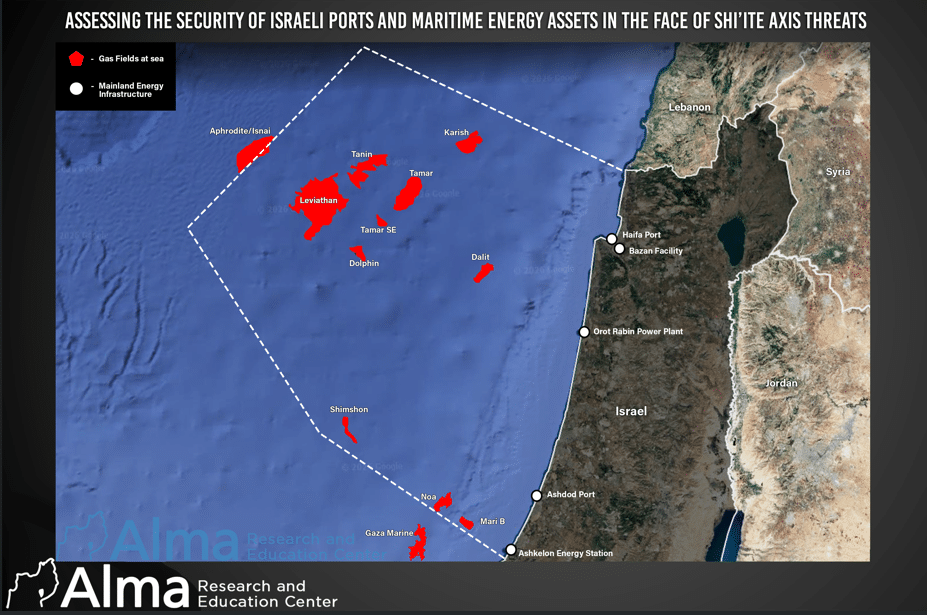
The military campaigns against Iran in June 2025 and in February-March 2026 turned Israel’s ports, gas rigs, and oil refineries into clear wartime targets with direct strategic value in the eyes of the Iranian-led Shiite axis.
A continuing threat to these targets also exists from Hezbollah, though in a reduced form.
In both wars with Iran, Israel proactively shut down its own Karish and Leviathan gas rigs out of concern over a direct Iranian strike, while in Haifa Bay, an Iranian attack hit the Bazan oil refinery complex and led to the shutdown of all facilities, illustrating that the threat to Israel’s energy hinterland is no longer merely a theoretical scenario but a capability that has been used in practice.
At the same time, these wars also showed that Israel succeeded in maintaining partial continuity of its maritime and energy economy through a combination of proactive shutdowns of vulnerable infrastructure, a multi-layered defensive response at sea and on shore, and the maintenance of port operations even under direct threat.
During both wars, the ports of Haifa, Ashdod, Ashkelon, which includes a port and tanker areas for the storage of petroleum products, and Hadera, which serves as the maritime service port of the Orot Rabin power station, remained open for normal activity, although restrictions were imposed on hazardous cargo and stricter maritime security measures were introduced.
The Israeli economy was forced to rely on the Tamar rig, located in the Mediterranean opposite the southern coast, on more polluting fuels, and on emergency adjustments to bridge the proactive shutdowns of the Karish rig, located in Israel’s exclusive economic waters about 90 kilometers northwest of Haifa, and the Leviathan rig, located about 10 kilometers offshore, south of Haifa, to which gas is fed through an undersea pipeline from the Leviathan field located about 120 kilometers west of Haifa.
The proactive closure of two of the largest rigs was intended to reduce the threat level and the risk of a direct hit.
In June and July 2026, figures in the Islamic Revolutionary Guard Corps warned that any further damage to Iranian energy infrastructure would lead to attacks on regional energy assets, and threatened an infrastructure war targeting energy sites.
In July, media outlets identified with the Revolutionary Guards threatened attacks on the port of Haifa and on Jebel Ali port in the United Arab Emirates in response to American strikes on infrastructure and transportation targets at Iran’s strategic Bandar Abbas port and elsewhere in the Islamic Republic.
The important UAE port of Fujairah also joined the list of sites threatened by Tehran.
The current threat includes the possibility of a combined Iranian and Hezbollah attack on the gas rigs, on Haifa Bay, and on civilian shipping traffic, using ballistic missiles, UAVs, cruise missiles, anti-shipping munitions, explosive boats, and possibly also underwater means and commando capabilities.
At the same time, proven defenses exist against each of these types of threat.
Hezbollah is capable of doing this with its residual capabilities, through Unit 7900 – Hezbollah’s shore-to-sea missile unit – and through Unit 1200 – its naval unit.
It should be recalled that Hezbollah has already launched UAVs toward the Karish reservoir / rig.
In early July 2022, Hezbollah launched three UAVs (which were intercepted) toward the Karish reservoir / rig.
During the war, it appears to have made additional attempts to strike Israeli assets in the maritime arena.
More than 70% of Israel’s electricity production is based on natural gas originating from Mediterranean rigs, and more than half of the fresh water supply comes from desalination facilities along the Mediterranean coast.
In addition, the overwhelming majority of Israel’s maritime trade passes through its seaports, with Haifa and Ashdod together handling the vast majority of cargo traffic, while Eilat port previously played a limited but unique role, mainly in vehicle imports and trade with Asia.
Energy Assets and Ports as Wartime Targets
Israel’s maritime energy system is based on a relatively small number of critical assets, and any prolonged damage to one of them creates a systemic effect.
The Karish and Leviathan rigs supply a significant share of the gas for the domestic economy and for regional export, while the Bazan complex in Haifa plays a central role in refining, fuel production, and the chemical industry.
Therefore, even if a hit on a rig or refinery does not immediately paralyze the entire national system, it generates pressure on the electricity grid, exports, supply chains, and the resilience of Israel’s home front.
According to a Calcalist report of March 15, 2026, the loss of a single gas rig could amount to damage in the billions of shekels.
The operational meaning is that Iran does not have to “destroy” a rig or a port in order to achieve a gain.
Stopping production, causing a temporary shutdown, frightening civilian crews, hardening marine insurance conditions, or creating risk to commercial shipping are enough to produce a strategic effect.
This is exactly the result seen in the two most recent wars: Israel itself chose to shut down facilities so as not to risk a direct hit, indicating that the threat was perceived as sufficiently real to justify a calculated self-inflicted disruption to production continuity.
Haifa and Ashdod ports are also strategic targets.
A hit on a port, or even a sustained threat to ship movements, can disrupt imports of raw materials, fuels, military equipment, and civilian containers.
During the war in June 2025, the ports remained open, but restrictions on hazardous materials came into force.
The defense establishment views the maritime theater as a central combat arena and is investing increasing resources in developing defense capabilities in this theater.
Eilat and the Houthis: Economic Harm Without a Direct Hit on the Port
Eilat port illustrates the dimension of economic coercion exercised by the Iranian axis.
As of July 2026, the Houthi threat by itself to shipping in the Red Sea and Bab el-Mandeb continued to affect shipping patterns (even if the threat was reduced due to the absence of Iranian spy ships in the Red Sea that had previously directed Houthi attacks), and affected insurance and routing, even where no direct attack on the port itself was involved.
Port activity in Eilat fell by more than 90% since the beginning of the Houthi campaign against shipping linked to Israel, and in July 2025 it was even reported that the port was facing closure due to financial collapse, and since then the port has in practice remained paralyzed.
According to recent reports, the Houthis renewed the threat in June against ships with an Israeli connection, and therefore Eilat became a clear example of the way an enemy can disrupt a strategic maritime gateway by deterring shipping, raising insurance premiums, and diverting routes, even without physically striking the piers.
What Iran Has Already Tried to Do
Throughout the two most recent wars, a clear pattern emerged: relatively limited Israeli moves against Iranian infrastructure took place, and an Iranian counter-threat developed against Israel’s energy assets.
In June 2025, damage was recorded to pipelines and Bazan facilities, and at the same time gas flow from the Karish and Leviathan rigs was halted.
In March 2026, with the renewal of the war, Iran again explicitly threatened regional energy infrastructure, and Israel once more shut down some of the rigs.
The Iranian effort did not focus only on immediate physical damage, but also on activating a threat that would cause Israel to shut down sensitive systems itself.
This is a logic of strategic coercion: to cause the adversary to generate “over-hardening” and “preventive shutdown.”
Even without a direct hit on the rigs themselves, Israel stopped their activity, at least temporarily, in two different wars.
During the wars, after the closure of Karish and Leviathan, Israel operated an “emergency energy market.”
In addition, the kinetic strike actually occurred at a complex near the shore, the Bazan complex, and not at a rig at sea.
This teaches that although protection of the rigs is at the center of public discourse, coastal processing facilities, refineries, pipelines, and power stations may be more accessible targets for the enemy, with a similar or even greater effect on energy continuity.
There were in fact two separate events at the Bazan complex that should be distinguished:
The first, in June 2025, was an Iranian strike on the complex’s internal power station, which caused significant damage to the steam and electricity systems, led to the shutdown of all refining facilities, and killed three company employees.
The second, in March 2026, involved reports of damage in the Haifa refineries area during an Iranian barrage or as a result of interception fragments: according to the reports, local damage, a fire, damage to a high-voltage line, and electricity disruptions were caused, but with no leakage of hazardous materials and no significant infrastructure damage according to the initial statements.
The Israeli Response: Proactive Shutdown, Naval Defense, and Port Continuity
The Israeli response that emerged in the two most recent wars rested on three layers: reducing exposure through the proactive shutdown of vulnerable infrastructure, multi-layered defense at sea and on shore, and preservation of the ports’ functional continuity even under threat.
When Israel ordered the halt of part of the gas fields at the start of the fighting, the ports continued to operate under stringent procedures.
In the maritime defensive dimension, in recent years the Israeli Navy has built a concept that places the protection of the gas rigs and energy routes at the heart of its naval doctrine.
Saar 6 ships were built, among other purposes, to protect the exclusive economic zone, and they are equipped with advanced aerial and maritime defense systems, including C-Dome – the naval Iron Dome – the Barak MX system, and the advanced MF-Star radars for the detection of threats.
The deployment of naval Iron Dome aboard Saar 6 ships was intended to provide a response to threats from rockets, cruise missiles, and unmanned aircraft against the rigs.
The ships mark a transition from a concept focused mainly on coastal defense and routine security to a concept of protecting strategic assets in the deep sea.
Alongside this, Israel is working to expand the defensive envelope against more advanced threats as well.
Saar 6 ships carried out a test with the Barak LRAD interceptor, the long-range version of the Barak MX system, indicating a strengthening of the defensive layer against ballistic missiles at greater ranges and against aerial and maritime targets.
Of course, Israel’s seaports are also protected by the land-based multi-layered air-defense system, which includes Iron Dome, David’s Sling, and Arrow 2 and 3.
In addition, there is planning to integrate laser cannons for point defense at such sites against UAV and drone threats.
Israel’s security concept also relies on unmanned surface vessels and on autonomous underwater vessels.
At the same time, open-source reporting exists on an Israeli move to a broader underwater-detection layer.
For the first time, the Navy began operating unmanned underwater vessels in Israel’s economic waters in order to build a maritime intelligence picture, analyze threats, and protect strategic assets, foremost among them, the gas rigs.
In addition, Israeli companies offer concepts of multi-layered underwater awareness based on fixed seabed sonars, diver-detection systems, and mobile sensors.
In other words, alongside air defense and area defense, Israel is also developing an underwater warning layer against divers, unmanned vessels, and underwater sabotage threats.
The Israeli response is based on the ability to continue operating the ports of Haifa and Ashdod despite the wartime threats, and to protect import and export sea routes even at the cost of raising a controlled level of risk, alongside multi-layered defense of the rigs at sea.
This is a combination of protection, intelligence, maritime control, civilian emergency procedures, and an understanding that ports cannot be closed for long periods without generating severe economic damage.
The heavy investment in securing the rigs was justified, but the latest wars show that refineries, power stations, fuel terminals, pipeline infrastructure, and storage farms are targets with higher strategic profitability for the enemy, because they are large, fixed, known, and perhaps easier to hit than a smaller maritime target protected by Navy ships.
What Still Remains in the Arms Race and Has Not Been Fully Tested
Despite the two wars, some of the capabilities that may characterize the next war have not yet been fully tested.
At the top of the list is a combined and coordinated attack on several energy and maritime targets simultaneously: a rig, a refinery, a coastal power station, and a shipping lane.
Such an attack could combine ballistic missiles, attack UAVs, cruise missiles, shore-to-sea missiles, explosive boats, suicide UAVs in the maritime arena, and electronic interference in order to create saturation pressure on detection and interception arrays.
Another capability that remains largely at the level of potential is the use of underwater means, manned (commando) or unmanned, against gas infrastructure or against access routes to ports.
The very fact that Israel in recent years has emphasized the development of autonomous maritime means for defense indicates that the threat is not regarded as theoretical.
In addition, the question of how the ports themselves would cope with a prolonged campaign of intimidating shipping companies, marine insurance, and cargo risks has still not been fully tested.
Cyberspace: A Threat to Continuity, Not Only to Secrecy
Another dimension that has not yet been sufficiently emphasized is cyber.
In the wars against Iran, cyberspace became a parallel arena of coercion and disruption: groups identified with Iran and with pro-Iranian actors claimed operations against energy companies, airports, banks, and infrastructure in the Gulf and in Israel, alongside denial-of-service attacks, leaks, and attempts to penetrate operational systems.
For ports, refineries, desalination facilities, power stations, and gas rigs, the main risk is not only theft of information but harm to continuity: disruption of cargo-management systems, industrial control, ship coordination, electricity systems, communications, navigation, AIS, and GPS.
Therefore, protection of maritime infrastructure must also include segmentation, backup, manual drills, continuous monitoring, and readiness to operate under cyberattack.
Hezbollah: A Reduced but Not Negligible Maritime Capability
Alongside the direct Iranian threat, Hezbollah’s ability to strike rigs and ports using shore-to-sea missiles such as the Yakhont and the like currently appears more limited than in the past, due to damage sustained by this array, but it has not disappeared.
According to updated assessments by the Alma Center, after the war and the continuing targeting operations, Hezbollah’s arsenal is based mainly on short- and medium-range rockets, while the advanced missile arrays, including shore-to-sea missiles and cruise missiles, are more limited in number.
At the same time, Alma still assesses that Hezbollah retains dozens to hundreds of advanced means, and that shore-to-sea and anti-shipping cruise missiles such as the Yakhont and Ghadir, alongside anti-shipping ballistic missiles such as the Khalij Fars, may remain part of a maritime threat to be activated in a broad escalation scenario.
According to findings based on open-source material, Hezbollah, for example, used Iranian cruise missiles of the “Paveh” type during the war in March 2026 (on March 17, a photograph was published showing what appeared to be tail remains of a “Paveh” missile that had apparently fallen in the area of Lake Qaraoun, south of the Beqaa in Lebanon, after being launched from the Beqaa area. Hezbollah also published a video showing a “Paveh” missile inside a civilian truck or trailer).
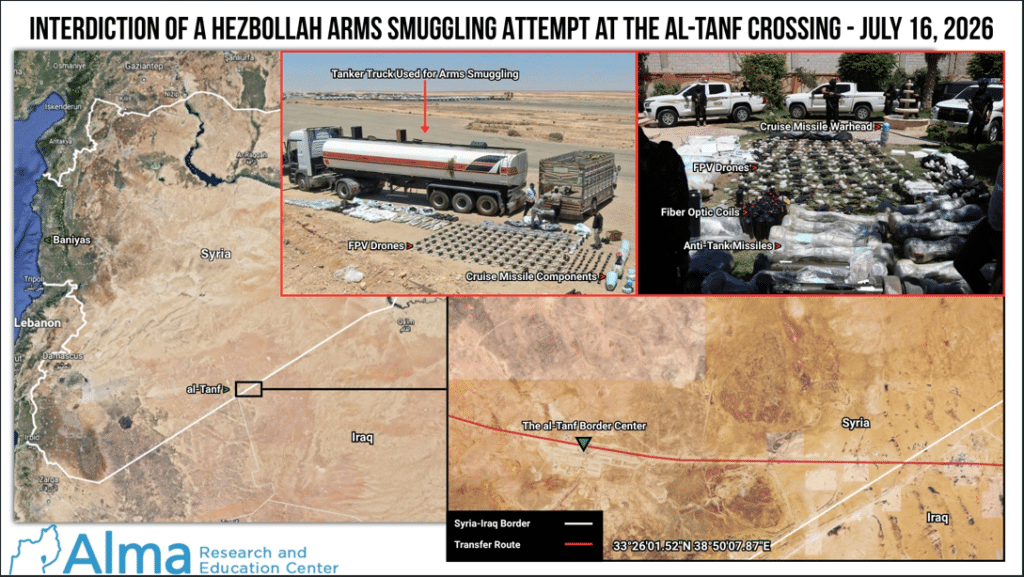
Components of missiles of this type were also discovered in a thwarted weapons-smuggling attempt inside a fuel truck at the al-Tanf crossing (Iraq-Syria border) on July 16.
The weapons were on their way to Hezbollah.
Hezbollah is capable of striking Israel’s maritime energy assets with its residual capabilities, through UAVs, cruise missiles, Unit 7900 – Hezbollah’s shore missile unit – and through Unit 1200 – its naval unit (Unit 1200) and its capabilities, which include the additional potential use of explosive boats and commando capabilities.
The Current Threat and What Israel Must Prepare For
The current threat to Israel’s energy infrastructure and ports is now characterized by a combination of declared intent, existing attack precedents, and capabilities that are in continuous development.
Iran has already shown that it is willing to put Israel’s energy assets in its target bank, and Israel has already shown that it takes this threat seriously enough to invest in suitable defense capabilities and to shut down part of the infrastructure on its own.
Therefore, Israeli preparedness cannot be built only around the question of intercepting the next missile, but around defending an entire system: rigs, refineries, power stations, pipelines, ports, ship traffic, and civilian crews.
In this sense, the pattern exposed in the two most recent wars indicates that the next phase in the arms race will focus not only on improving interceptors and adding ships, but on expanding the ability to manage an energy and ports system under fire.
For Israel, this means continued strengthening of the maritime defense around the rigs, hardening coastal facilities, first and foremost Bazan, improving the survivability of electricity and steam in the Haifa Bay area, building import and export alternatives, and continued investment in maritime intelligence, cyber, and unmanned systems.
The threats to the Karish and Leviathan rigs, to Bazan, and to the ports of Haifa and Ashdod are no longer a marginal issue of Israeli maritime security, but a central component of the current threat picture.
The last two wars with Iran showed that it is possible to shut down the maritime energy economy even without destroying a rig, that it is possible to significantly damage a critical coastal facility such as Bazan, and that Israel will have to continue managing not only the defense of this infrastructure but also its functional survivability in wartime.
It follows that the central question is with what combination of means the Shiite axis will attack these targets in the future, and to what extent Israel will succeed in preventing not only physical damage but also shutdown.
https://www.jpost.com/israel-news/article-891624
https://www.calcalistech.com/ctechnews/article/byklkrscze
https://www.worldoil.com/news/2026/3/2/israel-halts-leviathan-karish-gas-fields-after-iran-strikes
https://www.ynetnews.com/article/hkeyksdnbe
https://www.jpost.com/opinion/article-894736
https://thesoufancenter.org/intelbrief-2025-june-27
https://www.maariv.co.il/news/world/article-1343103
https://caspianpost.com/iran/irgc-linked-media-calls-for-strikes-on-israel-s-haifa-uae-s-jebel-ali
https://en.globes.co.il/en/article-israel-navy-deploys-unmanned-underwater-vehicles-1001511546
https://socradar.io/iran-israel-cyber-conflict-dashboard




One Response
Dear Yaakov,
The best defence is a good offense. Reacting to terror threats is poor policy. Removing terror threats is good policy. The time has come to remove the ayatollah/IRGC terrorist threat from the face of the earth. Pure evil, darkness and death cannot be appeased, it must be removed. Light casts out darkness.