The Iranian Arena
Over the past day, strikes across Iran have continued:
Waves of attacks in Tehran targeted regime infrastructure. Among the targets struck was the gas station belonging to Sharif University of Technology.
Various aircraft were also targeted, including airplanes and helicopters, as well as infrastructure used by the regime’s armed forces for military purposes at three airports across Tehran: Bahram Airport, Mehrabad Airport, and Azmayesh Airport.
In addition, a strike was carried out on the “South Pars” petrochemical facility in Asaluyeh, the largest petrochemical complex in Iran, and the petrochemical complex in Marvdasht was also targeted. Strikes were also reported in Shiraz, Isfahan, Karaj, and Qom.
According to several reports, the Parchin nuclear facility was also targeted.
Eliminations
During the night between April 5–6, Majid Khademi, head of the IRGC Intelligence Directorate, who assumed his position in June 2025, was eliminated.
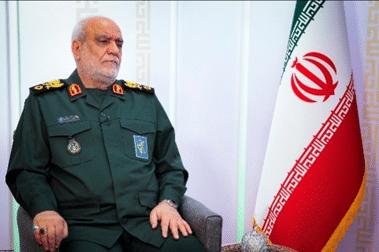
The IRGC Intelligence Directorate is responsible for special operations, countering internal political subversion, cooperation in suppressing protests and unrest, and combating Western cultural influence in Iran.
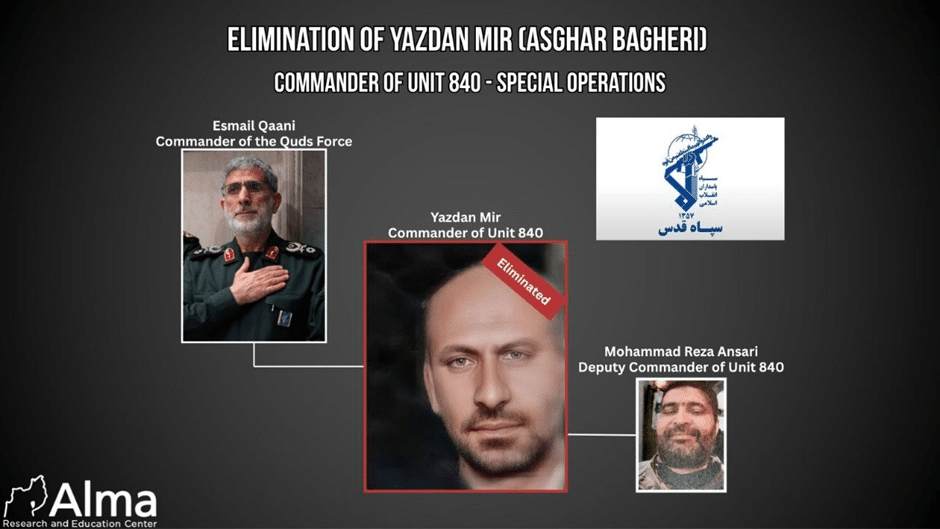
At the same time, Yazdan Mir, also known as Asghar Bakeri, was also eliminated, the commander of Unit 840, the special operations unit of the Quds Force, responsible for promoting and directing terrorist activity against Israelis and Jews inside Israel, along its borders, and worldwide, through terrorist cells remotely directed by it.
The IDF also eliminated Mohammad Reza Ashrafi Kahi in the Tehran area on Friday (April 3), a senior commander in the IRGC Oil Headquarters who served as the head of commerce in the headquarters.
According to Iranian opposition sources, Brigadier General Masoud Zare, commander of Iran’s Air Defense College, was eliminated in strikes on April 5 in Isfahan.
Iranian Activity in the Regional Arena
United Arab Emirates – As of April 5, the country’s air defense systems intercepted 9 ballistic missiles, one cruise missile, and 50 UAVs launched from Iran. Today, it was reported that an Iranian UAV struck a communications building in Fujairah.
Qatar– On April 5, several UAVs and two cruise missiles launched from Iran were intercepted in Qatari airspace.
According to unverified Iranian reports, an “Israeli ship” was attacked using a Qader cruise missile in the Jebel Ali port channel in the United Arab Emirates.
(Note – the Qader missile is an anti-ship missile with a range of 200 km and a 200 kg explosive warhead.)
Iraq
The U.S. Embassy in Baghdad stated that on the night of April 5, Iranian-backed Iraqi militias attacked American diplomatic facilities in Iraq. According to the embassy statement, these were attempts to assassinate American diplomats in Iraq.
The U.S. Victoria base was attacked by Iran.
The Shiite militia Saraya Awliya al-Dam, operating in Iraq, claimed responsibility for attacks on targets in Syria, Jordan, and Kuwait using suicide UAVs.
In the attached video, several UAV launches by the militia toward Kuwait and toward American bases in the area can be seen. Notably, the UAVs are mounted and launched from a civilian truck trailer.
Infrastructure of Battalion 52 of the al-Hashd al-Shaabi militia was attacked in eastern Salah al-Din, Iraq.
The Israeli Arena
Iranian attacks against Israel (as of April 6)
Over the past day, a direct hit was recorded in a civilian area, when a missile launched from Iran struck a residential building in the city of Haifa. As a result of the impact, four civilians were killed and approximately 10 others were injured.
During the night, fire from Iran continued and included launches toward all regions of Israel. A cluster munition fired toward the Tel Aviv area struck several locations in the area, and two civilians were injured.
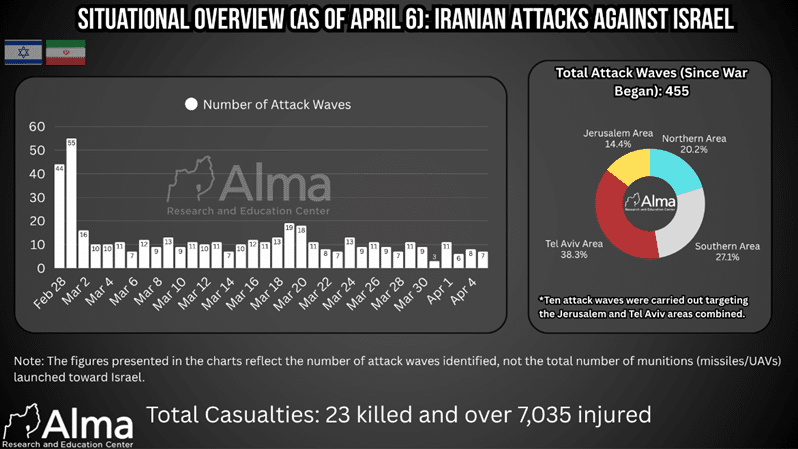
In recent days, there has been a significant Iranian focus on fire directed toward northern Israel. Over the past week (March 30–April 5), 18 waves of attacks were carried out toward the north, indicating an expansion of the geographic effort and increased pressure on this region.
It appears that the Iranians are concentrating efforts to strike strategic infrastructure in the Haifa area.
In terms of trends, over the past week there has been a decrease in the scope of attacks, with a daily average of 7.7 waves of attacks per day. Since the beginning of the war and up to last week, the overall average stood at 12.4 waves of attacks per day.
In total, since the beginning of the campaign, 455 Iranian attack waves against Israel have been identified. In cumulative geographic distribution, the central region—particularly the Tel Aviv metropolitan area—continues to be the primary target, alongside significant activity in the south and north, as well as in the Jerusalem area.
Since the beginning of the war, 23 civilians in Israel have been killed, and more than 7,035 people have been injured to varying degrees as a result of direct hits, falling interceptor debris, and secondary damage. In addition, extensive damage has been caused to residential buildings and civilian infrastructure, and the ongoing fire continues to disrupt daily life.
Approximately 6,700 residents (from 42 municipalities) are staying in hotels and community accommodation solutions due to evacuation from their damaged homes.
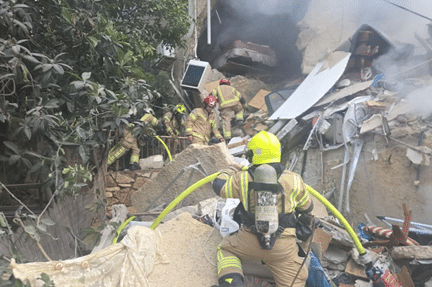
Fall of a munition item in Haifa. Credit: Fire and Rescue Services
Hezbollah Attacks Against Israel (as of April 6)
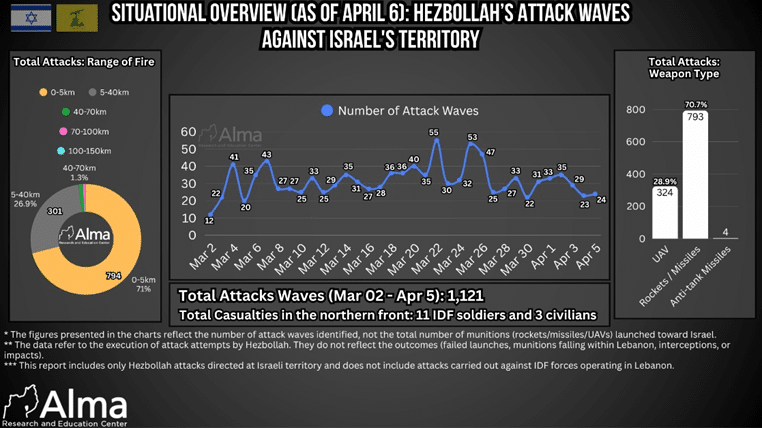
In recent days, a certain decline in the scope of attack waves has been observed, particularly over the past two days.
Yesterday (March 5), a UAV launched by Hezbollah struck a residential home in a community near Acre in the Galilee.
The average number of daily attacks since the beginning of the fighting stands at approximately 31 attack waves per day, a figure indicating sustained intensity of the conflict despite daily fluctuations.
So far, 11 IDF soldiers and 3 civilians have been killed as a result of the fighting in the Lebanese arena.
Hezbollah claimed responsibility (April 5) for launching a sea-to-sea missile at a vessel of the Israeli Navy. No Israeli naval vessel was hit; however, it was reported that a British warship, which was approximately 120 km off the coast of Lebanon, may have been struck and sustained damage as a result of the incident.
In terms of overall scope, since the beginning of the fighting on March 2, 1,121 waves of attacks by Hezbollah toward Israeli territory have been identified.
Regarding types of weaponry, there is a clear dominance of rocket and missile fire (approximately 70.7%), alongside significant use of UAVs (approximately 28.9%), and relatively limited use of anti-tank missiles.
Geographically, the majority of attacks continue to focus on northern Israel, particularly on communities along the border:
794 attacks (approximately 71%) were directed at ranges of up to 5 km from the border.
301 attacks (approximately 26.9%) were carried out at ranges of 5–40 km, up to the Haifa area.
A very small proportion of attacks reached longer ranges.
Lebanon and Hezbollah
Lebanese Minister of Justice Adel Nassar stated in an interview with Al Jazeera that when Lebanon chooses to confront Israel in the military arena, the gap in capabilities, given Israel’s military strength and the international support it receives, creates a clear imbalance. According to him, Hezbollah itself has acknowledged that it is unable to create a military balance with Israel. Nassar emphasized that based on this reality, the correct way to defend Lebanon is not military, but through diplomatic negotiations conducted by the Lebanese state.
Lebanese Hezbollah-affiliated Member of Parliament Ali Fayyad stated in a television interview that the organization demands an Israeli withdrawal from the areas it has occupied, a cessation of strikes, and the return of border residents to their homes. At the same time, he noted that Hezbollah does not reject a diplomatic track in principle, but opposes a policy of concessions without compensation, which in his view has undermined Lebanon’s bargaining leverage.
Deputy Chairman of the Higher Shiite Islamic Council, Ali al-Khatib, expressed opposition to political steps vis-à-vis Israel and presented Hezbollah’s activity as an achievement, claiming that civilian casualties reflect Israeli military weakness.
France emphasized to Israel the need to protect UNIFIL forces and prevent broader escalation, and called for a ceasefire and the opening of a diplomatic track.
Israel, for its part, denied any intention to harm UNIFIL and clarified that its actions stem from the lack of enforcement by the Lebanese state against Hezbollah.
Over the past day, extensive IDF strikes were recorded in southern Lebanon, the Beqaa Valley, and Beirut. As part of these strikes, headquarters and fuel stations belonging to the “Al-Amana” company were targeted. According to the IDF Spokesperson, more than 15 of the company’s fuel stations have been struck since the beginning of the campaign.
The al-Qasmiya Bridge (between Tyre and Sidon) was struck again and completely disabled.
In addition, an Israeli Navy vessel struck a residential apartment in Ain Saadeh, east of Beirut. The target of the strike was an operative from the Palestine Corps of the Iranian Quds Force, but the elimination attempt failed.
It should be noted that for some time now, Hezbollah and operatives affiliated with it, including IRGC operatives, have shifted certain activities and presence to locations that are “non-traditional” for the organization, such as Christian and mixed areas. The area where the apartment was struck is a Christian area.
As a result of the strike, a senior figure in the Christian “Lebanese Forces” party, who lived in a nearby apartment, was killed.
The IDF struck yesterday (April 5) the main headquarters of the “Imam Hussein Division” and eliminated the organization’s artillery commander, Kamal Malham, as well as another senior operative—an aide to the division commander Yahya Hussein Meshimsh—and additional operatives.
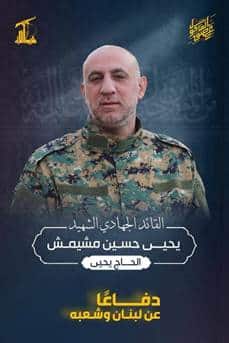
Yahya Hussein Meshimsh
Syria
President of Ukraine Volodymyr Zelensky met with Syrian President al-Sharaa in Damascus. The two pledged to strengthen security cooperation between their countries.