The Iranian Arena
Over the past 24 hours, the IDF carried out extensive waves of strikes in Tehran and Isfahan, targeting key infrastructure of the Iranian regime. As part of the strikes in Tehran, two production sites for naval cruise missiles were destroyed, while in Isfahan, the offices of the Iranian Ministry of Defense’s optics company, responsible for manufacturing optical equipment for the military industry, were targeted.
One of Iran’s main explosives production facilities, used for the development and production of explosives for a variety of weapons systems, was also targeted.
The center for research and development of underwater military systems, responsible for the planning and development of submarines and auxiliary systems for the Iranian navy, was targeted as well.
Ballistic missile launch sites, weapons production facilities, and defense systems of the Iranian regime were also targeted.
According to reports in Iran, an area within the Bushehr nuclear facility complex was struck.
Strikes were carried out at sites linked to activity in the Alborz industrial zone, and additional strikes targeted Iranian assets in the cities of Yazd, Bandar Abbas, Karaj, and Shiraz.
Iran Targets Across the Middle East
Iran continues to strike targets across the Middle East:
The Ministries of Defense of Bahrain and the United Arab Emirates reported that in an Iranian attack carried out yesterday (March 24) in Bahrain, a member of the UAE security forces was killed and several additional security personnel were injured.
Saudi Arabia – the Ministry of Defense reported that two UAVs were intercepted over Riyadh and the country’s Eastern Province.
Iraq
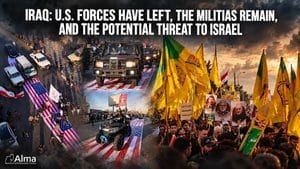
Pro-Iranian militias published footage showing UAV strikes on a radar position and a U.S. Army Black Hawk helicopter at Victoria Base near Baghdad.
Additionally, it was claimed that the U.S. consulate in Erbil, in the Kurdistan Region of Iraq, was also attacked.
Since the beginning of the campaign, pro-Iranian militias have been operating not only in Iraq but have carried out attacks across the Middle East, including in Kuwait, Saudi Arabia, Jordan, and Syria.
At the same time, U.S. A-10 aircraft struck targets belonging to al-Hashd al-Shaabi in Anbar Province this morning, with reports indicating at least seven fatalities and ten wounded.
According to Iraqi media reports, the National Security Council in Baghdad, headed by Prime Minister Mohammed al-Sudani, granted al-Hashd al-Shaabi a green light to respond to the American strikes under a framework of “self-defense.” The Prime Minister also ordered the summoning of the chargé d’affaires at the U.S. Embassy in Baghdad to protest the American strikes against al-Hashd al-Shaabi, as it is considered a body “subordinate to the Iraqi army.”
The Israeli Arena
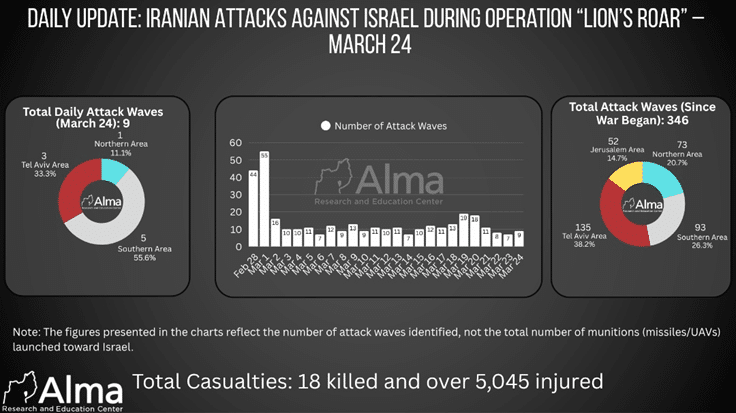
On March 24, nine waves of Iranian attacks against Israel were identified, carried out using ballistic missiles. This reflects a moderate increase compared to the previous day, while maintaining a consistent pattern of activity within Iran’s strategy of sustained pressure.
Geographically, the attacks were distributed across several regions: five waves (55.6%) targeted southern Israel, three waves (33.3%) targeted the Tel Aviv area, and one wave (11.1%) targeted the north. These figures continue to indicate a focus on the south, alongside sustained complementary targeting of the center.
As part of the attacks, impacts were recorded in civilian areas. Residential buildings were hit in the city of Nesher in the north, as well as in central Israel in Tel Aviv, Petah Tikva, and Bnei Brak, where approximately ten people were injured, including an infant. These incidents highlight the direct impact on the civilian home front and the ongoing risk to the population.
Since the beginning of the campaign, a total of 346 Iranian attack waves against Israel have been identified. In cumulative distribution, the central region—particularly the Tel Aviv metropolitan area—remains the primary target, alongside expanded activity in the south and north.
Since the start of the war, 18 civilians in Israel have been killed, and more than 5,045 people have been injured to varying degrees as a result of direct strikes, falling interceptor debris, and secondary damage. In addition, thousands of civilians have been evacuated from their homes due to missile impacts, and the ongoing fire continues to disrupt daily life.
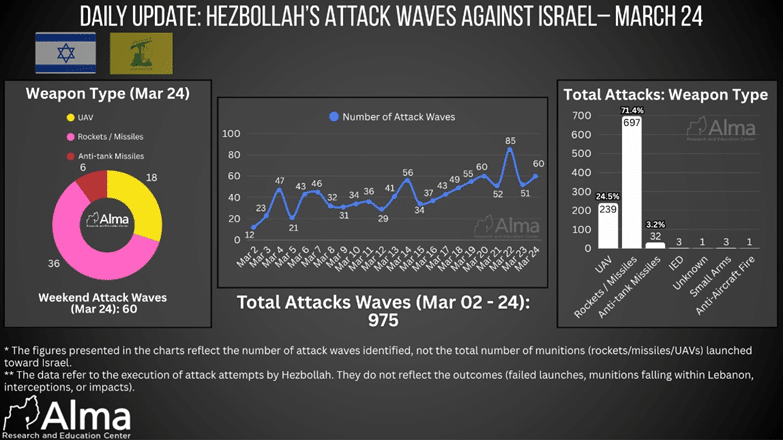
On March 24, 60 Hezbollah attack waves against Israel were identified, indicating continued intense and sustained activity, while maintaining high levels of attacks in recent days. In one of the rocket barrages fired by Hezbollah toward communities in the Galilee, a civilian woman was killed.
In terms of weapon types, most of the attacks were carried out using rockets and missiles (36 waves – 60%), alongside 18 attack waves (30%) using UAVs and 6 attack waves (10%) using anti-tank missiles. It should be noted that all anti-tank attacks are based on Hezbollah’s claims of responsibility and were directed against IDF forces operating in Lebanon against the organization.
Geographically, most of the attacks were directed at northern Israel, with a broad range of firing distances:
• 25 attacks (approximately 41.7%) targeted communities along the border line (0–5 km from the border).
• 2 attacks (approximately 3.3%) targeted the 5–10 km range – the Ma’alot-Tarshiha area.
• 2 attacks (approximately 3.3%) targeted the 10–20 km range – the areas of the cities of Karmiel and Katzrin.
• 1 attack wave (approximately 1.7%) targeted the 20–30 km range – toward the Krayot area, including at least approximately 15 rockets.
It also emerges that 30 attack waves (approximately 50%) were carried out within Lebanon against IDF forces operating against Hezbollah, for which the organization claimed responsibility. These attacks were carried out through a combination of anti-tank fire, indirect fire, and loitering UAVs.
Since Hezbollah joined the fighting on March 2, a total of 975 attack waves against Israel have been identified. Trend analysis indicates continued intensive offensive activity, combining large-scale fire toward the civilian home front with declared attacks against IDF forces in the Lebanese arena.
Lebanon and Hezbollah
Hezbollah-affiliated Member of Parliament Hassan Fadlallah outlined the organization’s demands, which include an Israeli withdrawal, a halt to attacks, the return of prisoners, the return of residents to their villages, and their reconstruction. According to him, Lebanon faces a real opportunity to restore its sovereignty and protect its citizens through its “power,” foremost among them Hezbollah’s military wing.
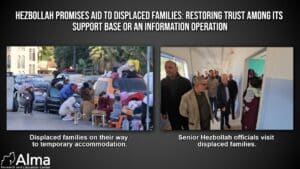
Economy Minister Amer Al-Bisat stated that Lebanon currently has over 1.1 million displaced persons, constituting about one-fifth of the population, of whom more than 120,000 are staying in official reception centers.
The issue of expelling the Iranian ambassador continues to generate internal controversy. Al-Bisat emphasized that this is a sovereign move aimed at restoring state control over all its domains, including a monopoly over security decision-making and the possession of weapons. However, he clarified that this does not constitute a severance of relations with Iran, but rather a desire to maintain “normal” relations.
In contrast, political figures affiliated with Hezbollah, led by Speaker of Parliament Nabih Berri, are working to reverse the decision to expel the Iranian ambassador. Hezbollah itself strongly criticized the move, describing it as illegal and a capitulation to external pressures, and warned of its implications for internal unity in Lebanon.
A report in the newspaper “Asharq Al-Awsat” stated that four Hezbollah operatives were investigated by Lebanon’s military court on charges of possessing rockets and military weapons. Two of them were arrested in the village of Kafr Houna after being caught transporting 21 rockets from the Bekaa to southern Lebanon, admitted to their actions, and arrest warrants were issued against them, while the weapons were confiscated by the Lebanese army. At the same time, two additional operatives were arrested—one after being caught with 6 machine guns and 4 pistols, and another whose arrest had been ordered earlier—as part of further investigations into weapons transfers.
The IDF continues its strikes in southern Lebanon and Beirut. Among other targets, infrastructure linked to Hezbollah was struck, including continued strikes on fuel stations belonging to the Hezbollah-affiliated Al-Amana company in the villages of Khirbet Selm and Al-Duweir in Nabatieh Governorate in southern Lebanon.
The International Arena
French President Emmanuel Macron, in his conversation with the President of Israel, emphasized the need to prevent escalation in Lebanon and to preserve its stability and sovereignty. Macron stated that Hezbollah made a serious mistake in attacking Israel, and stressed the importance of de-escalation, strengthening the Lebanese government, and protecting the civilian population. He also expressed support for renewing direct talks between Israel and Lebanon.
At the same time, it was reported that Egypt is working to advance mediation efforts in the Lebanese arena, including initiating political contacts and sending a delegation to Beirut.
German President Frank-Walter Steinmeier described the war as a blatant violation of international law and a serious political mistake, emphasizing that it is an unnecessary war that could have been avoided, particularly if the goal was to halt Iran’s path toward nuclear weapons.
Turkish President Recep Tayyip Erdoğan also voiced sharp criticism, stating that although this is Israel’s war, the entire world is paying the price. According to him, the move is driven by the domestic political considerations of Israeli Prime Minister Benjamin Netanyahu, while its consequences affect billions of people. Erdoğan called for an immediate halt to the fighting and stressed that the international community must take a bold and active stance, while preventing harm to diplomatic solutions.
Bloomberg reported that Iran has halted gas flows to Turkey following the Israeli strike on gas facilities in the South Pars field.
Spanish Prime Minister Pedro Sánchez also expressed strong criticism of the operation, questioned its achievements, and warned that silence in the face of an unjust war is not caution but cowardice. He stated that Iran has been preparing for such a confrontation for decades, and that the current situation is even more severe than the Iraqi scenario.
According to a report in The New York Times, Saudi Crown Prince Mohammed bin Salman is pressuring the President of the United States to continue the strikes in Iran, viewing this as a strategic opportunity to reshape the region.
Chinese Foreign Minister Wang Yi spoke with his Iranian counterpart Abbas Araghchi and expressed hope that all parties would seize the opportunity and advance a peace process as soon as possible.