

The Iranian Arena
Brad Cooper, Commander of the U.S. Central Command, announced that B-2 bombers carried out strikes in Iran overnight. According to him, the United States is moving to the next phase—dismantling Iran’s defense industries. Cooper also stated that the U.S. has destroyed more than 30 Iranian vessels, including the drone carrier Shahid Bagheri.
Over the past 24 hours, the IDF struck approximately 200 targets in western and central Iran (with reported strikes in Tehran, Kermanshah, Qom, Karaj, Tabriz, Bushehr, and Isfahan). Among the targets destroyed were ballistic missile launchers, aircraft, air defense systems, and Islamic Revolutionary Guard Corps command centers.
In Tehran, the underground bunker of the Supreme Leader was attacked. Approximately 50 fighter jets dropped more than 100 munitions until the complex was destroyed. Israeli assessments indicate that senior officials of the Iranian regime were inside the bunker.
In addition, the IRGC’s “Miqdad” base in Tehran and the Imam Ali Officers’ Academy were attacked.
Satellite images revealed damage to the defense industries facility in Parchin, where warheads, engines, and various systems for missile and munitions arrays are produced and stored. The site also includes facilities for repair and maintenance.
Iran Attacks Targets in the Middle East
Over the past 24 hours, Iran and Iranian-backed organizations continued offensive operations across several regional arenas, using missiles and UAVs.
Bahrain: An attack on oil refineries; a hotel was hit during an Iranian strike overnight.
United Arab Emirates: An attack on the Ben Zayed Airport in Abu Dhabi. A building in Sharjah was struck by an Iranian UAV.
Iraq:
The Islamic Resistance in Iraq, an Iranian proxy, has been carrying out attacks since the beginning of the war against targets in Iraq and other countries. Over the past 24 hours, the group claimed responsibility for a UAV attack targeting a site in Duhok.
The Israeli Arena
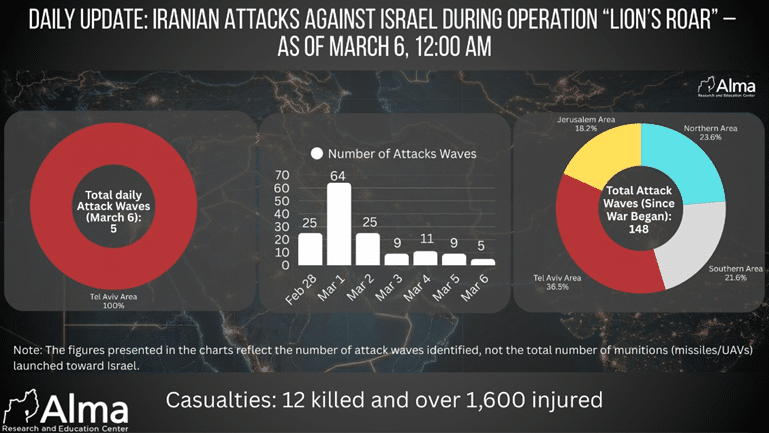
Since yesterday (as of 12:00, March 6), five Iranian attack waves have been launched toward Israel, including ballistic missiles, missiles with multiple warheads, and UAVs. All of the attacks were directed toward the Tel Aviv area, where a population concentration of approximately four million Israelis resides.
Since the beginning of the war, 12 civilians in Israel have been killed and more than 1,600 have been injured to varying degrees. In the past 24 hours alone, about 140 civilians were injured. More than 3,000 residents have been forced to leave their homes due to missile impacts and interception debris. The main cities where impacts were recorded are Tel Aviv, Bnei Brak, Ramat Gan, Petah Tikva, Beit Shemesh, and Be’er Sheva.
On the first day of the war (February 28), there were 25 attack waves; on the second day (March 1), which has so far been the most intense, there were 64 attack waves; on the third day (March 2), there were 25 attack waves from Iran; on the fourth day (March 3), 9 attack waves; on the fifth day (March 4), 11 attack waves; on the sixth day (March 5), 9 attack waves; and on the seventh day (March 6, as of 12:00), 5 attack waves.
Since the beginning of the war, a total of 148 attack waves have been launched from Iran against Israel.
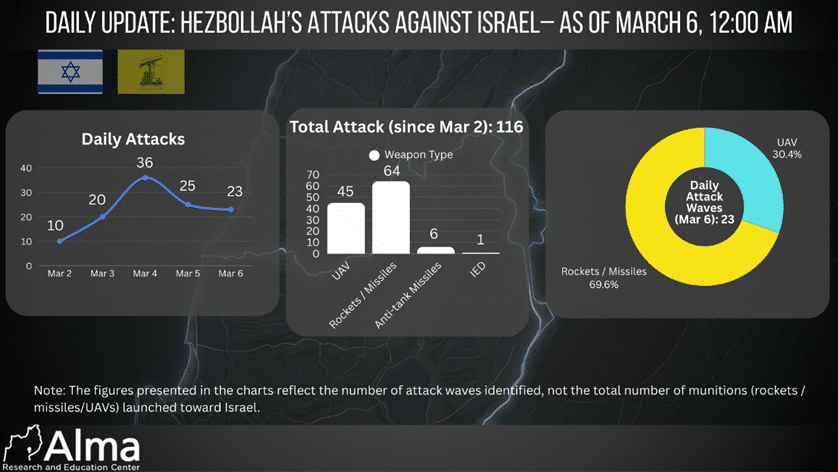
Since the beginning of its involvement, Hezbollah has carried out a total of 116 attack waves against Israeli territory and IDF forces operating in Lebanon, including rocket launches, missiles, UAVs, anti-tank missiles, and an explosive device attack (based on Hezbollah’s claims of responsibility).
Over the past 24 hours, Hezbollah conducted 23 attacks against Israel using rockets (16 incidents) and UAVs (7 incidents), targeting northern Israel—the border communities, the Galilee, the Golan, and the Haifa area. The primary weapons used by Hezbollah for attacks against Israeli territory are rockets and missiles.
As a result of Hezbollah’s attacks over the past 24 hours, property damage was reported to vehicles and businesses in the city of Tiberias were damaged.
On the first day of Hezbollah’s involvement (March 2), 10 attack waves were recorded. On the second day, 20 attack waves were recorded; on the third day, which has so far been the most intense, there were 36 attack waves; on the fourth day, 25; and on the fifth day, 23. Most of the attacks (64 incidents) were carried out using rockets and missiles.
Over the past 24 hours, 10 IDF soldiers were injured to varying degrees by Hezbollah anti-tank fire and indirect fire.
Lebanon and Hezbollah
The Lebanese government is hardening its stance against Iranian involvement in the country and has passed decisions aimed at reducing and potentially halting the activities of Iranian Revolutionary Guard personnel on Lebanese soil. During a cabinet meeting, Prime Minister Nawaf Salam stated that he rejects accusations that the government is acting according to Israeli demands, calling such claims irresponsible and divisive. The government decided to instruct all security and military bodies to act against any security or military activity carried out by members of the Iranian Revolutionary Guard Corps in Lebanon.
The decision includes identifying and locating IRGC personnel in the country, preventing any of their security or military activities, arresting them under judicial supervision, and preparing for their deportation from Lebanese territory. The decision was passed despite opposition from several ministers.
The Lebanese state is taking enforcement measures against the transfer of weapons and military activity outside the framework of the state. Security sources reported increased enforcement activity against the transfer of weapons between different areas in Lebanon. So far, 23 individuals have been arrested—some identified as Hezbollah operatives and others as civilians—who were carrying weapons and military equipment while moving between areas of the country.
According to reports so far, weapons were confiscated and those carrying them were arrested. It was reported that the arrests are being carried out regardless of political affiliation. During one operation, a Kornet anti-tank missile was also seized. In addition, a video circulated showing the Lebanese army transporting a rocket launcher that was found in the village of Qlayleh, north of the Litani River.
It was reported that dozens of IRGC operatives left Beirut in the past 48 hours out of fear of a strike. Most of the operatives belonged to the Quds Force and operated as military advisors to Hezbollah. A small group of IRGC officers has remained in Lebanon to maintain a presence and serve as a liaison with Hezbollah.
More than 400,000 residents have evacuated from southern Lebanon, along with tens of thousands more from the Dahieh area.
The leader of the Druze community in Lebanon, Walid Jumblatt, warned: “This is a very serious crisis. The residents of southern Lebanon, the Dahieh, and the entire country are paying the price for decisions that are not Lebanese at all. These are decisions that came from outside—from Iran. And what can these people do? Nothing. Only to enter once again into a path of suffering, oppression, and bloodshed.”
Lebanese journalist Rami Naim, from the anti-Hezbollah camp, said that “Naim Qassem is a criminal against his own Shiite community, and Israel is more merciful than he is. The Israeli warns before he strikes, while Qassem left his community asleep, children and women, and endangered their lives.”
Lebanese Member of Parliament Mark Daou argued that “a threat to all of Dahieh means the objective is the elimination of Hezbollah, and there are no limits to the aggression. The Shiites must decide whether Iran and Hezbollah are worth all these sacrifices.”
Alongside the military and political developments, there has been a sharp increase on social media and in public discourse in Lebanon in criticism of Hezbollah and its leadership. In recent days, many videos have circulated of Lebanese citizens expressing anger toward Hezbollah. Statements circulating online claim that the organization dragged Lebanon into a war that is not its own, as part of a regional struggle linked to Iran. Many speakers direct criticism at Hezbollah Secretary-General Naim Qassem, accusing him of acting according to Iran’s interests rather than Lebanon’s. Some have even called him “an Iranian collaborator,” arguing that his decisions have led to destruction and severe harm to Lebanese civilians. Many citizens express feelings of humiliation and lack of dignity, claiming they are forced to sleep in the streets and become displaced within their own country due to decisions made by Hezbollah. According to the public discourse, the current situation is widely perceived as proof that Lebanon is paying the price for the confrontation between Israel and Iran.
The IDF completed this morning its 26th wave of strikes in Beirut, attacking dozens of targets, including high-rise buildings, a UAV warehouse, and a Radwan Force headquarters. Since the beginning of the campaign in the north, the IDF has struck more than 500 targets.
Strikes were also carried out in the Nabatieh area, in Sidon, and in the Beqaa Valley.
On March 4, Zaid Ali Jomaa—responsible for managing Hezbollah’s firepower and in charge of artillery in southern Lebanon—was eliminated.
Syria
Alongside the fighting in the south, concerns have also risen in Lebanon regarding troop movements on the Syrian side of the border. The Lebanese government received clarifications from Syria stating that the troop deployment along the border is not directed against Lebanon. According to the Syrian statement, these measures are intended to strengthen border control and prevent smuggling. The Lebanese army announced that it has reinforced its deployment along the eastern border in coordination with the Syrian authorities.
The International Arena
According to a report in The Wall Street Journal, the United Arab Emirates is considering a series of measures against Iran, including freezing Iranian assets held by front companies worth billions of dollars and conducting raids on money changers. The more direct option of seizing Iranian ships is also being considered. At this stage, no decision has yet been made.
Saudi Arabia, Kuwait, and Bahrain expressed frustration with the United States due to a lack of coordination and insufficient protection following the Iranian missile and UAV attacks.
Turkey condemned the UAV strikes on Azerbaijan, stating: “Turkey will continue, as always, to stand by Azerbaijan.”
Reports indicate that Azerbaijan has halted the movement of vehicles and transportation between itself and Iran. Azerbaijan’s foreign minister instructed the return of Azerbaijani diplomats from the embassy in Tehran and announced that the embassy will be closed. It was also reported that Azerbaijan is moving military equipment and assets to the border with Iran.
Kremlin spokesperson Dmitry Peskov stated that the war between the United States, Israel, and Iran in the Middle East “is not our war.”
In the United Kingdom, Prime Minister Keir Starmer stated that Britain did not participate in the initial strikes against Iran, but has reinforced its forces in the region to protect British bases and citizens. The UK has deployed additional fighter jets, warships, and air defense systems to the Middle East. At the same time, Starmer emphasized the need for de-escalation and a diplomatic solution.
Germany’s foreign minister emphasized that Europe will not allow internal disagreements to undermine unity.
European countries (including France, Italy, and the Netherlands) announced the deployment of forces to protect Cyprus and the surrounding region.
Note: The next daily report will be published on Sunday, March 8.




2 Responses
Where is our King David and our G-d at this time of needed helping 😢 😢 hospital 🏥 for our family?
The situation in the Middle East is extremely tense 😟🔥. Both sides are launching heavy attacks, with civilians caught in the crossfire 💔💣. Hoping for a peaceful resolution soon before more lives are lost 🕊️🙏.