
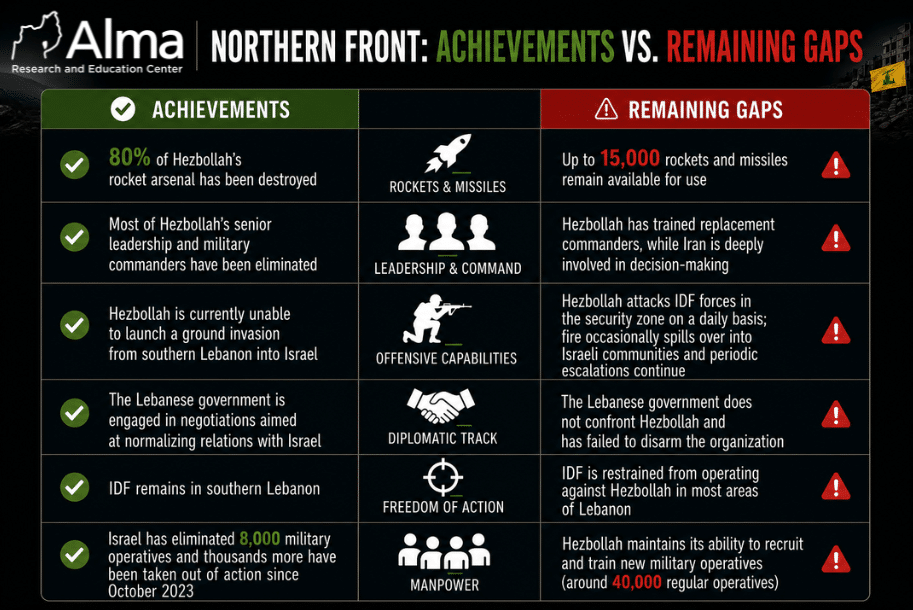
The war between Israel and Hezbollah in northern Israel produced significant achievements that severely degraded the organization’s military capabilities. However, alongside these successes, substantial gaps and challenges remain, continuing to shape the security reality along the northern border.
One of the most notable achievements was the damage inflicted on Hezbollah’s firepower array. According to assessments, approximately 80% of the organization’s rocket arsenal was destroyed during the fighting. This represents an unprecedented blow to a military capability that had been built up over many years. Nevertheless, the threat has not been eliminated entirely. Hezbollah is still estimated to possess up to 15,000 rockets and missiles, which could pose a significant threat to Israel’s civilian rear in the event of renewed escalation.
Significant success was also achieved in the area of command and control. Most of Hezbollah’s senior leadership and top commanders were eliminated during the war. However, the organization has succeeded in training replacements for some of the commanders it lost. At the same time, Iran is now deeply involved in Hezbollah’s decision-making processes and in directing its activities, enabling the organization to maintain operational continuity despite the damage it has sustained.
In terms of offensive capabilities, Hezbollah has largely lost its ability to carry out a ground invasion of Israel from southern Lebanon—an objective the organization had pursued for years. Nevertheless, it continues to attack IDF forces in southern Lebanon on a daily basis, while sporadic rocket fire toward Israeli communities and periodic escalations continue to occur even during the ceasefire period.
On the political level, some progress has been made, as the Lebanese government is engaged in contacts and discussions aimed at advancing a process of normalization in relations with Israel. However, the Lebanese government continues to avoid a direct confrontation with Hezbollah and has so far failed to disarm the organization or significantly reduce its political and military power.
The issue of freedom of action also remains complex. On the one hand, the IDF continues to maintain forces in southern Lebanon and to operate in defense of the border. On the other hand, Israel’s freedom of action against Hezbollah across most areas of Lebanon is limited and constrained by the understandings and arrangements established following the war. This limitation allows Hezbollah to preserve operational hubs and infrastructure in areas where Israel faces difficulties operating freely.
Another area in which the picture remains mixed is Hezbollah’s force build-up. The smuggling of weapons through Syria has become more difficult, but it has not ceased. The organization continues to acquire weapons through alternative smuggling routes while simultaneously maintaining independent production capabilities on Lebanese soil. In addition, since October 2023, Israel has eliminated approximately 8,000 Hezbollah military operatives and rendered thousands more unfit for service. Nevertheless, the organization retains the ability to recruit, train, and integrate new operatives into its ranks, and currently maintains approximately 40,000 regular military personnel.
In conclusion, the war dramatically altered the balance of power in the north and dealt a severe blow to Hezbollah, but it did not defeat the organization. Hezbollah lost a significant portion of its capabilities, yet it still retains considerable military strength, continues to rebuild its power, and is adapting to the new reality. Therefore, despite the impressive achievements, Israel still faces an ongoing challenge that requires continuous monitoring, preparedness, and the maintenance of long-term readiness.
The central question now is how to preserve these achievements and gradually close the remaining gaps. This will be far more difficult under the current circumstances, in which the IDF’s freedom of action is severely restricted and Hezbollah’s reconstruction efforts will increasingly threaten not only Israeli communities, but first and foremost the very presence of the IDF in Lebanon.
If substantial funds begin flowing once again to the Ayatollah regime in Iran, rather than leading to the regime’s downfall, it will be strengthened—and so will Hezbollah in Lebanon. Such a development would inevitably weaken the Lebanese government and render negotiations toward peace futile. The decision regarding where this trajectory leads will not be made in Beirut or Jerusalem, but in Washington, which now faces a critical test in confronting Tehran’s uncompromising position and its continued involvement in Lebanon.



One Response
Dear Sarit,
You are correct that hezbollah is not yet entirely gone. But they are only a shadow of their October 8 threat. They were never a real military. Just jihaddist rats and snakes hiding in their underground rat holes and snake dens under civilian populations. Puffing up their venomous heads to create fear, and consuming their fellow rats to promote lies and create propaganda to decieve the world.
Their lies are being exposed, and their cowardice is revealed, in spite of all their lying propaganda. The Light of Truth has exposed their evil hypocrisy and moral bankruptcy. Soon the stench of dead rats and snakes will dissipate, and life will return in peace.