Executive Summary
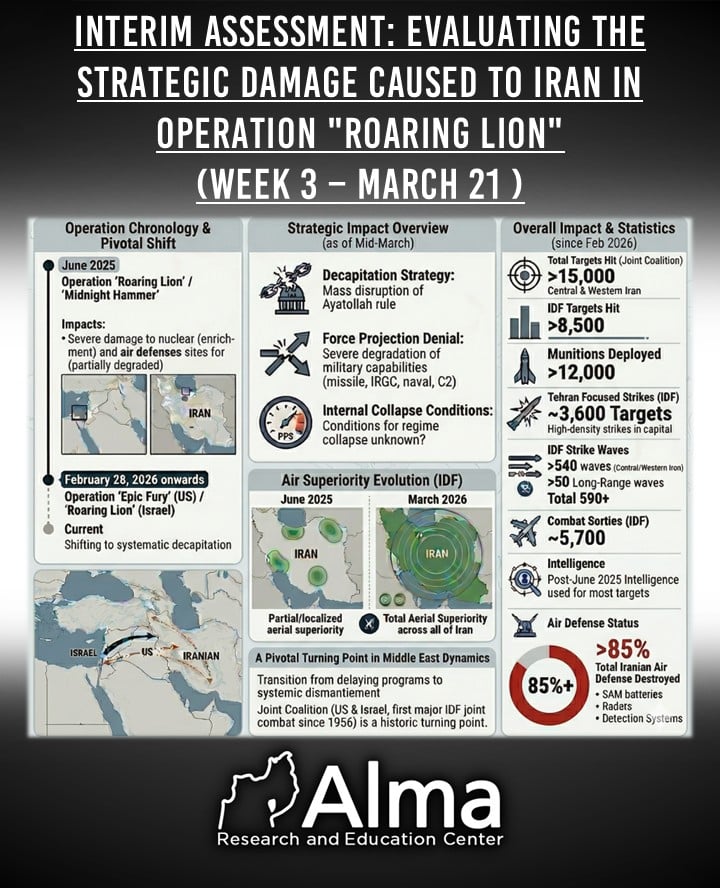
At the time of writing these lines (March 21, 2026), an initial assessment of the strategic and systemic damage inflicted on the Iranian regime as a result of Operation “Roaring Lion” (known in the US Central Command as “Epic Fury”), as of the end of the third week of the campaign, indicates a significant blow to all core capabilities of the Islamic Republic.
The joint operation by the United States and Israel constitutes the most significant turning point in the Middle East in recent decades, marking a shift to a strategy of decapitation and systematic dismantling of Iran’s core military capabilities.
Nine months earlier, in June 2025, the “12-Day War” (Operation “Rising Lion” / “Midnight Hammer”) concluded, dealing a severe blow to Iran’s nuclear infrastructure (primarily uranium enrichment sites) and air defense arrays. (For an assessment report on the damages Operation Rising Lion caused to the Iranian nuclear program and other regime capabilities, click here).
However, the current campaign is characterized by unprecedented scope and intensity, aimed not merely at delaying military programs, but at the functional collapse of the Ayatollah regime, denying its power projection capabilities, and creating the conditions for its internal collapse. While some of the damage caused to the regime’s capabilities can already be measured today, it is impossible to know whether the conditions for the fall of the regime have been created at this time.
The Israeli-American coalition forces (this marks the first time since 1956 that the IDF has fought as part of a military coalition) have struck over 15,000 targets across Iran so far, in a series of strike waves that began on February 28, 2026, with the IDF alone striking approximately 8,500 targets to date, with a focus on central and western Iran but spreading to other regions as well.
According to military sources in Israel, over 12,000 munitions have been utilized by Israel in the campaign so far, and about 3,600 of them were used in Tehran alone. The IDF conducted over 540 strike waves in central and western Iran, and about 50 longer-range strike waves. A total of 5,700 combat sorties were executed. Most of the targets were based on intelligence efforts that occurred after the First Iran War in June 2025.
While in June 2025 the IDF achieved air superiority in three regions in Iran, in the current war the IDF has achieved air superiority across all of Iran (approximately 85% of Iranian air defense components have been destroyed, including systems of all types, radars, and additional detection means). Findings emerging from this report regarding the damage absorbed by the Iranian regime so far:
- The Missile Program – Highly significant damage to launching, storage, and production capabilities.
- Leadership – Systematic elimination of the political and military leaders of the Iranian regime, and the continued elimination of their replacements.
- The Nuclear Program – Surgical strikes on several nuclear program sites after the majority of the program was destroyed in Operation “Rising Lion” in June 2025.
- The Basij and Internal Security Mechanisms – Decapitation of the top leadership, mass damage to bases and alternative bases, and attacks on field presence.
- Energy – A significant strike on a gas production site in southern Iran responsible for electricity generation for the domestic grid. Impairment of the functional continuity of the military array and potential for spurring civil unrest later on.
The Missile Program
Iran’s ballistic missile program has served for decades as the backbone of the Islamic Republic’s national security concept, and its central means of deterrence and extortion against regional countries and the West.
Under the shadow of the Iranian ballistic arsenal, which was the largest and most diverse of its kind in the world, Tehran built a network of terror armies to encircle Israel and project its aspiration to export the Islamic Revolution to the entire Middle East, and beyond.
An analysis of the findings from the third week of Operation “Roaring Lion” reveals that this program sustained an extremely severe blow, likely intended to strip Tehran of its future capability to manage a long-term military campaign via standoff fire. The scope of the targeted strikes on production, storage, and launching infrastructure indicates a clear intention by the United States and Israel to deny Iran a strategic missile strike capability for the foreseeable future.
On the eve of the outbreak of the “12-Day War” in June 2025, the Iranian ballistic missile arsenal was estimated to stand at approximately 3,000 missiles. Following that campaign, the inventory was reduced to about 1,500 missiles, but Iran began an accelerated rehabilitation effort with a strategic goal of reaching 8,000 missiles by 2027, according to intelligence assessments in Israel.
This arsenal poses an existential threat in its own right due to its ability to saturate Israeli defense systems merely by exploiting quantitative advantage, had Iran continued its mass industrial production of missiles and launchers.
Since many of the missiles are equipped with warheads containing about a ton of explosives, a threat of this magnitude to a small country like Israel is very clear. Furthermore, Iran was deep into research and development processes for the future production of intercontinental ballistic missiles (ICBMs), carrying a potential threat to the European continent and the United States, all under the guise of a space program.
On the eve of Operation “Roaring Lion” in February 2026, Iran managed to rebuild its inventory to about 2,500 missiles, amid an ever-increasing production rate. These figures clarify the operational urgency of the Israeli-American coalition forces to paralyze the production and supply chains before Iran could reach a threshold of irreversible capability. According to data from the Israeli Air Force and the IDF Spokesperson, since the start of the current campaign, over 4,700 dedicated strikes have been carried out against the Iranian missile program alone. As of mid-March 2026, coalition forces have destroyed over 700 ballistic missiles in their storage facilities prior to launch, and eliminated about 70 percent of Iran’s missile launcher array, with the total number of launchers hit standing at least 300 and likely more.
| Topic | Critical Data and Details |
| Ballistic Missile Inventory | • Eve of the “12-Day War” (June 2025): approx. 3,000 missiles. • After the 2025 War: approx. 1,500 missiles (with a rehabilitation goal of 8,000 by 2027). • Eve of Operation “Roaring Lion” (February 2026): approx. 2,500 missiles. |
| Achievements of Operation “Roaring Lion” | • Over 4,700 targeted strikes were carried out against the missile program. • Destruction of approx. 1,500 missiles in production processes and over 700 missiles in storage facilities. • Elimination of about 70% of the launcher array (at least 300 launchers destroyed). • A 90% reduction in Iran’s missile launch capability. |
| Destroyed Strategic Hubs | • Underground production and storage facilities: Shiraz, Tabriz, Ahvaz, Karaj, Isfahan, Bushehr, and Kermanshah. • Precision missile production sites: Parchin and Shahrud. • Intercontinental Ballistic Missile (ICBM) development: The Iranian Space Research Center (ISRC) in Tehran. |
| Tactical and Operational Changes | • Rate of Fire: A plunge from tens of missiles a day to single launches in each barrage (to less than 20 a day) and a transition to an “economy of munitions.” • Cluster Munitions: About 50% of the missiles in the third week of the operation carried cluster bombs, aiming to bypass air defenses and hit civilians (Holon, Ramat Gan, Eilat, Arava). |
| Regional Implications | • A massive blow to Iran’s deterrence capability in the Middle East. • Strikes in the Gulf: Missiles and UAVs directed at American bases and economic facilities in Kuwait, Saudi Arabia, Qatar, and the UAE in an attempt to force a ceasefire. |
US Secretary of Defense Pete Hegseth stated that Iran’s ballistic missile launch capability was reduced by 90 percent. The direct result of this infrastructural damage is reflected in a drastic decline in the volume of Iranian fire. While during the first two days of the campaign Iran launched dozens of missiles a day, this rate dropped to barrages of single-digit missiles on the remaining days of the war, even as the Iranians attempted to maintain a high rate of fire throughout the campaign.
According to monitoring data from the Alma Center, an examination of the daily trend points to relative stability in the pace of attacks since March 2, the date when a decrease in the intensity of strike waves occurred relative to the opening phase of the campaign. Since then, a consistent pace of activity has been maintained, hovering around an average of about 10 strike waves a day (the volume of fire ranges from a few missiles up to about 20 missiles per day).
Additionally, it must be considered that in the early days of the campaign, Iran burned through a significant portion of its remaining operational arsenal, and following the severe blow it sustained, also decided to transition to a state of ‘munitions economy.’
The damage to production and development infrastructure focused on strategic hubs across the country. The Israeli and American Air Forces (the IAF completing hundreds of strike sorties almost every day), destroyed underground production and storage facilities in central areas such as Shiraz, Tabriz, Ahvaz, Karaj, Isfahan, Bushehr, and Kermanshah, according to various reports.
Among the critical targets destroyed were key missile production sites in Parchin and Shahrud, which formed the core of the Islamic Republic’s precision rocket production array, as well as the industrial complex where critical components were manufactured.
According to IDF data, roughly 1,500 missiles that were in the production process were completely destroyed. Beyond traditional missile production, the Israeli Air Force destroyed the Iranian Space Research Center (ISRC) in Tehran. This center not only functioned ostensibly as a civilian space agency, but served as a cover and a central platform for the development of advanced propulsion technologies for intercontinental ballistic missiles (ICBMs) and anti-satellite strike capabilities in the upper atmosphere.
Uprooting the space development capability constitutes a blow to the Iranian aspiration to threaten the West at long ranges. Tactically and operationally, it appears Iran attempted to compensate for the damage to its launcher array and its inventory of precise conventional missiles by transitioning to the use of cluster warheads. Iran altered its munitions mix, and about 50 percent of the missiles launched towards Israel in the third week of the campaign carry cluster bomb warheads (cluster munitions).
This tactical shift is no coincidence; it indicates operational desperation and a frustrated attempt to bypass Israeli air defense systems, since no interception system can guarantee a hermetic seal against swarms of cluster bombs scattering at high altitudes (though it can better learn how to intercept such a missile before the cluster deployment phase).
This deliberate use of cluster weapons was distinctly aimed at harming civilian population centers and economic hubs, leading to direct hits and casualties in dense urban areas in Israel, such as the cities of Holon, Ramat Gan, Eilat, and communities in the Arava. According to Alma Center data, the central region and mainly the Tel Aviv metropolis continues to be the primary attack target, with 111 strike waves (39.5%).
Should the Iranian missile program remain damaged and not be rebuilt, and should the regime survive, Iranian deterrence capability in the Middle East region will be significantly impaired. Without the complete ballistic threat umbrella, Iran will find it difficult to effectively threaten its neighbors, and this may spur an unprecedented consolidation of a Sunni-Arab coalition against it. Iran directed its attacks not only at Israel, but launched numerous missiles and UAVs at economic facilities, civilian areas, and American bases in Kuwait, Saudi Arabia, Qatar, Bahrain, Oman, and the UAE, attempting to hold the global energy economy hostage in order to force a ceasefire on terms favorable to it.
Over the past weekend, Iran launched two missiles toward the Diego Garcia base, a distance of approximately 4,000 kilometers. According to reports, one of the missiles fell short along the way, while the other was intercepted by a U.S. vessel. Beyond this information, no further details are available. However, it is clear that this serves as yet another wake-up call for European countries: what begins in the Middle East does not end in the Middle East…
Leadership of the Islamic Republic
The strategic ‘decapitation’ doctrine implemented by Israel from the first stage of the war generated significant governmental disruption at the top of the Islamic Republic, but it remains unclear how quickly Iran is managing to recover based on appointing replacements. Unlike Operation Rising Lion, the strike on the leadership was not confined to the narrow military echelon or to field commanders in proxy organizations, but was directed directly, intensely, and in a coordinated manner at the highest political-religious echelon, with the declared aim of damaging the hierarchical structure of the decision-making apparatus and creating institutional chaos.
The resounding opening point occurred in the initial hours of Operation “Roaring Lion” on February 28, 2026. At that time, precise intelligence, described as an exceptionally deep intelligence penetration, enabled the simultaneous strike of three central meetings in Tehran. The attack was carried out in broad daylight, above ground, and involved some 200 fighter jets of the Israeli Air Force, in what was described as the largest operational sortie in its history.
This opening blow led to the immediate elimination of the Supreme Leader, Ayatollah Ali Khamenei, along with about 40 of the regime’s top figures and the highest military leadership. The chain of command that was eliminated included IRGC Commander Mohammad Pakpour, Chief of Staff of the Armed Forces Abdolrahim Mousavi, Defense Minister Aziz Nasirzadeh, Secretary of the Defense Council Ali Shamkhani, Head of the Supreme Leader’s Military Office Mohammad Shirazi, and Head of the Intelligence Directorate at the Khatam al-Anbiya Headquarters Saleh Asadi.
This unprecedented elimination, which essentially severed the head of the ruling pyramid, left the regime with no preparation time for an orderly transfer of power and dragged Iran into an immediate crisis. Following Khamenei’s death, the Assembly of Experts convened and appointed his son, Mojtaba Khamenei, as the new Supreme Leader in a flash appointment. However, various reports indicate that Mojtaba himself was injured to an unknown degree of severity in one of the strikes. Although official Iranian sources rushed to release statements in his name calling for “intense blood vengeance,” Western officials and intelligence assessments suggest that the Revolutionary Guards are actually in de facto control of publishing these messages. US President Donald Trump even publicly expressed doubts regarding Mojtaba’s ability to physically survive his injuries.
The blow to the chain of command went on continuously and surgically in the ensuing weeks as well, as highly significant figures who attempted to seize the reins of power or coordinate internal suppression efforts were marked and eliminated. A particularly prominent event is the elimination of Ali Larijani, Secretary of the Supreme National Security Council, who was considered the de-facto leader of the regime following the neutralization of Ali Khamenei, and was designated as the one practically leading the country. Larijani, who also had an American bounty of $10 million on his head, was eliminated in an airstrike by Israeli Air Force jets in the early morning hours, while staying in a safe house in the Pardis area of eastern Tehran.
At that time, according to various reports, Larijani was holding an emergency meeting with senior security establishment officials, in order to plan the suppression of the Fire Festival (Chaharshanbe Suri) protests.
The precise strike on this secret and hidden location underscores the Israeli intelligence penetration within Iran’s leadership; The leadership is forced to hide at all times in their own country during the campaign, as described by IDF officials, and despite this, they are located and destroyed. In addition to Larijani, the Israeli Air Force eliminated the head of the Supreme Leader’s Military Staff, Abolghasem Babaian, who was only recently appointed to head the emergency apparatus – “Khatam al-Anbiya”.
Another psychological blow was recorded when an Israeli strike hit near the head of the judiciary, Gholam-Hossein Mohseni-Eje’i, as he was giving a live television interview at a “Quds Day” rally, an event where the regime used civilians as human shields around the leadership. The campaign also placed special emphasis on neutralizing the Iranian intelligence community and its emergency planning mechanisms.
Intelligence Minister Esmaeil Khatib, who was designated as Mojtaba Khamenei’s strongman, was eliminated in a targeted operation in central Tehran. Concurrently, the intelligence brass of the “Khatam al-Anbiya” emergency headquarters was wiped out, the body responsible for coordinating emergency operations, synchronizing security branches against Israel, and analyzing strategic intelligence.
The replacements for Saleh Asadi, Abdollah Jalali-Nasab and Amir Shariat, who were appointed to their roles in the top intelligence echelon just a few days prior, were also eliminated in a targeted strike by the Israeli Air Force. This consistent decapitation of commanders and their replacements immediately upon taking office prevents functional continuity, incites paranoia, and paralyzes the intelligence analysis capability of the Ayatollah regime.
According to reports, the strikes were carried out alongside the physical destruction of the Intelligence Ministry’s headquarters in Tehran, which was camouflaged inside a building of the Iranian Electric Company and used for managing internal suppression. From a logistical, psychological, and symbolic standpoint, the destruction of the leadership also manifested in the denial of freedom of movement and diplomatic coordination for the top echelon. In a dramatic strike at the Mehrabad International Airport, the Israeli Air Force destroyed the personal plane of the Supreme Leader, an Airbus A340 aircraft. This plane served Khamenei, President Pezeshkian, and other senior officials for military procurement missions and covert coordination with “Axis of Resistance” countries in Syria, Russia, and other arenas.
Another impact of the systemic assassination series is evident, according to several reports, in deepening rifts within the remaining leadership. At least two senior Iranian diplomats – Alireza Sohbati, stationed at the embassy in Copenhagen, Denmark, and Mohammad Pournajaf, stationed at the embassy in Canberra, Australia – have officially defected from their posts and submitted requests for political asylum in their host countries. Within Iran’s borders, a public and unprecedented rift was exposed between Iran’s President, Masoud Pezeshkian, and elements within the Revolutionary Guards. Pezeshkian rushed to apologize to the Arab Gulf states for the impacts of Iranian missiles in their territory, declaring that Iran never intended to attack “friendly countries,” in a desperate bid to prevent them from actively joining the US and Israel. This public apology sparked public outrage from hardliners; conservative Member of Parliament Hamid Rasaee and Parliament Speaker Mohammad Bagher Ghalibaf harshly attacked the President, called his stance “feeble begging diplomacy,” contradicted his words, and clarified that Iran’s aggressive defense strategy would not change, while demanding to take the microphone away from the President. Immediately following the President’s speech, Iranian missiles were launched towards Arab Gulf states.
The Islamic Revolutionary Guard Corps (IRGC)
The most powerful and important military-economic-political organization in the Islamic Republic, the Revolutionary Guards (IRGC), experienced a sequence of tactical and strategic blows. According to recent assessments, the Revolutionary Guards reached the end of the third week of the war without an effective command and control mechanism, without coordination or synchronization between the organization’s components, and often based on local initiatives of field commanders. The operational pressure on the Revolutionary Guards in Operation “Roaring Lion” combines conventional kinetic warfare, destruction of physical infrastructure, and economic-logistical warfare. Assessments point to over 6,000 Revolutionary Guard operatives killed since the start of the campaign, alongside about 15,000 wounded who lost their combat fitness. These numbers include both junior field operatives and the senior command echelon and mid-level ranks, which constitute the organizational memory and operational expertise of the organization.
| Topic | Critical Data and Details |
| Command, Control, and Manpower | • Status: Collapse of the command and control mechanism; transition to local field initiatives. • Casualties: Over 6,000 killed and approx. 15,000 wounded (including senior command echelon and mid-level). • Prominent Eliminations: Assassination of the IRGC Commander (Mohammad Pakpour) in the opening strike; destruction of permanent headquarters and makeshift command posts (tents) of IRGC and Basij commanders. |
| Air Arm and Quds Force | • Transport and Logistics: Destruction of 17 out of 20 strategic transport planes of the Quds Force (16 of which were destroyed at Mehrabad Airport by Israel), planes that transferred weapons to Hezbollah and the Houthis. • Assassinations in Iran: The Tabriz Air Base Commander and the Arak Aerospace Force Commander were eliminated. • Activity in Lebanon: Elimination of 7 senior Quds Force commanders (including a strike on the top brass of the “Lebanon Corps” and “Palestine Corps” at the Ramada Plaza hotel in Beirut); a fatal blow to the command echelon of the “Imam Hussein” Division (a joint unit of the Quds Force and Hezbollah). |
| The Naval Arm (Gulf and Hormuz) | • Force Collapse: Over 100 vessels were destroyed in the first two weeks by the US; the arm ceased to exist as an organized combat force. • Strategic Vessels Sunk: All 4 “Soleimani” class stealth ships, the frigate IRIS Dena, and the paralysis of the auxiliary ship IRIS Bushehr. • Thwarting Minelaying: The US destroyed 16-28 fast minelaying ships, and thwarted the Iranian attempt to close the Strait of Hormuz. |
Simultaneously alongside the elimination of the organization’s top officials, headed by IRGC Commander Mohammad Pakpour in the opening strike, the aerial campaign targeted critical headquarters and troop concentrations of the Revolutionary Guards across a vast geographical expanse. The command center of the security units, the headquarters of the force units responsible for launching the ballistic missiles, as well as the IRGC headquarters in various provinces, including Hamedan and Isfahan provinces, sustained severe hits from the air and were destroyed.
In an attempt to evade the heavy bombings on permanent infrastructure, commanders and senior officers abandoned their regulated and guarded bases and moved to manage operations from makeshift tents in parks and open spaces in Tehran and other cities. However, it appears the Israeli Air Force also located and destroyed a significant portion of these temporary refuge sites, as happened at the tent compound where the Basij commanders were eliminated (as will be detailed later).
The Aerospace Force of the Revolutionary Guards (IRGC-AF) absorbed a severe blow as well: the commander of the organization’s air base in Tabriz, General Dariush Soleimani, and a senior commander of the Aerospace Force in Arak, Esmaeil Dehghan, were both eliminated in targeted assassinations. Mehdi Qureishi, the reported IRGC Aerospace Force Commander in Isfahan, was eliminated according to reports. The IRGC Spokesperson Ali Mohammad Naini was also killed.
Alongside the major blow to the missile and radar production array described above, the Israeli-American coalition hit the aerial transport and logistics mechanism of the Quds Force, a part of the IRGC.
The Quds Force, the arm tasked with exporting the revolution and operating proxies, lost 17 of its 20 strategic transport planes within a few days. In a targeted and dramatic strike at the Mehrabad International Airport in western Tehran, the Israeli Air Force destroyed at least 16 aircraft of the Quds Force while they were parked on the runways, thereby severing the logistical ‘oxygen pipeline’ that enabled the transfer of weapons, missile components, and cash between Tehran and Hezbollah in Lebanon and the Houthis in Yemen.
Moreover, the blow to the Revolutionary Guards crossed Iran’s borders and pursued Quds Force commanders throughout the Middle East. In Lebanon alone, 7 senior Quds Force commanders, who were staying in the country to closely manage the assistance, rehabilitation, and fire management efforts for Hezbollah, were thwarted in precise attacks on safe houses and hotels. A prominent example of this is the bombing of the “Ramada Plaza” hotel on the Beirut coast (Raouché area), where the top brass of the Quds Force’s “Lebanon Corps” and “Palestine Corps” had convened; The strike led to the death of the commanders, and although Iranian denial attempts claimed they were “diplomats,” officials in the Lebanese government confirmed the identities of those killed.
The “Imam Hussein” Division, a joint militia of the Quds Force and Hezbollah intended to serve as a regional strike force, was significantly damaged after its command echelon, and the commander of its UAV array, were eliminated in strikes in Lebanon. This severance of the chain of command forces Hezbollah to fight in a decentralized manner without guidance or significant supply from Tehran in real-time.
The naval arm of the Revolutionary Guards, which was built as an asymmetric swarm warfare force designed to challenge the American fleet and terrorize commercial shipping in the Strait of Hormuz, essentially ceased to exist as a significant and organized combat force. Admiral Brad Cooper, Commander of US Central Command, reported that during the first two weeks of the operation, over 100 vessels of the Revolutionary Guards and the Iranian Navy were completely destroyed. All four modern warships of the “Soleimani” class, which were the crowning achievement of the Iranian naval industry and included (according to Iranian claims) certain stealth capabilities, were sunk and destroyed by the US.
In addition, traditional warships and large vessels such as the frigate IRIS Dena were sunk and the auxiliary ship IRIS Bushehr was completely paralyzed. The destruction of the naval array was meant to paralyze Iran’s ability to produce a credible threat to global energy routes in the Strait of Hormuz. Although the commander of the IRGC Navy, Alireza Tangsiri, publicly boasted of orders he received to “keep the straits closed to passage,” his attempts to implement this through naval minelaying were mostly thwarted, after US Navy forces identified and destroyed 16 to 28 fast Iranian minelaying ships in a short period of just a few days.
Israel also struck targets of the Iranian Navy and its infrastructure in the Caspian Sea. Intelligence from the Israeli Navy working in close collaboration with the Israeli Air Force in planning and execution led to the striking of dozens of military assets, including vessels, missile ships and a corvette, the naval command headquarters, and the shipyard. According to the IDF Spokesperson, this strike also degraded capabilities encompassing defensive and offensive systems that could have threatened Israeli operations. “The significance of this is that the Caspian Sea is a closed sea,” according to the IDF International Spokesperson Lt. Col. Nadav Shoshani. Simultaneously, according to media reports, strikes were recorded on the central data servers (data center) and the main headquarters building of “Bank Sepah” in the heart of Tehran. This bank, which has been under a severe Western sanctions regime for many years, is the oldest financial institution in Iran and served as the central platform, and essentially the almost exclusive one, for transferring salaries, grants, and logistical budgets to all Revolutionary Guard operatives and regular army soldiers (“Artesh”).
The Nuclear Program
Although most of the campaign’s activity is concentrated on dismantling Iran’s conventional military power, it included surgical strikes on several sites of its military nuclear program. After the “12-Day War” in June 2025 caused massive damage to the traditional enrichment facilities in Natanz, Fordow, and Isfahan, additional sites were hit during the current war. The most central focal point to absorb a blow in this context was the “Taleghan 2” facility located deep inside the secret military complex in Parchin, southeast of Tehran. This facility, which was already attacked by Israel in October 2024, served as a development and testing center for the “Amad Plan”, the flagship covert project for developing Iranian nuclear weapons from the early 2000s, which was allegedly suspended in 2003 but maintained infrastructural relevance.
Intelligence organizations watched with concern the accelerated rehabilitation efforts of the facility that began taking place during 2024, rehabilitation that included an extraordinary engineering effort to establish deep excavation and a massively proportioned concrete fortification above the test chamber structure. The concrete envelope was designed to harden the site against penetration by surface munitions and serve as a shelter for the next generation of development.
Alongside the physical hardening of Taleghan 2, Israeli and American intelligence identified renewed and troubling research activity at the site. This activity included the development of complex computerized models, sensitive metallurgy experiments, and the resumption of tests with dedicated and exceptionally high-power explosives, which are required to create the explosion to detonate fissile material to create a chain reaction in a nuclear device.
According to reports, the Israeli Air Force, utilizing precise intelligence from Units 8200 and 9900, attacked the site using bunker-buster bombs. Commercial satellite imagery and analyses published by the Vantor Institute and the Institute for Science and International Security (ISIS) visually confirmed the strike, clearly displaying three penetration holes blasted by the dedicated Israeli bombs in the facility’s roof, causing extensive destruction to the building’s interior.
The strike on Taleghan 2 damaged Iran’s ability to produce a nuclear detonation mechanism (weaponization). Similarly, a compound near Tehran used secretly by nuclear scientists for research, belonging to the SPND (the organization that inherited the nuclear program from the Amad project, was also hit. According to the IDF, physics scientists operated secretly to advance the acquisition of nuclear weapons and were convinced that their activity was not being monitored by Israel.
In addition, the Institute for Science and International Security published an analysis of satellite imagery identifying damage at the Isfahan site that occurred during the days of the war. The institute assesses that the affected site is related to the defense of the Isfahan site, a site that was related to uranium conversion and the storage of highly enriched uranium.
| Central Nuclear Facilities and Thwarting Operations | Current Status |
| Taleghan 2 (Parchin) | Attacked. Penetration of 3 bunker busters through the concrete sarcophagus; development equipment destroyed. |
| Secret research facility outside Tehran | Attacked and destroyed |
| Isfahan (Mountain Complex) | Destruction of surface production buildings; burying of tunnel entrances for fear of continued strikes. |
| Natanz (Pickaxe Mountain) | Not attacked. Closely monitored. The site was covered with a thick protective envelope. |
| Highly Enriched Uranium (HEU) Stockpile | The IAEA estimates that the 440 kg were dispersed inside the Natanz and Isfahan tunnels. |
| Bushehr Reactor | Random hit by a rogue Iranian missile near the facility, with no casualties. |
| Isfahan Site | A strike on a site near the uranium facility that is apparently related to the defense of the area. |
The Basij Organization and Internal Security Mechanisms
The Basij organization and the internal security forces and the morality police constitute the primary internal suppression mechanism of the Ayatollah regime. These mechanisms ensure the regime’s survival against the popular rage and vibrant civil protest of the Iranian citizens, who experienced the most violent months of suppression in their history, including the massacre of over 30,000 protesters in the months preceding the outbreak of the war in a desperate attempt to maintain the stability of the government.
Accordingly, Operation “Roaring Lion” activated a widespread, systematic, and methodologically exceptional hunting effort against these suppression mechanisms, with the clear goal of encouraging the Iranian street to rise up against the regime (which has not yet happened, as of this writing), undermining the confidence of the policing forces, and accelerating a civil rebellion that would topple the ruling structure from its foundations.
At the center of the effort against internal security was a network of targeted assassinations that led to the decapitation of the Basij and police top brass in key cities. In a surgical operation in the heart of Tehran, Israeli Air Force intelligence located a makeshift and secret tent to which the commander of the Basij organization at the national level, General Gholamreza Soleimani, and his deputy, Ghasem Qoreyshi, had fled. The two fled from their residence at the organization’s headquarters out of a tangible fear of staying in military command centers, a phenomenon that has become common among all regime commanders since the opening strike of February 28.
Despite the attempt to hide in a camouflaged temporary tent compound in the heart of an urban park, the Israeli Air Force attacked the site and eliminated the two on the spot. Soleimani, who was under international sanctions by the US and the European Union, was notorious as the chief architect of the murderous violent suppression of civil protests over the past six years.
The elimination of Soleimani and Qoreyshi was part of a broader campaign. It joined the deaths of over 300 field commanders and operations officers of the Basij, who were eliminated in a wave of airborne strikes on more than 10 Basij posts and police and internal security stations. The strikes focused particularly on the areas of Tehran and Shiraz, two urban hubs that experienced stormy protests and where the regime concentrated forces.
Among other targets, posts and police stations were attacked around the historic “Revolution Square” in Tehran (an important symbolic center) and near “Amirkabir” University, a strike that resulted in the deaths of about 20 Basij operatives in a single spot.
Overall assessments indicate that in total, over 5,000 police and Basij operatives have been killed since the start of the war. During the campaign, according to various reports, a “population-based intelligence” model or the “Basij Hunter” phenomenon was deployed against the Basij.
Israeli unmanned aerial vehicles, which enjoy air superiority and absolute freedom of operation over Iranian skies following the destruction of the air defense systems, operated as hunters in the urban space. They patrolled above the streets of Tehran and Karaj, directly attacking forward checkpoints and patrol posts of Basij operatives attempting to control the movement of citizens. According to several reports, Israeli intelligence began receiving precise coordinates, real-time warnings regarding troop deployment, and waypoints of the locations of Basij and police checkpoints directly from citizens and local opposition cells.
The Iranian Intelligence Ministry, which also absorbed direct hits (as mentioned, the Intelligence Ministry’s headquarters, hidden in an electric company building in Tehran and attacked) tried desperately to stem the popular “collaborator” phenomenon.
The ministry frantically announced that it had arrested 18 Iranian citizens on charges of “acting as mercenaries for Israel” and espionage, claiming they photographed and sent information on the bombing damage to opposition stations operating outside Iran, such as Iran International in Britain. According to various testimonies and analyses, Iran implemented broad internet blackouts that became one of the most severe in history, attempting to create a sort of internal network devoid of access to the outside world, alongside the creation of phishing apps disguised as satellite internet software (such as Starlink) to hunt down regime opponents trying to communicate with the world.
| Disintegration of Internal Security Arrays (The Basij and Police) | Repercussions on the Ground |
| Elimination of the Supreme Basij Command | Gholamreza Soleimani and Ghasem Qoreyshi were eliminated in a tent in Tehran; paralysis of the command in the capital. |
| Casualties among suppression forces | About 5,000 police officers and Basij personnel killed; 300+ field commanders eliminated. |
| Civilian intelligence collaboration | Citizens relay Basij checkpoint locations to the IDF, the checkpoints are destroyed from the air. |
| Intelligence Ministry Headquarters | Completely destroyed in an Air Force strike, collapse of the central surveillance capability. |
| Chaharshanbe Suri celebrations | Mass and fearless violation of the police curfew; burning of regime symbols in broad daylight. |
Energy
In addition, in a historic strike that may also contribute to destabilizing the regime, a gas production site in southern Iran was attacked near a gas field containing about 5,100 BCM of natural gas, which is responsible for about 70% of Iran’s gas production. About 80% of Iran’s electricity consumption is based on gas, so this constitutes a blow to a critical source for national electricity consumption that could also damage the supply to the Iranian military system. A gas shortage may also lead to nationwide power outages, which could further spur resistance to the regime. However, it should be noted that in contrast to the ability to quantitatively measure impacts on the regime’s capabilities and commanders, it is impossible to know when a significant coup attempt against the regime will occur.
Sources:
- IDF Spokesperson Briefings
- Comprehensive Updated Assessment of Iranian Nuclear Sites Five …, https://isis-online.org/isis-reports/comprehensive-updated-assessment-of-iranian-nuclear-sites-five-months-after-the-12-day-war
- Operation Epic Fury Situation Report | Battlefield Effects and Early Strategic Signals, https://www.hudson.org/missile-defense/operation-epic-fury-situation-report-battlefield-effects-strategic-outcomes-can-kasapoglu
- Operation Epic Fury and the Remnants of Iran’s Nuclear Program – CSIS, https://www.csis.org/analysis/operation-epic-fury-and-remnants-irans-nuclear-program
- ‘50% of Iranian missile launchers destroyed’, https://www.jns.org/analysis/50-of-iranian-missile-launchers-destroyed
- Operation Roaring Lion: More than 7,600 attacks on Iranian targets, https://www.israeltoday.co.il/read/operation-roaring-lion-more-than-7600-attacks-on-iranian-targets/
- 2026 Iran war – Wikipedia, https://en.wikipedia.org/wiki/2026_Iran_war
- Iran’s missile fire rate has collapsed by 92%: What’s next? | The Jerusalem Post, https://www.jpost.com/defense-and-tech/article-889435
- 2026 Iran war – Simple English Wikipedia, the free encyclopedia, https://simple.wikipedia.org/wiki/2026_Iran_war
- List of attacks during the 2026 Iran war – Wikipedia, https://en.wikipedia.org/wiki/List_of_attacks_during_the_2026_Iran_war
- Israel Announces 600 Iranian Military Sites Struck, 47 IRGC Commanders Killed in “Operation Roaring Lion”, https://www.kurdistan24.net/en/story/897828/israel-announces-600-iranian-military-sites-struck-47-irgc-commanders-killed-in-operation-roaring-lion
- Israel Strikes Missile Complex, Regime Headquarters Across Iran, https://themedialine.org/headlines/israel-strikes-missile-complex-regime-headquarters-across-iran/
- From Ali Larijani to Ali Khameini: Top of Iran’s power structure eliminated in US–Israel strikes, https://www.livemint.com/news/world/ali-larijani-ali-khameini-top-of-iran-s-power-structure-eliminated-in-us-israel-strikes-strait-of-hormuz-irgc-israel-11773796381218.html
- Israel says it killed aide to Iran’s ‘new leader’ in Tehran, https://www.iranintl.com/en/202603081050
- Israel claims 2 senior Iranian intelligence officials killed in Tehran airstrike, https://www.aninews.in/news/world/middle-east/israel-claims-2-senior-iranian-intelligence-officials-killed-in-tehran-airstrike20260315005148
- Iran Update Morning Special Report, March 11, 2026 | ISW, https://understandingwar.org/research/middle-east/iran-update-morning-special-report-march-11-2026/
- Iran’s Bank Sepah’s data center hit in strike on Tehran | The Jerusalem Post, https://www.jpost.com/middle-east/iran-news/article-889604
- Iran’s authorities warn against protests as Israel threatens Basij forces, https://www.aljazeera.com/news/2026/3/12/irans-authorities-warn-against-protests-as-israel-threatens-basij-forces
- Several U.S.-Linked Banks in the Region Reportedly Close Branches Following Iranian Military Warning – WANA News Agency, https://wanaen.com/several-u-s-linked-banks-in-the-region-reportedly-close-branches-following-iranian-military-warning/
- Pay delays hit Iran security units as morale declines | Iran International, https://www.iranintl.com/en/202603174700
- Iran Update Evening Special Report, March 12, 2026 – Institute for the Study of War, https://understandingwar.org/research/middle-east/iran-update-evening-special-report-march-12-2026/
- Israel hit nuke weapons research site in Iran last month, set back program — report, https://www.timesofisrael.com/israel-targeted-secret-nuclear-weapons-research-in-iran-strikes-last-month-report/
- New Activity at the Esfahan Nuclear Complex | ISIS Reports …, https://isis-online.org/isis-reports/new-activity-at-the-esfahan-nuclear-complex
- Israel says it struck IRGC weapons research site in Tehran | Iran International, https://www.iranintl.com/en/202603103646
- IAF Strikes Multiple Iranian Military and Research Sites in Tehran – Kurdistan24, https://www.kurdistan24.net/en/story/899469/iaf-strikes-multiple-iranian-military-and-research-sites-in-tehran
- Israel strikes missile R&D site in Tehran as fresh airstrikes pummel Iranian capital, https://www.ynetnews.com/article/b1erk006twx
- Iran Strikes Raise Complex Questions of Legality, Proportionality – The Colgate Maroon-News, https://thecolgatemaroonnews.com/68351/commentary/bombs-fell-on-the-tehran/
- Iran Strike Scenarios: Retaliation, Transition, and the Path Forward – Middle East Forum, https://www.meforum.org/mef-reports/iran-strike-scenarios-retaliation-transition-and-the-path-forward
- Still Too Early To Silence the Lions Roaring Above Iran – FDD, https://www.fdd.org/analysis/2026/03/16/still-too-early-to-silence-the-lions-roaring-above-iran/