
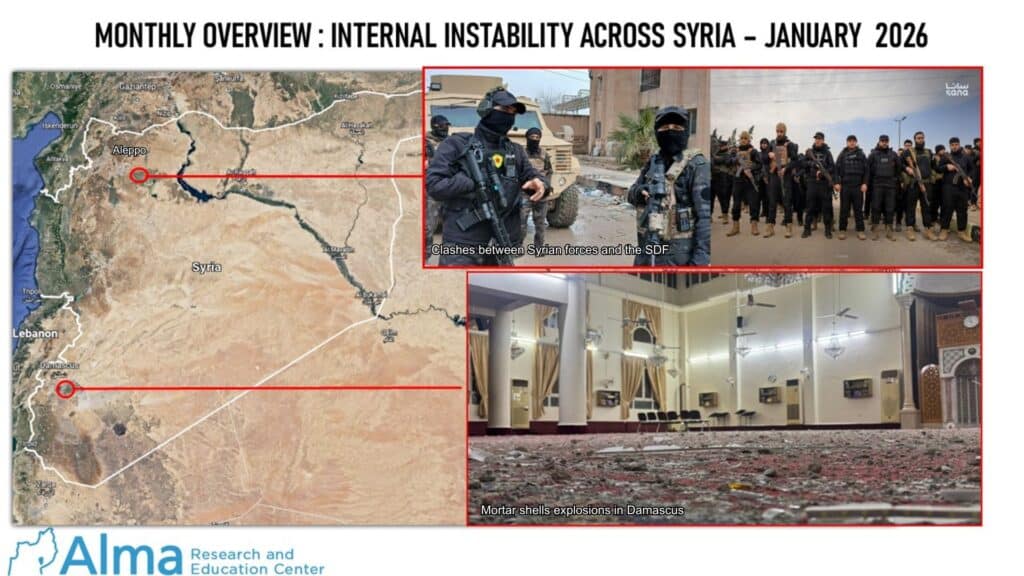
Instability and challenges to internal security in Syria persist. Although a ceasefire has been achieved on the northeastern front with the Kurdish forces, and the United States has chosen to gamble on al-Sharaa as its new partner, a growing sense of abandonment is taking hold among the Kurds. The real test of the agreement will not be measured solely by the ceasefire itself, but by its actual implementation: the meaningful integration of the Kurds into state institutions, the safeguarding of their civil and political rights, and the provision of equal, not merely symbolic, representation. At the same time, the Syrian regime continues to contend with internal pockets of instability, clashes with the Druze population in the south, ongoing violence across various arenas, terrorist activity, and a persistent lack of transparency in its conduct. Taken together, these factors undermine the regime’s prospects of establishing stability and full control.
Al-Sharaa In, the Kurds Out
After weeks of fighting between the Syrian regime’s security forces and the Kurdish Syrian Democratic Forces (SDF), a ceasefire was declared between the sides on January 30, 2026. In our assessment, the regime’s forces received Turkish backing and assistance in the form of weapons, intelligence, the deployment of various operational capabilities, and logistics. The fighting began with localized clashes in the Aleppo area in early January 2026, following many months of tension, military friction, and failure to implement the agreement signed on March 10, 2025.
The results of the fighting are dramatic: approximately 80% of the territory that had been under Kurdish control was transferred to Damascus’s control, including Raqqa Governorate, Deir ez-Zor Governorate, and al-Hasakah Governorate. These are areas of the highest strategic importance, encompassing energy infrastructure, oil fields, and water resources, and directly affecting electricity and water supply at both the national and regional levels. Military airfields, such as those in Tabqa and Deir ez-Zor, also came under the control of the Syrian regime. In addition, Syrian forces took over sensitive facilities, including al-Hol camp and the prison in Shaddadi, where ISIS operatives and their family members were held.
The United States Chooses a Side — and the Kurds Pay the Price
According to a Reuters report, the attack was carried out with the consent of the United States. If this is indeed the case, Washington has chosen President al-Sharaa and the Syrian regime as its new partner, effectively abandoning the Kurds. Trump’s envoy, Tom Barrack, clarified that the original purpose behind the establishment of the Kurdish forces had “largely expired” and that their best option is integration into the institutions of the Syrian state.
At the same time, alongside support for the Syrian regime, more cautious voices were also heard among senior American officials. Senator Lindsey Graham, for example, called for avoiding an expansion of the fighting and for protecting Kurdish civilians. Graham and U.S. Vice President J.D. Vance even threatened the reimposition of sanctions on Syria if the escalation continues. These calls, however, did not alter Washington’s overall strategic line.
The Ceasefire
Under the ceasefire announced on January 30, it was agreed that SDF forces would be gradually integrated into the Syrian army and security forces. The plan is to establish a military framework equivalent to a division, under which three SDF brigades will operate, while at the same time SDF fighters will be deployed under government command in the Aleppo area. The agreement does not explicitly address the SDF’s Women’s Protection Units (YPJ), which, according to assessments, will be integrated as a separate unit within the brigades.
Despite the regime’s demand to integrate Kurdish fighters in a dispersed manner within the military, in practice they will be incorporated as separate units. The entry of government security forces into the cities of Qamishli and al-Hasakah will also be carried out gradually and on a limited scale (as of the time of writing, Syrian security forces have entered Qamishli and al-Hasakah), primarily for the purpose of restoring state institutions to operation. Furthermore, the institutions of the SDF’s autonomous administration will be absorbed into the state institutions in Damascus, effectively marking the end of the “self-administration” model.
The agreement allows the SDF to propose candidates for key positions, including governor of al-Hasakah Governorate and another senior security post. The candidate mentioned is Nur al-Din Ahmad (“Abu Omar Khaniqa”), born in Qamishli in 1969, holds a degree in mechanical and electrical engineering, active in the institutions of the autonomous administration and in the field of “social reconciliation,” and has served in positions within the SDF. This constitutes a political gesture aimed at anchoring the agreement through administrative, not only military, control, though it remains doubtful whether this reflects a genuine partnership or merely an illusion of representation.
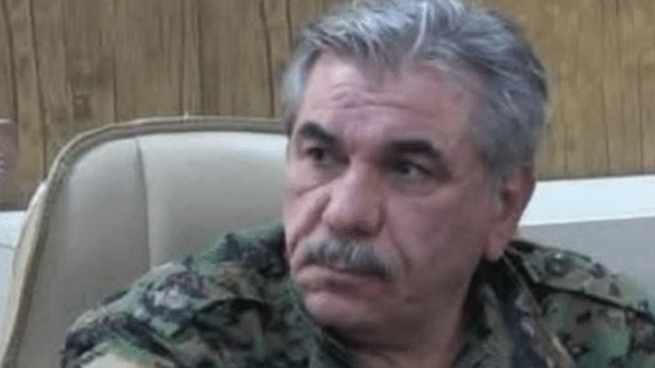
Nur al-Din Ahmad
Gestures Toward the Kurds — and the Gap Between Declarations and Reality
As part of the agreement, promises were made regarding civil and educational rights for the Kurds and the return of displaced persons. On January 16, al-Sharaa issued a presidential decree recognizing Kurdish culture and the Kurdish language as a national language, and Kurdish New Year as a national holiday. These steps were intended to appease the Kurdish population and present the regime as protecting the rights of all Syrian citizens.
However, on the ground, many voices among the Kurds express disappointment and a sense of betrayal. Documentation published from the time regime forces entered the northern neighborhoods of Aleppo until the declaration of the ceasefire presents evidence of severe acts of hostility and violence against Kurds: humiliation, abuse, executions of prisoners, the burning of bodies, and harm to civilians, including women and children. In some cases, these acts were carried out by Syrian fighters, although reports and documentation were also published regarding serious acts of violence by Kurds against Arab tribes that assisted the regime.
Is America on the Way Out?
Despite the troubling reports, the U.S. administration appears determined to continue its support for al-Sharaa. According to The Wall Street Journal, the United States is considering a full military withdrawal from Syria. American officials stated that recent developments and the weakening of the Kurds have led the Pentagon to question the viability of continuing the U.S. mission in the country.
If the Americans do indeed carry out a full withdrawal from Syria, including from the al-Tanf area in southeastern Syria, this would provide a very significant incentive for Iranian activity in its efforts to restore its foothold in Syria. Added to this is the deep Kurdish frustration, which carries potential for exploitation by Iran.
ISIS Detention Facilities: A Ticking Time Bomb
One of the central concerns relates to the future of detainees and their family members held in detention facilities and camps that until now had been managed by the Kurds. The Syrian regime’s offensive led to a rapid and uncoordinated withdrawal of SDF forces, and humanitarian organizations operating in the camps left the area.
According to reports, the UN is expected to assume responsibility for al-Hol camp, while the United States will handle the prisoners, with a plan to transfer approximately 7,000 of them to Iraq. However, the plan has already encountered difficulties: in Baghdad, there is a preference to examine the return of prisoners to their countries of origin, and doubts are being expressed about the Iraqi judicial system’s ability to cope with the burden. At the same time, aid organizations report a severe shortage of food, water, and medicine in the camps due to road blockages.
Ongoing Violence — A Grim Snapshot
On January 1, The Syrian Network for Human Rights (SNHR) published its annual report for 2025. According to the report, 3,338 people were killed in Syria, including 328 children and 312 women, as well as 32 who died under torture. The year 2025 was defined as one of the most difficult and complex from a security perspective. In December alone, 80 civilians were killed as a result of ongoing violence, unexploded ordnance, and remnants of past fighting.
The report indicates that the killings were carried out by a variety of actors: forces of the new regime, remnants of the Assad regime, the SDF, armed militias, and also as a result of Israeli and Turkish activity. The Syrian coastal region, led by Latakia Governorate, recorded the highest number of casualties. The report concludes that the continued harm to civilians illustrates the fragility of the transition period and the urgent need for security reform based on international human rights law.
Mortar Fire in the Heart of Damascus: A Warning Sign for Regime Stability
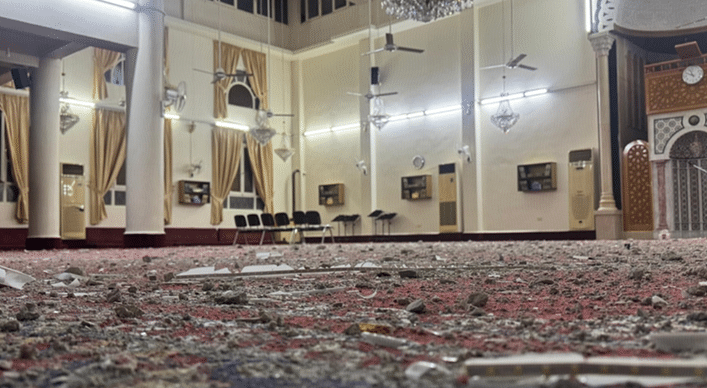
On January 3, it was reported that three mortar shells landed in the al-Mezzeh neighborhood of Damascus, causing damage to buildings but no casualties. According to an official statement, one shell struck the dome of the al-Muhammadi Mosque in the Mezzeh 86 area, another hit a communications facility, and the third landed near the perimeter of the Mezzeh military airport.
At this stage, no information has been released regarding those responsible for the fire, and no claim of responsibility has been reported. However, this was not an isolated or unprecedented incident: in the past, mortar fire has already been directed toward the vicinity of Mezzeh airport, and in previous cases improvised launchers were even discovered in the Damascus area. This sequence of events points to the continued use of indirect fire in the heart of the capital, a phenomenon that undermines the image of control and security the regime seeks to project, even if the damage at this stage remains limited.
“The Druze South” as a Volatile Arena: Clashes in Western al-Suwayda
On January 3, clashes were also reported in the western part of Suwayda Governorate between the regime’s internal security forces and the Druze local militia the “National Guard” (الحرس الوطني). The clashes erupted after the militia attacked security forces along the axis of the town of al-Mazra‘a, during which injuries were reported among internal security personnel.
At the same time, fatalities were reported among the ranks of the “National Guard,” along with civilians wounded in the village of ‘Atil, as well as additional casualties in the village of Rima Hazem. These events are taking place against the backdrop of repeated violations of the ceasefire in effect since July 2025. The militia, identified with Sheikh Hikmat al-Hijri, has previously also been attributed with additional attacks against security forces in the area, including the use of drones and mortars.
Developments in southern Syria underscore that even beyond the Kurdish arena, the regime is facing significant internal security challenges. Suwayda Governorate continues to emerge as a volatile arena, where local loyalties, armed militias, and distrust toward the regime in Damascus could ignite a broader escalation, precisely at a time when the regime is seeking to project a return to “normalization” and full control over the country.
The Fight Against ISIS — A Warning for the Future
The international coalition’s fight against ISIS continues. Over the past month, the United States has continued Operation “Eagle Eye,” under which dozens of ISIS targets across Syria were struck. Britain, France, and Jordan also participated in airstrikes, aimed at preventing ISIS from reconstituting. The international activity indicates that ISIS and other terrorist organizations continue to operate in Syria and pose a threat to Syria’s internal stability and to regional security.
The Lifting of Sanctions and the Risk of Iran’s Renewed Presence in Syria
According to a report by the Washington Institute, in early January Syria received an additional shipment of crude oil from Russia aboard the vessel Ater, which is under U.S. sanctions. The ship is linked to the “shipping empire” of Mohammad Hossein Shamkhani, the son of Ali Shamkhani, an adviser to Iran’s Supreme Leader, and is part of Iran’s “shadow fleet.”
The report underscores the core problem: lifting sanctions on Syria without a genuine commitment from the regime and without international oversight mechanisms plays into Iran’s hands and enables it to renew and deepen its presence in the country, precisely at a time when Syria is in dire need of stability, transparency, and accountability.


One Response
I wanted to address the section about the Druze in the article. It is complete propaganda and does a disservice to the Druze cause. The article fails to mention that government security forces were not attacked first by the militia; rather, they committed the massacre and crimes against civilians. Women, children, and other civilians were executed, burned, and raped—atrocities carried out by the Syrian government. These facts, well documented and widely available online and on social media, are completely ignored by the writer. Furthermore, it overlooks the role of the Druze’s own defense forces , are community volunteers who are trusted to protect and save lives. This omission undermines the truth and the sacrifices made by the Druze people.