
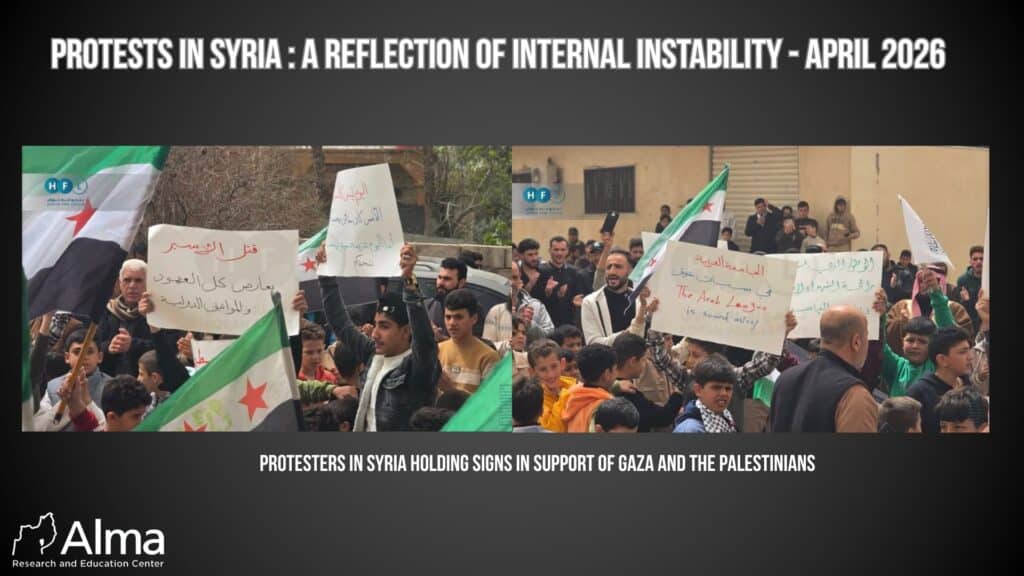
During the weekend (April 3–4), demonstrations in support of Hamas and the Palestinians took place at several locations across Syria, following the passage of a law imposing the death penalty on terrorists in Israel and restrictions at the Temple Mount. The protests were recorded in the south of the country, near the border with Israel, in the capital Damascus and its surroundings, in Hama province, Aleppo, and additional areas. According to unofficial estimates, thousands participated in demonstrations across the country, where protesters were seen carrying signs criticizing Arab states, expressing support for Gaza, and chanting against Israel and Jews, as well as in favor of the release of Palestinian prisoners.
As can be seen in the attached video, in some of the demonstrations explicit chants were heard against Jews, such as “Khaybar, Khaybar, O Jews, the army of Muhammad will return.” In the coastal city of Jableh (northwestern Syria), which is predominantly populated by Alawites, a demonstration by Sunni activists in support of the Palestinians took place, during which a display depicted the Prime Minister of Israel as a prisoner with a noose wrapped around his neck.
At the same time, on April 4, protesters gathered around the UAE embassy in Damascus and attempted to break into the compound in order to damage it, referring to it as a “Zionist embassy” and hanging Palestinian flags, an expression of criticism toward Arab states that normalized relations with Israel.
Some of the protesters carried Salafi flags, indicating the presence, and possibly influence, of jihadist elements. In addition, Hamas supporters hung Palestinian flags on the fence of the U.S. embassy in Damascus.
Drivers of the unrest: between internal factors and regional interests
Several key potential factors can be identified as driving the wave of protests, whose intensification serves their interests. First, the presence of a significant Palestinian population in Syria, including in the Daraa area, one of the protest centers, provides a social base for the unrest. Second, organizations such as Hamas and Palestinian Islamic Jihad have a clear interest in exploiting the Syrian arena in order to expand the circles of confrontation with Israel, including through incitement and the mobilization of local support.
Third, there is evident involvement of radical Sunni jihadist elements. The appearance of Salafi symbols in the demonstrations indicates an attempt by these groups to ride the wave of protest, both to challenge the Syrian regime and to promote confrontation with Israel, which they perceive as part of a broader struggle against the West and its allies.
At the same time, the role of Iran should also be taken into account. Tehran, which is working to reestablish its influence in Syria, may encourage the unrest, directly or indirectly, in order to open an additional front against Israel, divert Israeli attention to the Syrian arena, and even attempt to undermine the stability of the Syrian regime, which opposes the Iranian axis.
The protests as an indicator of regime weakness
Beyond the immediate context, the demonstrations should be viewed as part of a broader picture of internal instability in Syria. The state continues to face significant challenges from non-state actors operating within its territory, carrying agendas and extremist ideologies that do not align with the regime’s attempts to present a pragmatic and restrained policy in the regional arena, thereby continuously challenging its capacity for governance.
The structural weakness of the regime also enables external actors, both state and non-state, to influence developments in Syria and attempt to shape the political and security agenda. In this way, the Syrian arena becomes a space of competition between regional interests, with popular protest serving as a tool for various actors.
From the official standpoint, the Syrian regime has claimed that efforts were made to contain the demonstrations and prevent direct escalation with Israel. However, in practice, enforcement appears partial and cautious, with an emphasis that protests are permitted under the law as part of freedom of expression. This reflects a central dilemma: on the one hand, the desire to preserve stability and avoid external confrontation; on the other, the concern of being perceived as suppressing pro-Palestinian protest or as cooperating with Israel, especially in light of pressure from extremist elements within the public and even within the security apparatus.
It is possible that the regime is attempting to play a double game, and it may even benefit from these demonstrations, viewing them as an additional lever of pressure against Israel in the context of the negotiations (which, to the best of our understanding, were frozen at the time of writing) between the two countries.
Conclusion
The current wave of protests is not merely a response to developments in the Israeli-Palestinian arena, but rather an additional expression of the deep fractures within the Syrian system. It highlights the regime’s limited control over events within its territory and its difficulty in containing extremist actors and coping with external influences.
From a regional perspective, these events illustrate how external issues, particularly the Israeli-Palestinian conflict, serve as a catalyst for internal dynamics that generate instability. For Israel, this translates into an increased threat potential from non-state actors operating from Syrian territory, at times without effective regime control and at times even contrary to its interests. It is also possible that elements operating within or under the regime are encouraging such activity on ideological grounds.
Looking ahead, as long as the weakness of the Syrian regime persists and the internal arena remains exposed to competing influences, it is likely that such events will continue to develop and even intensify, creating stronger linkages between Syria’s internal arena and broader regional friction points, particularly with Israel.


One Response
Dear Dr Zoe,
Thank you for the Syrian update. My conclusion is that the only viable solution is to fully engage on the two current fronts with the IRGC and hezbollah: and ESCALLATE, ESCALLATE, ESCALLATE to Total Victory and Unconditional Surrender. My father with the US Army did that against Nazi Germany in 1945, and much of Europe was reduced to rubble. “Can these bones live?”