
Executive Summary
The period from July to mid-August 2026 marks an escalation and strategic deepening of Turkish involvement across four principal policy areas: the consolidation of independent military power, accelerated security-economic integration in Syria, continued patronage of Hamas infrastructure, and escalating rhetoric toward Israel.
Developments in August 2026 redefined Turkish strategy. The signing of the Joint Defense Agreement in Mecca on August 7 ostensibly created a new Sunni security bloc with Saudi Arabia and Pakistan, while passage of the “Law to Strengthen National Solidarity” on August 10 marked an attempt to neutralize the internal Kurdish threat posed by the PKK in favor of regional expansion. At the same time, relations with Damascus underwent a significant shift, expressed in the creation of a High-Level Coordination Council and the upgrading of relations to a strategic partnership, alongside expanded economic and security activity in Syria and Lebanon.
At the international level, despite US President Donald Trump’s declaration at the NATO summit in July that he intended to lift CAATSA sanctions — the Countering America’s Adversaries Through Sanctions Act — and consider the sale of F-35 aircraft, these processes remained stalled in August in the face of Congressional opposition. This report analyzes how these developments are converging into a new regional reality, in which Turkey is attempting to balance its interests vis-à-vis the West with the construction of regional hegemony.
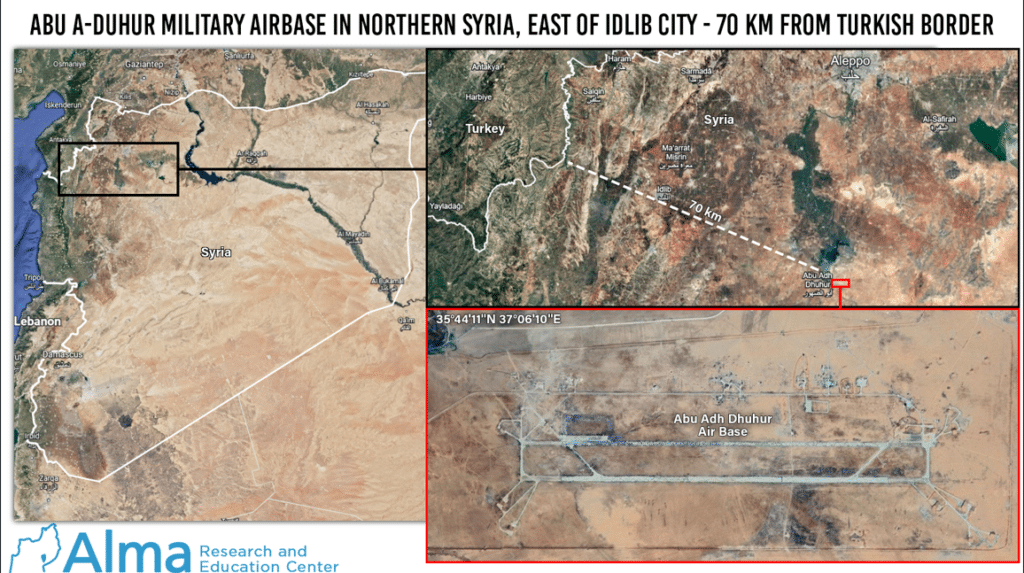
On August 18, 2026, Israel carried out several waves of airstrikes against the Abu al-Duhur military airfield in eastern Idlib, Syria. Satellite imagery confirmed significant damage, including four impact craters on runways and in hangars that were undergoing refurbishment by the Syrian military with Turkish assistance. Israel justified the strike as a preventive measure intended to forestall Turkish military buildup and the deployment of advanced air-defense systems that threaten Israel’s freedom of aerial action in the area. According to some reports, Turkey also planned to deploy unmanned aerial vehicles at the site.
While the Turkish Ministry of Defense denied a Turkish presence at the military airfield prior to the Israeli strike, several testimonies and reports tell a different story.
The strike caused significant diplomatic friction, as both the Syrian Foreign Ministry and the Turkish presidency condemned the action as an unlawful violation of sovereignty. US Special Envoy to Syria Tom Barrack expressed deep concern over the risk of rapid escalation and direct military confrontation between Israel and Turkey. Reports also indicate that Mossad chief Roman Gofman held an urgent warning call before the strike with Syrian Foreign Minister Asaad al-Shaibani on August 14, reiterating Israel’s strict red lines regarding a Turkish military presence on Syrian soil.
The Israeli Strike on the Abu al-Duhur Military Airfield
On August 18, 2026, Israel carried out several waves of airstrikes against the Abu al-Duhur military airfield in eastern Idlib province, Syria. Satellite imagery and reports confirmed significant damage, including four impact craters on the runways and taxiways, as well as damage to warehouses that were undergoing refurbishment by the Syrian military with Turkish assistance.
On August 14, four days before the strike, Mossad chief Roman Gofman, according to a Reuters report, held an urgent warning call with Syrian Foreign Minister Asaad al-Shaibani, in which he clarified Israel’s red lines regarding Turkish military presence on Syrian soil.
The purpose of the strike was to send a clear message to the al-Sharaa regime and to Turkey: Their actions in rehabilitating the airfield and their intention to deploy advanced military capabilities there — reportedly including air-defense systems, radar systems, and unmanned aerial vehicles — cannot be accommodated.
It is worth recalling reports of Turkish plans to deploy a Hisar air-defense system at the T-4 base, plans whose completion has not yet been confirmed. Israel reportedly warned Turkey against transferring military capabilities to this base that could disrupt the Israeli Air Force’s freedom of action, and it was reported in April 2025 that Israel bombed the base to prevent Turkey from establishing capabilities there.
In a video published on social media after the Israeli strike on the Abu al-Duhur military airfield, a soldier of Turkish origin, apparently identifiable by his accent and likely a former jihadist, can be seen.
In the video, which we edited from the original footage to highlight the relevant excerpts, the soldier explicitly claims that Turkish forces are present in the Abu al-Duhur area and that Israel was aware of their presence and had tracked them with unmanned aerial vehicles for several months. According to him, Israel struck Abu al-Duhur airfield in order to prevent the expansion of the Turkish presence there. If the video is authentic, its content contradicts the Turkish Ministry of Defense’s denial that Turkish forces were present in the airfield area before the strike.
If the video is authentic, the soldier — note the uniform beneath his civilian jacket — may currently serve in the Syrian Army’s 64th Division, which is responsible for the Idlib sector and the airfield area and operates under the Syrian Army’s Northern Command. The Northern Command area is Turkey’s main center of influence in Syria. Turkey supported rebel organizations there for years; after the fall of the Assad regime, these groups were dissolved and incorporated into the new Syrian army.
On August 20, Syrian sources reported that a Turkish technical team had been repairing the runway and control tower at Abu al-Duhur base and had departed two days before the Israeli strike. The sources stressed that no Turkish forces had been deployed at the base.
Another Turkish report, dated August 20, claimed that 200 Turkish soldiers were due to arrive approximately 13 hours after the strike. According to the report, infrastructure had been prepared to receive unmanned aircraft, armed aircraft, air-defense equipment, and ground and air equipment.
The testimonies and reports above contradict the Turkish Ministry of Defense’s denial of a Turkish presence at the airfield prior to the strike.
Syrian Foreign Minister al-Shaibani also contradicted the Turkish claims. He confirmed that Turkish military personnel had visited the base as part of training and military cooperation, but said that the base was empty at the time of the strike and that no Turkish forces were stationed there.
The office of Israeli Prime Minister Benjamin Netanyahu stated that Israel would not tolerate a Turkish military presence that poses a threat to its security. Some media reports defined the strike as a preventive measure intended to forestall Turkish military buildup and the deployment of advanced radar systems that could threaten Israel’s freedom of aerial action in the area — an area that may be relevant to an air route extending as far as Iran.
The Syrian Foreign Ministry and the Turkish presidency condemned the operation as a violation of sovereignty. Turkey claimed that the technical teams were engaged solely in restoring civilian infrastructure and accused Israel of attempting to undermine the tripartite “Mecca Agreement.” Tom Barrack, the US Special Envoy to Syria, expressed deep concern about the strike, which he described as an “unnecessary escalation” that raises the risk of direct military confrontation between Israel and Turkey. The United States is working to establish a mechanism to prevent friction between the parties.
It should be noted that on August 23–24, several reports emerged regarding meetings between the Syrian foreign minister and other Syrian officials with senior Israeli security officials, aimed at preventing escalation and easing tensions following Israeli strikes in Syria.
The meetings reportedly addressed concrete steps to reduce tensions, the creation of a coordination mechanism between the states, and the resumption of negotiations toward a security agreement between the two countries.
The Abu al-Duhur military airfield is located approximately five kilometers east of the town of Abu al-Duhur, about 45 kilometers east of Idlib city, and about 70 kilometers from the closest area of the border with Turkey. The airfield includes a main runway, taxiways, aprons, aircraft shelters, command buildings, warehouses, and residential facilities.
Historically, during the Assad regime, the airfield hosted the 678th Squadron, operating MiG-21 and MiG-23 aircraft and helicopters. It was regarded as one of the largest bases in northern Syria. Al-Sharaa and his forces knew Abu al-Duhur well from the Jabhat al-Nusra period, having seized it in September 2015 during the civil war. In January 2018, the Assad army retook the airfield with Russian air support. The base did not return to full operational readiness due to the destruction of its facilities. On November 30, 2024, rebel forces seized it again; after the fall of the Assad regime and the establishment of al-Sharaa’s new government, the airfield passed under the control of the Ministry of Defense and the new Syrian army.
Syria: Meetings with Turkish Officials, Latakia, and the Reopening of Border Crossings with Turkey
The Turkish warship TCG Istanbul docked at the Port of Latakia on July 13, following a delay of several weeks.
On August 5, 2026, the head of Turkey’s National Intelligence Organization, İbrahim Kalın, hosted Syrian Foreign Minister Asaad Hassan al-Shaibani in Ankara for discussions on bilateral cooperation, regional security, and the integration of the Syrian Democratic Forces.
On August 6, 2026, the direct security channel between Ankara and Damascus advanced further when Turkish Foreign Minister Hakan Fidan met in Ankara with his Syrian counterpart, al-Shaibani. Following the talks, the two states established a joint high-level strategic council.
The council’s purpose is to upgrade relations to a strategic partnership encompassing economic, security, and infrastructure cooperation.
The talks focused on coordinating counterterrorism efforts and integrating the Kurdish Syrian Democratic Forces into the new Syrian state, with an emphasis on removing elements of the Kurdistan Workers’ Party and the People’s Protection Units, the PKK/YPG, from the area.
Turkey’s ambassador in Damascus, Nuh Yılmaz, stated on August 15, 2026, that the four principal threats along the Turkish-Syrian border — human trafficking, drug smuggling, uncontrolled migration, and terrorism — had “suddenly” disappeared since the new Syrian government came to power in December 2024. The Turkish ambassador added that, in light of this, Turkey aims to reopen all border crossings, with the route between Nusaybin and Qamishli expected to open within three months.
The F-35 Deal: The Most Significant Political Development?
Despite US President Donald Trump’s declarations at the NATO summit in July that he intended to lift CAATSA sanctions and consider the sale of F-35 aircraft, the process remained stalled as of mid-August. In a report to Congress dated July 22, 2026, the US State Department clarified that Turkey had not yet met the legal requirements necessary to revive the deal, foremost among them its continued physical possession of the Russian S-400 system.
While Turkish President Recep Tayyip Erdoğan stated on August 15 that he expects Trump to honor his promise, members of Congress and the chairman of the US Senate Foreign Relations Committee, Jim Risch, made clear that unless the Russian system is removed from Turkish territory, US law — Section 1245 of the National Defense Authorization Act for Fiscal Year 2020 — blocks any transfer of aircraft. Meanwhile, approvals progressed for the sale of American engines for Turkey’s KAAN fighter jet, highlighting the gap between industrial cooperation and the political obstacles surrounding an F-35 deal.
The Mecca Defense Agreement: The Strategic Turning Point
On August 7, 2026, Turkey, Saudi Arabia, and Pakistan signed the “Joint Defense Agreement” in Mecca. The agreement, signed by Turkish President Erdoğan, Saudi Crown Prince Mohammed bin Salman, and Pakistani Prime Minister Shehbaz Sharif, includes a mutual-defense clause stipulating that an attack on one of the states will be treated as an attack on all. Turkish Foreign Minister Hakan Fidan described the provision as technically identical to Article 5 of the NATO treaty.
The agreement is intended to strengthen collective deterrence against Israel and Iran and to establish an independent Sunni security bloc. However, the degree to which the agreement will be implemented remains an open question. President Erdoğan and Minister Fidan stated that the agreement is open to additional states, identifying Egypt as a natural partner that could join after technical issues are resolved.
Houthi attacks against Saudi Arabia and targets in the Red Sea arena since July 2026 have produced mixed results. Some were intercepted by Saudi air-defense systems, including missiles aimed at refineries in Yanbu, while others struck strategic infrastructure, such as Abha Airport and oil tankers in the Red Sea. These attacks prompted an escalation in Saudi-led coalition responses against targets in Yemen.
Even after the Mecca Agreement was signed, when Saudi Arabia came under Houthi attack, there was no sign that Turkey and Pakistan would be asked to intervene on Riyadh’s behalf.
Turkish Military Force Buildup: Continuing Industrial Momentum
Turkey’s defense industry continues to expand its exports and indigenous development. The KAAN fighter jet, developed by Turkish Aerospace Industries, continues to advance toward serial production following the initial contract signed on May 12, 2026. The export agreement with Indonesia — for 48 aircraft valued at $10 billion, signed in June 2025 — serves as a key indicator of international demand for Turkish-made defense products.
The Tayfun Block-4 ballistic missile, with a range of 800 km and a speed of Mach 5 or more, continues to move into mass production, alongside ongoing development of the Yıldırım intercontinental ballistic missile, with a range of 6,000 km. The accumulation of these capabilities, coupled with the prospect of acquiring American F-35s, illustrates Ankara’s attempt to position itself simultaneously as a first-tier exporter and consumer of military technology.
Turkish Legislation: The National Reconciliation Initiative
On August 10, 2026, the Turkish parliament approved by a large majority the “Law to Strengthen National Solidarity,” a milestone in ending the conflict with the Kurdish insurgency, the PKK. The law offers a framework for conditional amnesty, release, and reintegration of thousands of PKK operatives in exchange for the organization’s full disarmament and dissolution, subject to approval by the National Security Council.
The amnesty does not include individuals convicted of premeditated murder or those given life sentences before 2005, a category that includes Abdullah Öcalan and other senior figures. The measure is viewed as a strategic shift that enables Ankara to deepen its influence in Syria and Iraq while neutralizing the internal threat.
The Terror Axis: From Istanbul to Gaza
While a June 21 IDF and Shin Bet announcement exposed five senior Hamas figures operating from Turkey and directing attacks in Judea and Samaria, July brought a further dimension to Turkish patronage of Hamas: Turkish media reports described a network of summer camps in Gaza operating with “Turkish funding” and under the patronage of the “Higher Council for Youth and Sports in Gaza.”
Turkey’s Anadolu Agency noted that Abd al-Salam Haniyeh, the deputy secretary-general of the Palestinian council, features prominently in these reports. Abd al-Salam is the son of Ismail Haniyeh, head of Hamas’s political bureau, who was assassinated in Tehran on July 31, 2024. After his father’s death, the younger Haniyeh was received in Istanbul by Turkish President Erdoğan and by İbrahim Kalın, the head of Turkey’s National Intelligence Organization, MIT.
A video published on Instagram showed children at a summer camp in Gaza standing beside a large portrait of Turkish President Erdoğan and Turkish flags. This combination of funding and ceremonial display, alongside Erdoğan’s declared protection of senior Hamas figures operating from Turkey — “Just as we protect our children, so we will protect you” — presents a consistent pattern of Turkish support for Hamas in both the West Bank and Gaza.
The Rhetorical Arena: From Erdoğan’s Statements to Diplomatic Rupture
Statements by the Turkish government continued the trend of rhetorical escalation against Israel in July, even as a degree of state-level rapprochement was recorded between Washington and Ankara. In an interview with CNN Türk, Turkish Foreign Minister Hakan Fidan described Israel as “a burden humanity can no longer bear.”
During his visit to Egypt on August 13, Fidan intensified his criticism of Israel’s leadership, accusing the government led by Israeli Prime Minister Benjamin Netanyahu of “ongoing escalation that violates human dignity.”
The Economic Axis
Turkish Trade Minister Ömer Bolat announced that bilateral trade between Turkey and Syria rose by 16 percent during the first seven months of 2026, following a 45 percent increase over 2025 as a whole. Total trade volume in 2025 reached $3.75 billion.
Turkish exports to Syria alone reached $1.28 billion during the first half of 2026, an increase of 26.4 percent compared with the corresponding period in the previous year.
On August 14, 2026, the Cilvegözü truck terminal was inaugurated on the Turkish side of the border, opposite Syria’s Bab al-Hawa crossing. The ceremony was attended by Qutaiba Badawi, head of the Syrian General Authority for Border Crossings and Customs. Badawi said the new facility regulates truck movements, reduces waiting times, and accelerates import, export, and transit operations between the two countries.
Badawi added that the Syrian authority is simultaneously expanding and upgrading the Bab al-Hawa crossing itself, including cargo areas, buildings, and traffic lanes for trucks and passengers, ahead of its reopening within three months. Bolat stated that six border crossings were operating between the two countries as of mid-August. He defined Syria as a “critical axis” for access to the Persian Gulf and North Africa, while Turkey serves as a central transit point for Syria en route to Western Europe and the Caucasus.
The Lebanese Arena: Turkish Involvement and Security Developments
On July 30, Erdoğan stated that Turkey is interested in participating in a new security initiative in Lebanon after the UNIFIL mandate, which is expected to end in late 2026. These developments are occurring against the backdrop of the Mecca Agreement, a tripartite defense alliance among Turkey, Saudi Arabia, and Pakistan intended to create a Sunni security bloc that balances Iranian influence and projects regional power.
This reality creates strategic complexity for Israel. Turkey is seeking to leverage its influence in Damascus and Beirut to strengthen its position, while presenting itself as a counterweight to Israeli activity and attempting to draw Lebanon into Turkey’s national-security sphere. All of this is taking place alongside the systematic deepening of Turkey’s presence in Syria.
Conclusion
The strike on the Abu al-Duhur military airfield in Idlib on August 18 constitutes a key event illustrating the direct and growing friction between Israel and Turkey. The action was apparently intended to thwart continued Turkish military buildup on Syrian soil and prevent the deployment of capabilities that could threaten Israel’s freedom of action in the area. Such capabilities could also potentially fall into jihadist hands within the new Syrian army.
More broadly, the period from July to mid-August 2026 illustrates Turkey’s emergence as a multi-arena strategic actor. Ankara is advancing complementary moves in parallel: on the one hand, it is building tangible assets of influence in Syria – economic, infrastructure, and security coordination – while consolidating its standing with Hamas; on the other hand, it has achieved a political breakthrough through the signing of the Mecca Agreement on joint defense with Saudi Arabia and Pakistan, forming a new Sunni security bloc.
Alongside these developments, dialogue with the Trump administration on the removal of CAATSA sanctions and the potential acquisition of F-35 aircraft poses a complex challenge for Israel: Turkey could, within several years, become an air and land power enjoying American backing and a regional defense umbrella.
The central question remains whether Jerusalem’s diplomatic efforts in Washington will succeed in blocking the F-35 deal, or whether Israel will be forced to prepare for a new era in which Turkey projects significant military power across both the near and more distant regional circles.
Gerret Margolis contributed to this report
Sources
1.https://www.aa.com.tr/en/turkiye/turkish-naval-ships-visit-syria-s-latakia-port/3996375
2.https://www.dailysabah.com/politics/turkish-navy-makes-inaugural-visit-to-post-assad-syria/news
3.https://www.jpost.com/middle-east/article-902480
4.https://turkishpress.com/turkiye-syria-naval-latakia
5.https://turkishpress.com/turkiye-syria-naval-cooperation
9.https://www.cnn.com/2026/07/07/politics/netanyahu-opposes-sale-f35-jets
10.https://www.jpost.com/israel-news/article-902268
12.https://www.middleeasteye.net/news/erdogan-gifts-trump-gold-plated-revolver-during-nato-summit
13.https://www.middleeasteye.net/news/turkey-moves-take-control-syrias-strategic-t4-air-base-sources
14.https://www.newarab.com/analysis/syrias-t4-airbase-flashpoint-turkey-and-israels-rivalry
15.http://usanasfoundation.com/from-proxy-to-partner-turkeys-role-in-reconstructing-syrias-military
16.https://israel-alma.org/the-turkish-axis-of-activity-and-influence-june-2026-monitor/
17.https://www.timesofisrael.com/erdogan-israels-strikes-on-lebanon-and-syria-threaten-turkey/
18.https://mitvim.org.il/en/tag/israel-turkey/
19.https://www.haberler.com/guncel/israil-saldirilarinin-golgesinde-buyuyen-gazzeli-20019664-haberi/
21.https://www.jpost.com/opinion/article-903901
22.https://www.instagram.com/p/DaYb_UpkTM1/
27.https://x.com/kann_news/status/2081794825926345132


One Response
Dear Yaakov and Gerret,
Great article. Erdogan’s terrorist financial connections and support will now become exposed. His jihaddist inflammatory and hostile accusations against Israel must cease and desist or there will be serious consequences. Tom Barrack must also be silenced from his hostile and inflammatory rhetoric against Israel and the president’s stated policies, or he should be immediately removed from diplomatic service. His denial of Israel’s right to retain the Golan Heights is a betrayal of both the USA, the president and the State of Israel. My recommendation is to dismiss him now. His actions are inexcusable.