
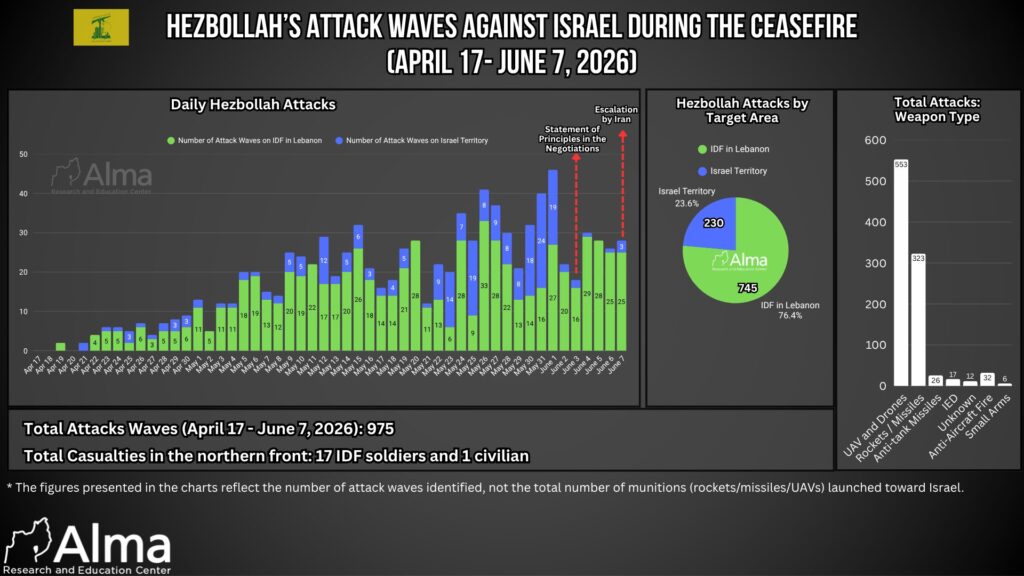
During the week, Hezbollah carried out 198 attack waves against Israel and IDF forces operating in Lebanon.
Most of the attacks (168) targeted IDF forces in southern Lebanon, while 30 attack waves were directed at Israeli territory.
The attacks against Israel were evenly divided between UAVs and explosive drones (15 attack waves) and rocket and missile fire (15 attack waves).
At the same time, Hezbollah launched 93 attack waves using rockets and missiles against IDF forces operating in southern Lebanon and 76 attack waves using UAVs and explosive drones, alongside additional attacks involving anti-tank guided missiles (ATGMs), anti-aircraft fire, improvised explosive devices (IEDs), and other weapon systems.
This week’s data indicate a noticeable shift in Hezbollah’s operational patterns, with an increase in the use of indirect fire systems (rockets and artillery) compared to previous weeks, during which the organization relied more heavily on UAVs and explosive drones. This trend may reflect an effort to increase both the volume of fire and the pace of attacks.
During the week, four IDF soldiers were killed in southern Lebanon. Two were killed by Hezbollah explosive drone strikes, one was killed by an anti-tank missile strike, and another was killed in an accidental discharge incident.
The week began with a peak in activity, as June 1 recorded the highest daily number of attacks since the beginning of the ceasefire (April 17). Although attack levels declined somewhat afterward, Hezbollah maintained a consistently high operational tempo throughout the week.
The decline in Hezbollah’s attacks later in the week was likely linked to the organization’s effort to confine the confrontation to southern Lebanon and to Israel’s declared policy that attacks on Israeli territory would trigger strikes against Hezbollah assets in Beirut’s Dahieh district. This dynamic emerged following the publication of the Statement of Principles on June 3 as part of the negotiations between Israel and Lebanon.
On June 7, Hezbollah launched rockets toward Israeli territory. In response, the IDF struck a Hezbollah command center in Dahieh, Beirut, killing two Hezbollah operatives. The incident led to further escalation and direct Iranian involvement, including several waves of ballistic missile attacks against Israel.
Cumulative Data Since the Ceasefire (April 17 – June 7)
Since the beginning of the ceasefire, 975 Hezbollah attack waves have been identified. Of these, 745 attack waves (76.4%) targeted IDF forces operating in Lebanon, while 230 attack waves (23.6%) were directed at Israeli territory.
In terms of weapon systems, Hezbollah’s attacks relied primarily on UAVs and explosive drones (553 attack waves) and rockets and missiles (323 attack waves). Additional attacks involved anti-aircraft fire (32), anti-tank guided missiles (26), IEDs (17), incidents in which the weapon type could not be identified (12), and small arms fire (6).
During the ceasefire period, 17 IDF soldiers and one Israeli civilian were killed on the northern front as a result of Hezbollah activity.
Neither the ceasefire agreement (April 17) nor the Statement of Principles (June 3) prevented Hezbollah from continuing to conduct high-intensity attacks against Israeli territory and IDF forces operating in southern Lebanon.




One Response
Dear Alma Staff,
The Ayatollah/IRGG regime and their proxies provide a continuous barrage of lies, broken agreements, and aggregious deception propaganda campaigns to produce the induced inversion of reality in the minds of the public who are not able to differentiate lies from Truth. Decades of subsersive media propaganda have darkened the minds of many. Time to counter attack with TRUTH!!!
Let the eyes of the blind be opened!!!
Missile attacks on Israel are Real Attacks!!!
Rocket attacks on Israel are Real Attacks!!!
Terror tunnels are Real Terror Infrastructure!!!
These violations will no longer be tolerated!!!