By: Dr. Zoe Levornik and Tal Beeri
Overview:
Lebanon’s reconstruction process presents the Lebanese government with a dual challenge: how to assist the population affected by the war while preventing Hezbollah from gaining control over reconstruction resources, which would strengthen the organization. According to an October 8 report, the United States is working with the Lebanese government and donor countries to develop a mechanism that would channel reconstruction funds through state institutions while overseeing the entities involved in the projects. The reported aim is to prevent companies and entities linked to Hezbollah from benefiting from reconstruction contracts, including through front companies.
This is the central issue in the struggle and “competition” between the state and Hezbollah: who will control the funds, who will carry out the work, and who will be seen by residents as providing reconstruction and assistance. The government seeks to establish the state’s responsibility, while Hezbollah seeks to maintain the population’s dependence on its systems, portraying the government as failing to assist those affected and blocking the funding sources that, it claims, should provide the aid.
Oversight Mechanisms: Preventing Reconstruction Funds from Strengthening Hezbollah
According to the report, the planned oversight mechanism will screen contractors, suppliers, and ultimate beneficiaries to prevent entities linked to Hezbollah or sanctioned individuals from receiving reconstruction contracts. The checks are expected to cover companies’ controlling owners, bank accounts, and subcontractors, limiting opportunities to participate in projects through front companies involved in rubble removal, construction, transport, and procurement. To our understanding, the mechanism has not yet been implemented.
The importance of oversight extends beyond checking the identity of the entity awarded the main contract. In our assessment, without oversight of the entire implementation chain, funds intended for civilian reconstruction could reach entities linked to Hezbollah through suppliers and subcontractors. Reconstruction contracts could provide them with revenue, economic activity, and local connections, helping sustain their influence even when funding comes from the state or external donors.
According to the same report, Washington seeks to align the pace of reconstruction with progress in the Lebanese Army’s deployment and the transfer of security responsibility to the state, initially focusing on infrastructure and public services in areas where the army is establishing its presence. This reflects an effort to connect the return of state institutions on the ground with their ability to meet residents’ civilian needs.
However, we have seen that even in pilot areas such as Zawtar al-Gharbiyeh and Froun, where responsibility was ostensibly transferred to the state, the first entities to enter the area alongside the Lebanese Army were health organizations and associations affiliated with Hezbollah and the Amal Movement, which effectively took over a substantial share of civilian reconstruction activities.
One of the main tools for reconstruction is the Lebanon Emergency Assistance Project (LEAP), implemented through the Council for Development and Reconstruction. The World Bank approved an initial $250 million in financing within a framework that can be expanded to $1 billion, subject to securing additional funding. The project focuses on rubble removal and the restoration of essential infrastructure and services, including water, energy, transport, health, and education. It is not a fund providing individual compensation to every family whose home was destroyed.
In our assessment, the success of oversight will be measured by the ability to ensure that resources reach their intended destination throughout the implementation process. Channeling funds through state institutions is an important step, but does not in itself guarantee that Hezbollah’s and Amal’s mechanisms will not benefit from them.
A Structural Problem: The Finance and Health Ministers and Ali Hamieh
The Lebanese government includes five ministers representing the Shiite duo, two of whom head ministries critical to the reconstruction process, creating a structural problem. Finance Minister Yassine Jaber is affiliated with the Amal Movement, while Health Minister Rakan Nassereddine is affiliated with Hezbollah.
The Lebanese Finance Ministry’s importance and influence over reconstruction are clear. The ministry is controlled by the Amal Movement. The Health Ministry’s involvement and influence in reconstruction are also clear. For Hezbollah, however, the importance of controlling this ministry stems from its relatively large budget. Control over it allows government funds to be directed according to Hezbollah’s priorities and interests.
In June 2025, Lebanese President Joseph Aoun appointed Ali Hamieh as a senior adviser on reconstruction. Hamieh is affiliated with Hezbollah and previously served as minister of public works. His academic background allows him to be presented as a technocrat, but in practice, his affiliations and interests lie with Hezbollah.
As the president’s adviser on reconstruction, his potential influence extends to mobilizing international aid, maintaining ties with international reconstruction actors, advancing projects, and influencing reconstruction decision-making.
To our understanding, Hamieh remains in his position. He is a clear example of how figures affiliated with Hezbollah are integrated into state positions, allowing them to influence state mechanisms and public resources. Hezbollah has ensured that such individuals are placed throughout Lebanon’s public sector.
This raises the question: how do figures affiliated with Hezbollah continue to play a significant role in state reconstruction mechanisms while the Lebanese government “competes” with Hezbollah over its role in reconstruction and declares its intention to curb the organization’s influence?
State Weakness Allows Hezbollah to Maintain Its Influence
The South Council illustrates the challenge. As we noted in the Alma Center’s October 2026 article on reconstruction in Zawtar al-Gharbiyeh, the council is an official state institution, but has long been under the dominant influence of the Amal Movement and Nabih Berri. Hezbollah’s influence over it is more indirect, operating through its alliance with Amal, local authorities, and the two movements’ networks of influence in the south. Consequently, even aid funded by the state budget may reach residents through a mechanism that preserves the two movements’ power and ensures they receive public credit for the assistance.
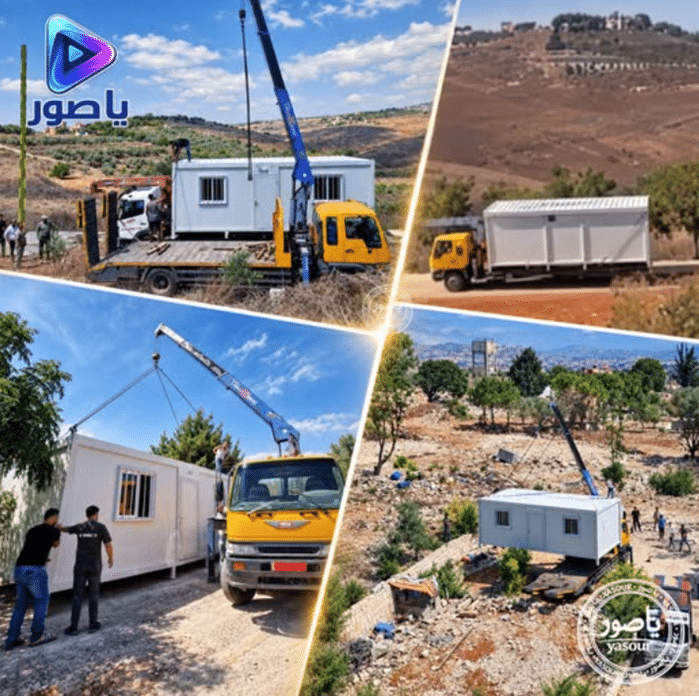
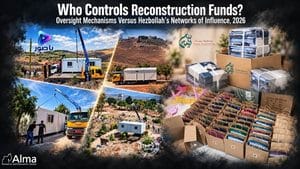
On September 21, the South Council began delivering the first batch of prefabricated homes to residents of Zawtar al-Gharbiyeh whose homes had been destroyed.
The delivery of prefabricated homes in Zawtar al-Gharbiyeh through the South Council illustrates the distinction between the source of the resources and the entity associated with their distribution. The state and donors may fund the assistance, while entities under the influence of Amal and Hezbollah remain the residents’ direct point of contact. The struggle over reconstruction therefore also takes place within and through state institutions.
In our assessment, Hezbollah cynically exploits the shortcomings of the government’s response. It portrays itself as assisting the population and the government as abandoning it, while presenting restrictions on its funding sources as harming civilians. In doing so, it seeks to turn the needs of those affected into an argument against measures intended to curb its power and divert criticism away from its responsibility for the war.
As we analyzed in the Alma Center’s October 4 article on Hezbollah’s civilian front against the government, actors affiliated with the organization also sought to channel residents’ protests into political pressure on the state. Demands for housing, compensation, and the restoration of services reflect genuine hardship, but their exploitation allows Hezbollah to portray itself as representing those affected and direct blame toward the government.
Residents’ hardship does not justify easing pressure on Hezbollah’s financing network. Funds transferred to Hezbollah may be used to rebuild its military capabilities and sustain its networks of dependence and influence, even when the transfers are presented as civilian aid. Its funding sources must therefore continue to be restricted, and entities linked to it must be prevented from exploiting reconstruction contracts. At the same time, aid provided under oversight should be expanded through state institutions and aid providers that are not under the organization’s control.
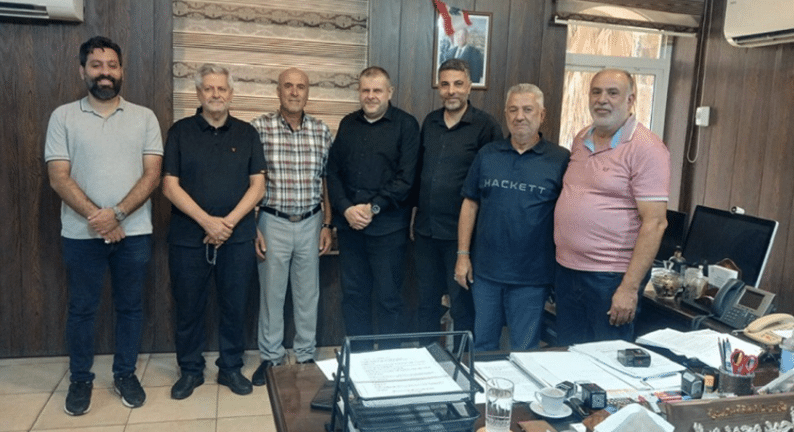
In the picture: A Hezbollah delegation led by the organization’s Sidon sector official, Sheikh Zaid Daher (fourth from the right), meets at government offices in Sidon with heads of government departments responsible for land affairs, education, agriculture, labor, civil registration, and the South Council. The delegation presented its activities as an effort to follow up on public service needs and improve cooperation with state institutions.
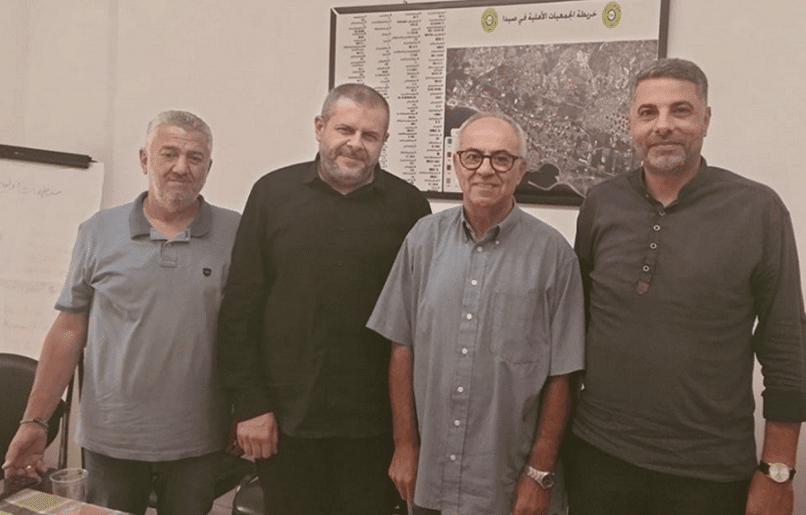
In the picture: On August 14, a Hezbollah delegation led by the organization’s Sidon sector official, Sheikh Zaid Daher (second from the left), visited Sidon Municipality. The delegation met with officials responsible for managing displacement shelters and discussed the needs of families still staying there and the continuation of assistance to them.
The Government’s Response Is Advancing but Remains Partial
In recent months, the government has announced aid and reconstruction measures, including financial assistance intended for 130,000 families, damage assessments, infrastructure work, and temporary housing solutions. During a visit to Nabatieh on October 2, Prime Minister Nawaf Salam announced 23 reconstruction tenders. These measures reflect an effort to restore the state’s functioning in the south, but do not establish how many families have actually received assistance or when a comprehensive response will be provided.
The scale of funding also limits capacity. The World Bank estimated reconstruction and recovery needs arising from the 2023–2024 war at approximately $11 billion, even before the additional damage sustained in 2026. Temporary housing solutions remain limited, and residents’ return also requires water, electricity, education, and employment. The gap between plans and everyday needs leaves many families without adequate support and gives Hezbollah grounds to continue criticizing the government.
Hezbollah’s Shelter Program: A Commitment to Aid and a Struggle for Public Standing
Hezbollah continues to provide medical services, distribute food and supplies, and maintain contact with displaced families and local authorities. These activities address certain needs, but are not equivalent to compensation for the loss of a home or long-term housing support. Reports of funding difficulties and frustration among some of its supporters illustrate the gap between its social presence and its ability to deliver reconstruction on a broad scale.
Following a series of reports about preparations to resume housing allowances, Ali Daamoush, head of Hezbollah’s Executive Council, announced a shelter program for displaced people and families whose homes were destroyed or severely damaged and are uninhabitable, and who have no alternative home. According to Daamoush, assistance is capped at $14,000 in Beirut and the Dahieh, and $12,000 elsewhere. These amounts include $8,000 for furnishings, plus $6,000 for rent in Beirut and the Dahieh or $4,000 in other areas.
The announcement presents a more clearly defined commitment than previous statements, but the report did not specify when payments would begin, how many families would receive them, or the total budget. The caps differ from earlier reports of a payment of approximately $3,000 to around 50,000 families, and the information provided does not explain how the arrangements relate to one another.
The source and scale of funding also remain unclear. The U.S. State Department denied a Reuters report that approximately $200 million had been transferred from Iran in September, while a Hezbollah source confirmed that money had been received without specifying the amount. Daamoush’s announcement does not verify the reported transfer. As we noted in the Alma Center’s October 8 article, a distinction must be made between the organization’s promises and funds that have actually reached eligible recipients.
In our assessment, the shelter program is also intended to restore Hezbollah’s standing as a source of funding and support for its base. The announcement allows it to present an alternative to the government’s response before its implementation can be assessed, while it continues to prioritize rebuilding its military capabilities.
Conclusion:
The challenge for the Lebanese government is to combine effective oversight with tangible assistance: preventing reconstruction resources from sustaining Hezbollah’s and Amal’s mechanisms while ensuring that those affected receive housing, services, and opportunities to earn a living. Without such a response, state weakness will continue to give Hezbollah opportunities to exploit the population’s hardship and maintain its dependence on the organization.