
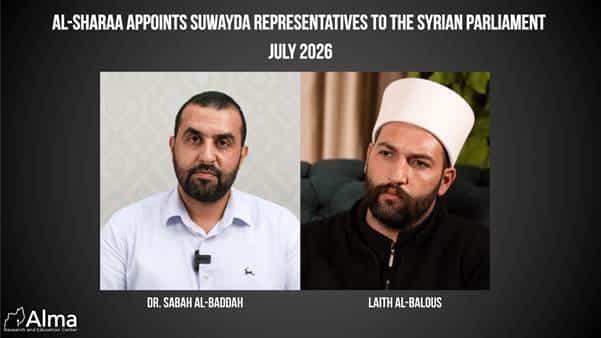
At the beginning of July, Syria’s Higher Committee for Elections announced the names of the 70 members of parliament appointed directly by President Ahmad al-Sharaa. These appointments complete the composition of the new 210-member parliament. The remaining two-thirds were selected through elections held beginning in October 2025 using an indirect electoral college system, rather than through direct public voting.
The completion of the parliament’s composition marks another step in the new regime’s efforts to establish state institutions and create the appearance of an orderly political process. At the same time, the manner in which the parliament was formed also reflects the governance challenges facing Damascus. The elections were not held simultaneously across the country, and their completion took many months due to territorial control gaps, security challenges, and local political tensions, further evidence that post-Assad Syria remains far from achieving stability and effective sovereignty over its entire territory.
Only this past weekend, exchanges of fire took place between regime forces and Druze militias in Suwayda.
It was only in May 2026 that elections were held in northeastern Syria, in areas that until recently had been under the control of the Autonomous Administration of North and East Syria (AANES) and the Syrian Democratic Forces (SDF). The elections in these areas had been postponed from October 2025 due to the unstable security situation and the fact that the regime had not yet reestablished effective control over the region. Completing the electoral process following the reintegration of these areas into the Syrian state was intended to signal the expansion of Damascus’s authority, but it does not necessarily indicate that the political disputes between the central government and the Kurdish actors have been resolved.
By contrast, Suwayda Province remained the only region in Syria where no elections were held. This was due to the ongoing tensions between the Druze population and the new regime, as well as internal divisions within the Druze leadership regarding the future of relations with Damascus, ranging from support for integration into the Syrian state to demands for greater autonomy (see our May 2026 report, The Druze in Suwayda: Ideological Divisions, Fragmented Leadership, and Multiple Armed Groups).
Against this backdrop, President Ahmad al-Sharaa chose to appoint two members of parliament representing Suwayda Province as part of his quota of 70 presidential appointments. The move was intended to provide the province with formal representation despite the absence of elections. However, this representation is largely symbolic, as the representatives were not elected by the province’s residents but were appointed directly by the president.
The two appointees are Laith Wahid al-Balous and Dr. Sabah Oqla al-Baddah.
Laith al-Balous is the son of Sheikh Wahid al-Balous, the founder of the Rijal al-Karama movement, who was assassinated in 2015. Al-Balous is affiliated with Madafat al-Karama and has in recent years been regarded as a relatively moderate figure. He opposes foreign intervention and initiatives aimed at partitioning Syria, while at the same time working to promote dialogue between the leadership in Suwayda and the central government.
Dr. Sabah Oqla al-Baddah is an academic and researcher specializing in Sharia studies who represents the tribal component of the province. He is known as a prominent social figure advocating for the rights of the Bedouin population in Suwayda and for strengthening its position within the local arena. His appointment also reflects the regime’s effort to portray Suwayda Province as comprising multiple communities rather than solely the Druze population, while providing political representation to the province’s Bedouin community as well.
From a political perspective, these appointments illustrate how the new regime is seeking to consolidate its authority by combining the establishment of state institutions with the careful management of local power centers. Rather than relying on competitive elections in a province where it has yet to establish full political and social control, al-Sharaa opted for a system of direct presidential appointments, enabling him to shape parliamentary representation in line with the interests of the central government.
The selection of individuals with established social and tribal standing was intended to convey a message of inclusion and representation, while also strengthening Damascus’s influence in the province through cooperation with local elites viewed as more pragmatic. In this sense, the move reflects the broader challenge facing the new regime: building legitimacy and state institutions in a country where sovereignty and governance remain uneven across its territory.


One Response
Dear Dr Zoe,
The whole al-Sharaa regime is extremely problematic at every level. He is an authoritarian, jihaddist, Erdogan muslim brotherhood puppet used for the delusional objective of advancing the illusion of the restoration of the ottoman empire. The Erdogan regime must die, along with his empirical lies, islamic terror, genocide, and delusions. Thanks to PM Netanyahu for calling him out for the ottoman islamic genocide against the Armenians.