
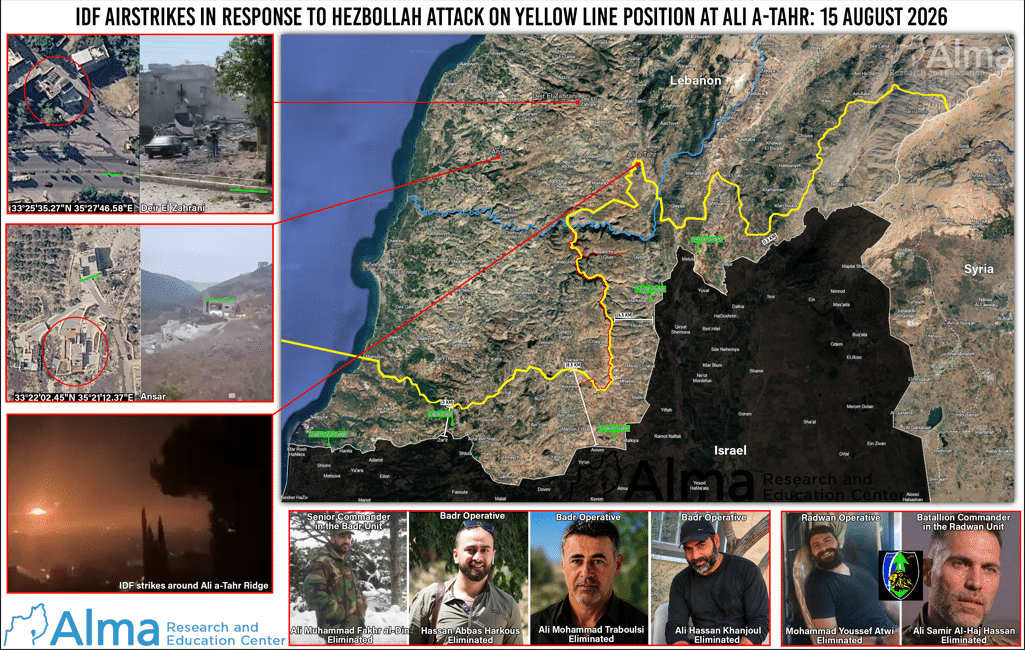
Hezbollah violated the ceasefire during the night of August 14–15, when it launched an explosive drone at Israel Defense Forces (IDF) troops positioned, in accordance with the Framework Agreement, inside the Yellow Zone in the Ali al-Taher Ridge area (مرتفع علي الطاهر). The explosive drone seriously wounded three IDF soldiers. This was the third explosive drone launched by Hezbollah against IDF forces in this area.
In response to Hezbollah’s violation, the IDF launched strikes against Hezbollah targets. The main strikes were carried out in Ansar (أنصار), Deir al-Zahrani (دير الزهراني), and the Ali al-Taher Ridge area. Six Hezbollah operatives were eliminated in the strikes, including two senior operatives from the Radwan Unit and the Badr Unit.
During the night of August 14–15, the IDF conducted a targeted strike against a Radwan Unit military headquarters operating from a civilian building inside the village of Ansar, in the Nabatieh Governorate of southern Lebanon. The strike eliminated Ali Samir Al-Haj Hassan (علي سمير الحاج حسن), from the village of Chmistar (شمسطار) in the Bekaa Governorate. Hassan served as a fawj commander (a battalion commander) in the Radwan Unit.
At the time of the strike, the wife and four children of Ali Samir Al-Haj Hassan were inside the headquarters building in Ansar. What were Hassan’s family members doing inside a Radwan headquarters in Ansar? Hezbollah routinely employs human-shield tactics in an attempt to disrupt strikes against its operatives and assets – or, when a strike does occur, to falsely accuse Israel of deliberately targeting innocent civilians.
The Lebanese leadership cooperated with Hezbollah’s false narrative. In his response to the strike, Lebanon’s prime minister completely ignored the fact that Hezbollah had violated the ceasefire and that the target was a Hezbollah headquarters from which a senior terrorist operative in the Radwan Unit was operating.
According to local reports, another operative – whom we assess was also a member of the Radwan Unit – was eliminated in the Ansar strike: Mohammad Youssef Atwi (محمد يوسف عطوي), from the village of al-Sarafand (الصرفند).
On the evening of August 15, 2026, the IDF struck a Badr Unit military asset inside the village of Deir al-Zahrani, eliminating Ali Muhammad Fakhr al-Din (علي محمد فخر الدين), also known as Abu Hassan Alaa (أبو حسن علاء), a senior Hezbollah Badr Unit commander. Also eliminated alongside him were Ali Hassan Khanjoul (علي حسن حنجول), known as Zakaria زكريا)), from the village of Arabsalim (عربصاليم); Ali Mohammad Traboulsi (علي محمد طرابلسي), from Deir al-Zahrani; and Hassan Abbas Harkous (حسن عباس حرقوص), from the village of Harouf (حاروف).
Fakhr al-Din was from the village of Younine (يونين) in the Bekaa. In recent years, he commanded several combat sectors operating against IDF forces and Israeli civilians. He also took part in advancing attack plans against IDF forces operating in Lebanon, particularly the launch of explosive drones at IDF soldiers in the security zone in southern Lebanon.
Two facts should be recalled. First, Hezbollah constructed strategic underground infrastructure beneath the Ali al-Taher Ridge that serves as a central headquarters of the Badr Unit. The survival of the operatives trapped inside this infrastructure would provide Hezbollah with a strategic victory image.
Second, Hezbollah seeks to derail the negotiations between Israel and the Lebanese state. With Iranian backing, Hezbollah is operating in the Ali al-Taher Ridge area to achieve both objectives described above. At the same time, Iran is exploiting developments on the ridge as a potential lever in its dealings with the United States.



One Response
Hezbollah terrorists are terrorists in their tactics, strategies and operational lies and deceptions for propaganda purposes to create a narrative to project the inversion of reality.
Hezbollah are the genocidal occupiers of Lebanon, not the IDF who are the liberators. When hezbollah is totally destroyed, Lebanon can then recover from this parasitic disease and incoherent babbling due to toxic paralysis.