
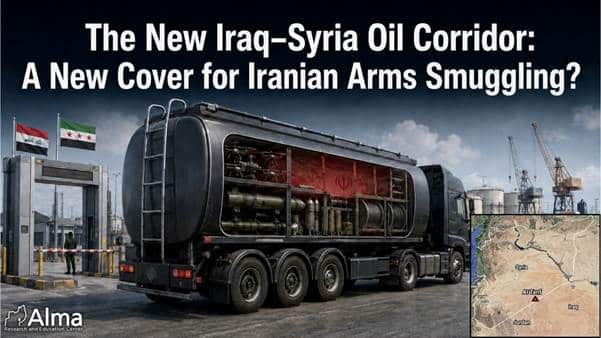
The sharp increase in the movement of oil tanker trucks through the al-Tanf crossing in southeastern Syria provides Iraq with an alternative export route, but also creates new civilian cover for smuggling Iranian weapons to Hezbollah.
Since April 2026, a new overland corridor has been operating to transport fuel oil from Iraq through Syria to the port of Baniyas. The route was opened following severe disruptions to tanker traffic in the Strait of Hormuz and Iraq’s urgent need to find an alternative to its export terminals in the Gulf. Hundreds of oil tanker trucks cross the Iraq–Syria border each day at the al-Waleed–al-Tanf crossing, continue westward through Syrian territory, and unload their cargo at the port of Baniyas, where the fuel oil is transferred to ships and sent to international markets.
For Iraq, which is almost entirely dependent on oil revenues, this is an essential economic measure. For Syria, the route generates transit-fee revenues, enables it to restore its status as a commercial and energy bridge between Iraq and the Mediterranean, and allows it to market itself as a potential future commercial bridge between the Gulf states and the Mediterranean. However, the same overland corridor, designed to bypass the Strait of Hormuz, also creates a new opportunity for Iran and its proxies: concealing weapons smuggling within legitimate, dense, and continuous civilian commercial traffic passing through one of the most sensitive regions in the Middle East.
This threat is not theoretical. As we previously reported, on July 16, the Syrian Ministry of Interior announced that it had thwarted an attempt to transport a large shipment of advanced weapons from Iraq through Syria to Hezbollah in Lebanon. According to reports, the weapons were concealed inside an oil tanker truck bound for Baniyas. The shipment was discovered during an inspection at the al-Tanf crossing and included, among other items, FPV drones, specialized drone warheads, fiber-optic cables, anti-tank missiles, including what was apparently an Iranian-made Almas system, as well as components used in Paveh-family cruise missiles, which Hezbollah had already employed during the war.
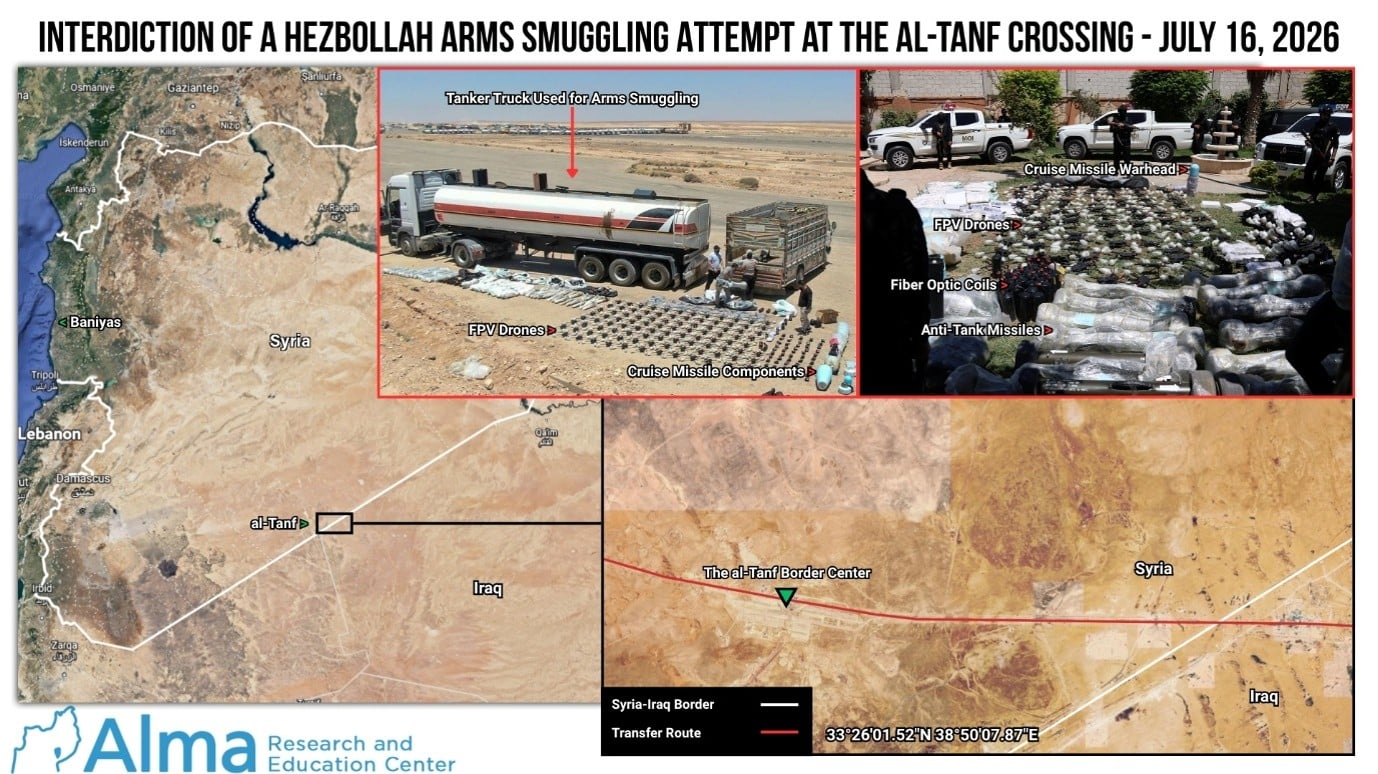
It is quite possible that individuals on the Iraqi side of the border assisted in transferring the shipment. Following the incident, the Iraqi prime minister ordered the establishment of an investigative committee and the coordination of the inquiry with the Syrian authorities. The very need for a joint investigation illustrates the route’s central weakness: its oversight depends on two border-control systems that suffer from limited resources, corruption, fragmented authority, and the presence of local networks and armed groups. Actors affiliated with pro-Iranian militias also operate in Iraq, some of whom have access to state institutions and civilian infrastructure.
The Pilot That Became an Active Corridor
In late March 2026, Iraq’s state-owned oil marketer, SOMO, awarded contracts to four Iraqi oil traders to transport approximately 650,000 metric tons of fuel oil per month through Syria. The pilot was intended to operate from April through June, but fuel oil continued to move through Baniyas in July. The names of the four traders were not disclosed, and the identities of some of the end buyers remain unknown.
The logistical scale is significant. According to reports based on Syrian sources and maritime tracking data, Baniyas received up to approximately 900 oil tanker trucks per day during this period, while one vessel was loaded at the port every seven to ten days. Even if the figures vary from day to day, this represents an unusual increase in heavy-vehicle traffic between Iraq and Syria.
In June and July 2026, three Aframax vessels were loaded at Baniyas with Iraqi fuel oil destined for the U.S. market, amounting to approximately 1.42 million barrels in total:
- On Passion: loaded approximately 716,600 barrels (scheduled to unload its cargo in the U.S. state of Texas later this month).
- Nissos Christina: loaded approximately 288,500 barrels (its cargo is scheduled to be unloaded on the U.S. Gulf Coast in early August).
- Green Warrior: loaded approximately 414,400 barrels (expected to reach the United States in the third week of August).
Assuming that a single tanker truck can carry an average of approximately 200 barrels of fuel oil, transporting the above quantity to Baniyas required approximately 7,100 tanker trucks.
These shipments were not made under a U.S. government agreement. As far as is known, they were commercial transactions based on SOMO contracts with Iraqi oil traders. The identities of the U.S. importers and refineries were also not disclosed. Nevertheless, the fact that fuel oil transported through this corridor is now reaching the U.S. market gives the route direct importance for Washington.
Alongside the tanker-truck route, a broader plan is being advanced to rehabilitate and construct an oil pipeline from Iraq through Syria to the port of Baniyas. In July, Iraq and Syria signed a memorandum of understanding in Washington to advance the project, in the presence of the U.S. Secretary of Energy. An additional memorandum was signed with a consortium comprising the U.S. companies Chevron and TI Capital and Qatar’s UCC Holding to prepare technical and financial studies and develop an implementation framework. The U.S. Department of State welcomed the initiative and described it as an infrastructure project of regional strategic importance.
A distinction must therefore be made between two levels: the current transportation of fuel oil by tanker trucks is conducted under Iraqi-Syrian commercial arrangements, while the documented U.S. support focuses primarily on the future pipeline project.
However, as Washington supports the expansion of this energy corridor, and as the U.S. market becomes a destination for shipments transported through it, the United States cannot regard the route’s security as solely an internal Iraqi and Syrian matter.
The Legitimate Corridor as a Cover
The smuggling attempt does not prove that the oil trade as a whole serves as an Iranian mechanism for transferring weapons. It does, however, demonstrate that Iran and its allies have already identified the potential created within legitimate traffic. This is a well-known and established modus operandi of the Shiite axis: using a civilian façade to conceal military terrorist activity.
Smuggling networks do not need to take control of the entire corridor. A small number of drivers, customs officials, terminal operators, or individuals within the security services is sufficient to insert an illicit shipment among thousands of legitimate journeys. As traffic volume increases, conducting a thorough inspection of every tanker truck without paralyzing the route becomes increasingly difficult. Economic pressure to ensure the rapid flow of oil may also encourage partial inspections and greater reliance on cargo documents, seals, and driver lists, measures that smuggling networks can forge or circumvent.
A tanker truck is particularly well suited for concealment. It is large, sealed, and difficult to inspect fully; it travels as part of commercial convoys; and delaying it for unloading or thorough scanning entails time, expense, and safety risks. The fact that the truck caught smuggling weapons carried documents and listed a destination that appeared to fit the commercial route to Baniyas illustrates how a legitimate route can provide a convincing cover story.
Over the years, Iran has used civilian trucks, fuel tankers, transportation companies, and trade documents to conceal military transfers throughout the Shiite axis. From Iran’s perspective, the disruption of the old corridor following the fall of the Assad regime does not negate the strategic objective: rebuilding Hezbollah and transferring advanced systems to Lebanon. Instead, it requires adaptation, dispersion, and deeper integration into civilian infrastructure and regional trade.
The Vacuum Left by the U.S. Withdrawal
Al-Tanf’s location gives it importance extending far beyond that of an ordinary border crossing. It lies near the Iraq–Syria–Jordan tri-border area and along the shortest route connecting Iraq to central Syria and, from there, to Lebanon. For years, the U.S. presence at the al-Tanf base restricted Iran’s freedom of action along this route and forced it to rely more heavily on the northern route through al-Bukamal and Deir ez-Zor.
In February 2026, the United States completed its withdrawal from the al-Tanf base and handed it over to forces of the new Syrian regime. The withdrawal did not create the smuggling networks, but it removed a layer of oversight, intelligence, and deterrence that had disrupted Iranian activity in the area for years. As mentioned above, only a few months later, a large shipment of Iranian weapons concealed inside an oil tanker truck was intercepted at the same crossing.
A single incident is not sufficient to determine that the U.S. withdrawal enabled the smuggling attempt. Nevertheless, the combination of circumstances should raise a red flag in Washington: the departure of U.S. forces, the opening of the border crossing to large-scale commercial traffic, the weakness of the oversight mechanisms in both countries, and the discovery of an advanced weapons shipment inside one of the oil tanker trucks.
The interception of the shipment should not create a sense of security either. While it indicates that the Syrian authorities are willing, at least in some cases, to act against arms smuggling to Hezbollah, it simultaneously raises the question of how many shipments passed through undetected. When thousands of trucks travel along the route, a single interception may represent a localized success, but it may also point to a broader phenomenon. Indeed, according to local reports, this was not the first attempt to smuggle weapons through the al-Tanf land corridor, and several previous shipments reportedly reached their destination. One unverified report even claimed that six previous shipments had passed through successfully.
U.S. Responsibility: Economic Support Requires a Security Framework
The United States has a legitimate interest in helping Iraq reduce its dependence on the Strait of Hormuz and limiting Iran’s ability to use it as a means of exerting pressure on the global energy market. Strengthening economic ties between Iraq and Syria could also contribute to their stability and reduce their dependence on Tehran. However, without a reliable oversight mechanism, a route intended to reduce Iranian leverage in the Strait of Hormuz could simultaneously expand Iran’s leverage along the overland corridor to Lebanon.
Washington should not obstruct trade, but rather condition its support for the corridor’s expansion on the establishment of an appropriate security framework. Such a framework should include technological scanning of tanker trucks at border crossings and in Baniyas; continuous digital verification of vehicles, drivers, and cargoes; the use of electronic seals and GPS tracking devices that cannot be removed without triggering an alert; cross-checking the quantities loaded in Iraq against those unloaded in Syria; and surprise inspections that do not rely solely on local border personnel.
In addition, a joint intelligence mechanism involving the United States, Iraq, and Syria and potentially other countries with interests in the region is needed to map transportation companies, traders, drivers, and border officials suspected of ties to the Islamic Revolutionary Guard Corps and the Iraqi militias.
The identities of the four traders awarded the SOMO contracts and the ownership structures of the companies involved should be disclosed, and transparency should be required regarding the end buyers and the commercial supply chain. Any actors found to be involved in smuggling should face license revocation, asset freezes, and individual sanctions.
U.S. involvement in the future pipeline project gives Washington significant leverage. It should be used now to ensure that the pipeline, terminals, and feeder routes are not operated by companies or subcontractors linked to the Iranian axis. Security should be a prerequisite for investment and financing, not an additional consideration to be examined after the corridor has been expanded.
Conclusion
The oil corridor from Iraq to Baniyas represents an important shift in the regional energy landscape. It allows Iraq to bypass the Strait of Hormuz, generates revenue for Syria, and reconnects both countries to the Mediterranean. Precisely for this reason, its traffic volume and political importance are expected to continue growing.
The smuggling attempt thwarted in an oil tanker truck at al-Tanf is a warning sign. Iran does not need to immediately restore the old military corridor that operated under the Assad regime. It can exploit the new economic corridor, integrate its activities into legitimate oil traffic, and use it to transfer military components in small, dispersed shipments. For Hezbollah, which is rebuilding after the damage it sustained during the war, even such shipments could be of significant value.
The United States seeks to turn the route into an instrument of stability, prosperity, and reduced dependence on Iran. To prevent this objective from being reversed, Washington must recognize that supply-chain security is an integral part of energy security. Greater caution, transparency, and strict oversight are not obstacles to the corridor’s development, they are essential to ensuring that it does not become Hezbollah’s new reconstruction route.


One Response
Dear Dr Zoe,
Thank you for bringing this to LIGHT! The axis of IRGC resistance has infected the region for 47 years, and its roots extend back to the grand mufti-hitler genocidal war of a century ago. They resist the G-d of Israel, the existance of Israel, and their policy is “death to Israel.” They will not be allowed to carry out their death threats. They will be crushed along with the head of the serpent they represent.