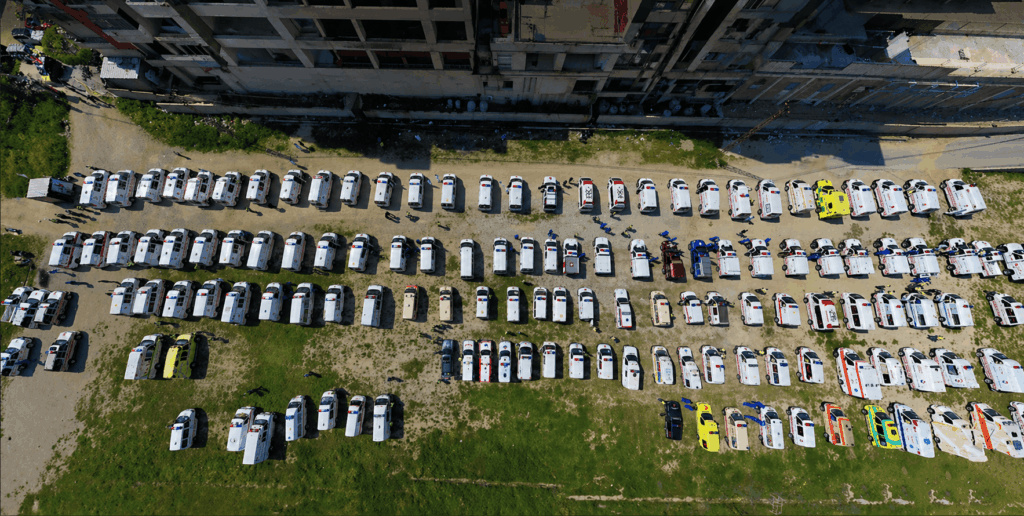
The healthcare system of the “Shiite duo” in Lebanon exploits its humanitarian status, which grants it protection from attack under international law, yet in practice it is deeply integrated into the military activities of Hezbollah and the Amal Movement, including the smuggling of weapons and the transport of operatives. This phenomenon illustrates one of the central characteristics of Hezbollah’s operational model, the deliberate blurring of the boundaries between civilian and military spheres.
Since the beginning of the campaign against Hezbollah on March 2, Lebanese and international media have claimed that Israel is deliberately targeting medical personnel, ambulances, and hospitals. According to data from the Lebanese Ministry of Health, approximately 100 medical personnel (most of them paramedics) have been killed so far, and 116 ambulances have been damaged.
Hezbollah’s health organizations, foremost among them the Islamic Health Organization, which operate under the Executive Council, are presented outwardly as a civilian-humanitarian system, but in reality, constitute a central pillar in the organization’s hybrid structure. This structure is not merely a byproduct of dual-use activity, but rather an organized strategy that serves the concept of a “society of resistance.” According to this concept, all civilian systems, education, welfare, and healthcare, are mobilized in support of the military effort, serving as a supporting, enabling, and even complementary infrastructure to combat capabilities.
As we published in the special report on the Executive Council, operatives within the healthcare system are systematically integrated into military activity, and at times operate alongside fighters and even participate in operational missions.
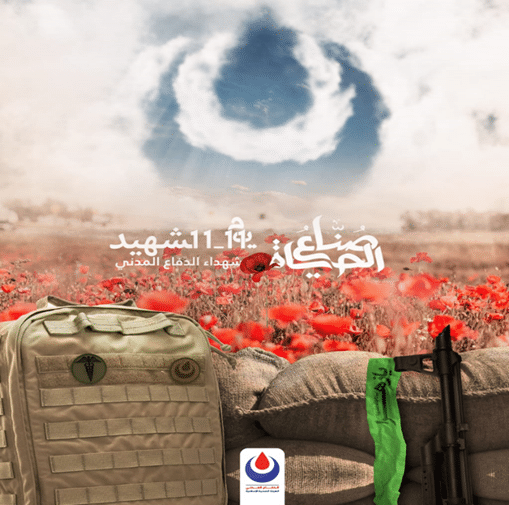
In the picture: A poster published on the occasion of “Commemoration Day- Alshahid day” (November 2020) illustrates the connection between Hezbollah’s Islamic Health Organization and Hezbollah’s military arm and emphasizes the activities of the health organization’s members within the military wing and the inseparable connection between them.
The “Islamic Health Organization,” which stands at the center of Hezbollah’s healthcare system, effectively functions as a kind of Hezbollah Ministry of Health. The Islamic Health Organization operates an extensive network of hospitals, clinics, and emergency services, providing medical services to the Shiite population as a substitute for the weak and collapsing healthcare system of the Lebanese state. In parallel, Hezbollah also operates a “civil defense” system, while the Amal Movement runs the “al-Risala” ambulance service.
Beyond their ostensibly civilian function, the health organizations also fulfill clear military roles. In times of conflict, they operate as an organic “medical corps” of Hezbollah, accompanying combat forces and providing them with medical treatment in the field. Moreover, there is significant overlap between medical personnel and military operatives, blurring the distinction between a healthcare worker and a combatant. This overlap is not incidental, but rather part of a mechanism that enables operational flexibility while cynically exploiting the protected status of medical actors.
Another central aspect is the use of medical infrastructure as cover for military activity. As can be seen in the attached video, ambulances are used to transport operatives, weapons, and operational equipment, and at times even for the storage of weapons and the management of military activity from within them (a mobile command post).
This pattern of activity directly aligns with the “human shield” tactic, within which military assets are embedded within civilian environments in order to complicate attacks against them and to raise the political and legal cost of striking them.
Hospitals operated by Hezbollah’s Islamic Health Organization are also part of this system. There are indications that weapons are stored near or within hospitals.
For example, on April 14, the IDF struck a weapons depot in Tebnine located approximately 50 meters from a hospital; in the footage, secondary explosions from the strike can be seen, indicating the presence of weapons. This location is not incidental: it is intended both to deter attacks and to serve the information campaign in the event of a strike, so that Israel is portrayed as deliberately targeting and harming medical infrastructure, thereby undermining the legitimacy of Israeli action.
In this context, it is important to emphasize that under international law, the immunity of medical facilities and personnel is conditional upon their not taking part in military activity. The use of medical infrastructure for military purposes may deprive them of this protection. Therefore, claims of unlawful harm cannot be assessed in isolation from the question of whether these infrastructures were used for military purposes.
The connection between the healthcare system and the Iranian axis adds another dimension to understanding the phenomenon. Elements affiliated with the Islamic Revolutionary Guard Corps and the Quds Force sometimes operate under civilian-medical cover, and in certain cases shipments of medical supplies are used to conceal the transfer of military equipment. In this way, the ostensibly humanitarian space becomes another arena of covert military activity as part of Iran’s regional strategy.
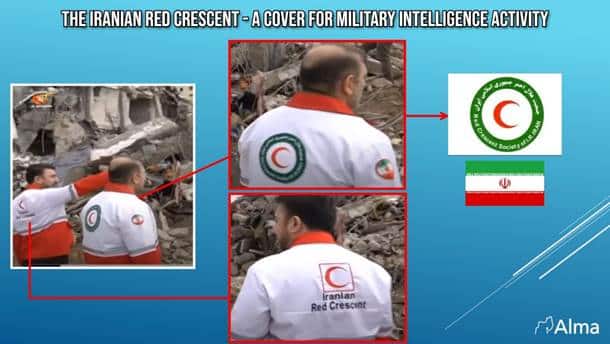
Iranian Red Crescent personnel in Nabatieh, Lebanon, December 2024
In conclusion, Hezbollah’s healthcare system cannot be regarded as a neutral humanitarian mechanism. It is a multi-functional system that combines civilian, military, and cognitive roles, and serves as a central pillar in the organization’s operational strategy. The integration of the civilian and military dimensions is not incidental but systematic and deliberate, aimed at preventing the very distinction that international law makes between those involved and those not involved, and in practice constitutes a “human shield in white” for Hezbollah’s military terrorist activity and that of the organizations operating alongside it.