
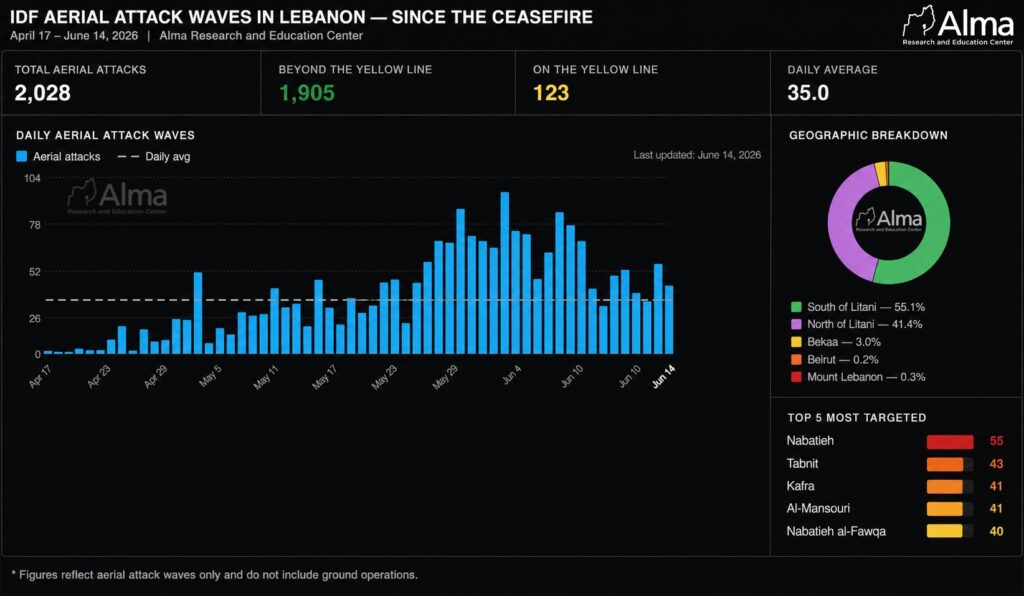
Key Trends This Week During the past week (8–14 June), the IDF conducted 281 waves of airstrikes across Lebanon. This represents a significant decrease compared to the previous week, during which 436 waves of airstrikes were carried out—a decline of approximately 36% in the scope of aerial operations.
Geographically, 144 strikes were conducted south of the Litani River, accounting for 51.2% of all strikes during the week, while 124 strikes were carried out north of the Litani, representing 44.1% of total strikes. In addition, 11 strikes were conducted in the Beqaa Valley (3.9% of all strikes), and one strike was carried out in Beirut (0.4%).
The vast majority of strikes were conducted outside the Yellow Line, with 271 out of 281 strike waves (96.4%) occurring in these areas. Only 10 strikes (3.6%) were carried out within the Yellow Line.
The strike in Beirut on 14 June was conducted in response to Hezbollah violations of the ceasefire understandings and its continued launches of UAVs and rockets toward Israeli communities.
Cumulative Data Since the Ceasefire
Since the beginning of the ceasefire, between 17 April and 14 June 2026, the IDF has conducted 2,028 waves of airstrikes in Lebanon, averaging 35 strike waves per day.
Most strikes were carried out south of the Litani River—1,117 strike waves, representing 55.1% of all strikes. An additional 840 strikes were conducted north of the Litani (41.4%), 61 strikes in the Beqaa Valley (3.0%), six strikes in Mount Lebanon (0.3%), and only four strikes in Beirut (0.2%).
The geographic areas that have sustained the highest number of strikes since the beginning of the ceasefire are Nabatieh (55 strikes), Tebnine (43), Kafra (41), Al-Mansouri (41), and Nabatieh al-Fawqa (40).
Note: The data presented in the charts refer exclusively to IDF airstrikes and do not include ground operations, artillery fire, or other military activities conducted during the period under review.



One Response
Dear Dana,
My desire is to see all hezbollah forces Totally Defeated. Israel should continue to defend itself. Until the ayatollah, the IRGC, and hezbollah all change their death cult mission statements, Israeli airstrikes and military countermeasures should continue. There can be no peace with terrorists attacking Israeli children going to school.