
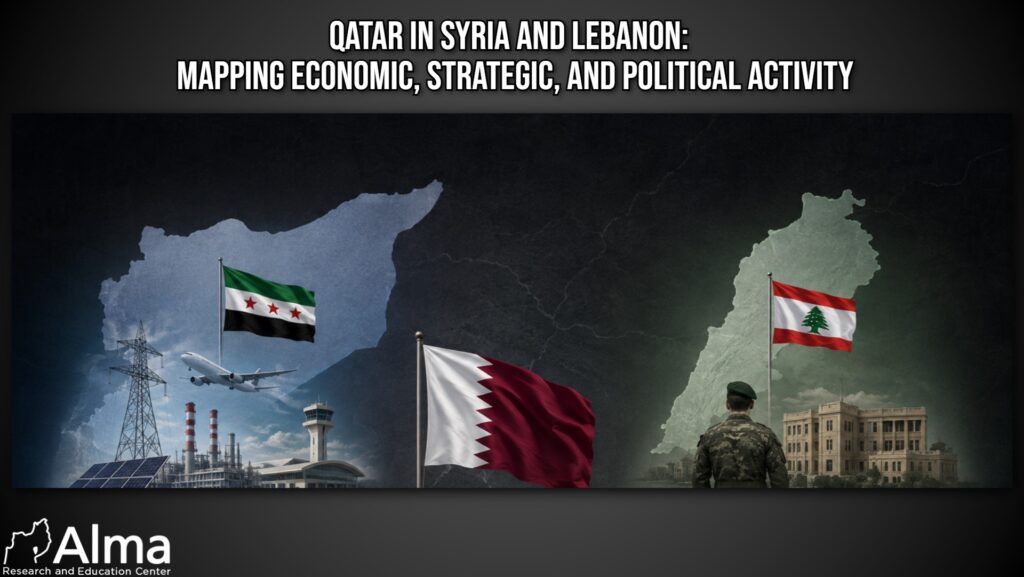
From January 2024 through the time of writing this report in August 2026, Qatar has continued to build a dual presence in the Syrian and Lebanese arenas: In Syria, as a leading investor in infrastructure and energy; and in Lebanon, as an important source of funding for the Lebanese Armed Forces and as part of an effort to position itself as a diplomatic mediator between Jerusalem and Beirut, while Qatari funding may also assist Hezbollah.
In Syria, out of approximately $25.9 billion in reported commitments under some 40 memoranda of understanding signed between the new Syrian administration and companies and consortiums from the Gulf and Turkey, a Qatari-Turkish-American consortium led by UCC Holding is responsible for two memoranda of understanding worth about $11 billion.
In Lebanon, Qatar has gradually expanded its support for the Lebanese Armed Forces from salary subsidies alone to funding vehicles, fuel, and infrastructure, while at the same time becoming a mediator in the indirect dialogue track between Israel and Lebanon, and reportedly also in additional regional channels.
At the same time, Qatar is channeling funds into Shiite areas and thereby, in practice, assisting Hezbollah in stabilizing and strengthening its power.
Syria: From the Collapse of the Regime to Large-Scale Infrastructure and Energy Investments
On January 30, 2025, the Emir of Qatar, Sheikh Tamim bin Hamad Al Thani, became the first Arab leader to visit Damascus after the change of government in Syria in December 2024.
This visit was the first by a head of state to Syria since the fall of the Assad regime on December 8, 2024, and the first visit by the Emir of Qatar to the country in more than 14 years.
During his meeting with President al-Sharaa, the Emir emphasized the need for an “inclusive” government and held detailed discussions on the rehabilitation of infrastructure, communications, the internet, and banking.
Since that visit, Qatar has expanded its involvement across all sectors: Energy, infrastructure, health, and the financial sector. In March 2025, Qatar, through the Qatar Fund for Development and in cooperation with the United Nations Development Program, announced the supply of natural gas to Syria via Jordan, enabling the generation of about 400 megawatts of electricity at the Deir Ali power station in Syria.
In May of that year, Syria signed a memorandum of understanding with a Qatari-Turkish-American consortium led by UCC Holding, which includes Power International USA and two Turkish companies — Kalyon and Cengiz — for the construction of four power plants and a solar farm, with a financial scope of about $7 billion.
Separately, on August 2, 2025, the Qatar Fund for Development announced the opening of the Turkey-Syria gas pipeline and the beginning of gas supplies from Azerbaijan to Syria via Turkey, with Qatari support, in order to increase electricity production at the power plant in Aleppo. Thus, these are two separate tracks: supply via Jordan in March 2025 and supply via Turkey in August 2025.
On August 6, 2025, a package of 12 strategic projects was signed in Damascus, with a reported total value of $14 billion, in the fields of infrastructure, transportation, and real estate. The package included a roughly $4 billion project to rehabilitate and expand Damascus International Airport with UCC Holding; alongside this, additional projects were reported, including a metro system in Damascus.
The chairman of the Syrian Investment Authority, Talal Al-Hilali, stated at the same ceremony that “the meeting was not merely an official event, but a clear and explicit declaration that Syria is open for investment.”
During this period, Qatar also financed a program to pay the salaries of Syrian public-sector employees, at a cost of $29 million per month, for three months, alongside humanitarian aid that included medicines, medical equipment, food, and the rehabilitation of water and sewage systems in rural areas and areas affected by the war.
On April 24, 2026, Syrian Finance Minister Mohammed Yasser Barnieh confirmed that cooperation with the Qatar Fund for Development, in the project to assess Syria’s financial and banking sector, constitutes “an important strategic stage in the process of qualitative transformation” in Syria’s economy.
According to estimates by the Syria-focused research and advisory firm Karam Shaar, out of approximately 40 memoranda of understanding signed between Syria and actors from the Gulf and Turkey, the scope of reported commitments stood at about $25.9 billion. Within that amount, a Qatari-Turkish-American consortium led by UCC Holding signed two memoranda worth $11 billion — about 43 percent of all reported commitments.
The FDD institute in Washington warned that the sweeping financial commitments by Gulf states, including Qatar, to the reconstruction of Syria carry a terror financing risk, in the absence of clear monitoring mechanisms regarding the targets of the investment.
Syria: The Qatari Objective and Cooperation with Turkey
Qatar’s objective in Syria goes beyond commercial investment or humanitarian aid. Doha seeks to anchor itself as one of the architects of the post-Assad order through control over, or a long-term presence in, essential infrastructure assets: electricity, gas, aviation, transportation, communications, banking, and public services.
Investment in power plants, gas supplies, Damascus airport, and the financial system gives Qatar influence over the new administration’s ability to provide basic services, attract foreign capital, and restore public legitimacy. In practical terms, Doha is not merely financing projects; it seeks to become an indispensable partner in the daily functioning of the regime in Damascus.
Cooperation with Turkey enables a clear division of labor. Qatar brings the wallet, and Turkey brings the power. Qatar brings capital, ties with international financial institutions, and the ability to finance long-term projects; Turkey brings a land border, construction companies, logistics networks, operational knowledge, a security presence, supply and military training capabilities, and direct political influence over large parts of northern Syria.
The agreement to build four power plants and a solar farm is expected to provide more than half of Syria’s electricity consumption once completed. In the same pattern, the Damascus airport project is being carried out through a consortium led by Qatar’s UCC and including major Turkish companies, among them Kalyon, Cengiz, and TAV.
This cooperation also has a geopolitical objective. It enables the two countries to reduce the space remaining for Russian and Iranian influence in Syria, bind Syria’s economy to themselves, and build energy, trade, and transportation routes that pass through Turkey. For Ankara, Qatari capital finances part of the ambition to turn Syria into an economic and security space linked to Turkey; for Doha, the Turkish presence provides a mechanism of protection, logistics, and implementation capacity that Qatar does not possess on its own.
Lebanon: From Salary Subsidies to the Role of Regional Mediator
Qatar’s support for the Lebanese Armed Forces began well before the period covered in this report: as early as 2022, Doha pledged $60 million to support soldiers’ salaries. In July 2024, Qatar transferred an additional $20 million to the Lebanese Armed Forces, and in April 2025, Qatar sent another fleet of military trucks alongside an additional $60 million donation to fund officers’ salaries.
On January 26, 2026, Qatar’s Minister of State for Foreign Affairs, Dr. Mohammed bin Abdulaziz Al-Khulaifi, confirmed that Qatar had supported the salaries of the Lebanese Armed Forces for four consecutive years, and that this support could also expand to the Lebanese Internal Security Forces (ISF).
The Internal Security Forces operate under the Ministry of Interior. The organization is, in effect, Lebanon’s national police and official security force.
In February of this year, an international meeting in support of the Lebanese army and security forces was held in the Qatari capital, Doha, with the participation of the United States, France, Egypt, Qatar, and Saudi Arabia.
On February 19, 2026, al-Khulaifi participated in another preparatory meeting in Cairo ahead of the Paris conference in support of the Lebanese Armed Forces.
Beyond financial support, Qatar attempted in the summer months of 2026 to become a central mediator between Israel and Lebanon. According to Lebanese and international reports, on June 19, 2026, talks began in Bürgenstock, Switzerland, under Qatari-Pakistani mediation and with American supervision or involvement, around an indirect dialogue track between Israel and Lebanon and issues related to Hezbollah.
According to a report in the Lebanese newspaper Al-Akhbar, a central mouthpiece of Hezbollah, the talks examined a Qatari initiative under which Doha would mediate indirect negotiations, while preserving the involvement of Lebanon’s official government, with the aim of reaching a stable, long-term ceasefire, in coordination with Washington and in coordination with Saudi Arabia.
Qatar as a Political Lever in Lebanon: Beyond Subsidies
An analysis published on June 16, 2026, by the Jerusalem Institute for Strategy and Security indicates that Qatar’s involvement in the Lebanese arena crossed, in 2025, the line between purely humanitarian-military assistance and a mechanism of strategic leverage. According to the analysis, Qatar’s prime minister held talks in 2025 with the commander of the Lebanese Armed Forces regarding assistance to the army and to additional institutions, and Qatar’s ambassador in Beirut conveyed direct messages to Lebanon’s president and prime minister, including Qatari grants that were conditioned on specific political demands.
In August 2025, Qatari delegations held discussions on assistance for electricity, water, and the army — all in exchange for political coordination with Doha. Ultimately, Qatari money and political influence in Lebanon assist Hezbollah because they reach Shiite villages in southern Lebanon directly rather than the Lebanese state.
In practice, there is no supervision or oversight by the Lebanese state, and Hezbollah will in any case be at the forefront — that is, from the perspective of the Shiite resident, Hezbollah is responsible for the flow of funds.
For example, as early as January 2026, before the outbreak of the current escalation in Lebanon, Qatar allocated $480 million for the reconstruction of three Lebanese villages in the south of the country, including Kfar Kila and Aita al-Shaab, as well as communities in the western sector such as Yarin, Jibbain, Tayr Harfa, and Alma al-Shaab, and announced an additional sum of $400 million for the reconstruction of the south — without any conditions from Hezbollah.
Qatari assistance to Lebanon gives Doha a double lever: direct access to Lebanese state institutions, foremost among them the army and security forces, alongside the ability to influence the pace of reconstruction in the Shiite sphere. From Hezbollah’s perspective, the value of the assistance is not necessarily in the direct transfer of funds to the organization, but rather in the way unconditional aid, or aid that is not subject to verification of disarmament, reduces the political and social cost of continuing to hold weapons.
As the residents of Shiite villages in the south receive fuel, electricity, infrastructure, housing reconstruction, and civilian services, Hezbollah can present itself as the actor that preserves the “resistance” and provides protection, while external funding — which the Shiite resident at the base does not distinguish from Hezbollah money — helps blunt the consequences of the confrontation for the organization’s support base.
This mechanism is important because Hezbollah does not rely only on military power. It maintains a parallel civilian system that includes Jihad al-Bina, Hezbollah’s civilian construction and reconstruction arm, aid networks, health institutions, education, and community services. These systems allow the organization to create dependency and a “captive audience.”
When reconstruction funds reach villages in the south through local councils, contractors, and aid networks that are not subject to sufficient external oversight, Hezbollah and its partners in the Amal movement can influence priorities, the identity of service recipients, and the allocation of resources. Therefore, external assistance that is not conditioned on the verified dismantling of military infrastructure may, in practice, strengthen the civilian system within which Hezbollah operates, even if the money is not transferred to the organization directly.
To this is added a political effect. Qatar presents itself as a mediator capable of speaking with all sides: the Lebanese government, the Lebanese Armed Forces, the United States, Hezbollah, and Israel. This capability increases its weight, but it also creates an incentive to prefer formulas of temporary de-escalation and conflict management over strict demands for Hezbollah’s disarmament.
Conclusion
Throughout the period under review, Qatar appears as a regional actor seeking to convert capital, aid, and diplomatic mediation into long-term structural influence. In Syria, Doha is not content with assistance for reconstruction after Assad’s fall, but seeks to anchor itself in the core of the new economy through energy, electricity, aviation, transportation, banking, and public services, while cooperating closely with Turkey.
In Lebanon, support for the army and civilian systems, alongside mediation vis-à-vis Israel, Hezbollah, and international actors, gives Qatar political leverage that goes beyond salary subsidies or humanitarian aid. However, the very breadth of this involvement sharpens the central risk: in the absence of clear conditions, external oversight, and a genuine link between assistance and the strengthening of state sovereignty and the dismantling of armed infrastructure, Qatari money may stabilize not only state institutions, but also Hezbollah’s systems of power.
Sources
- https://mofa.gov.qa/en/qatar/latest-articles/latest-news/details/2026/01/26/minister-of-state-at-ministry-of-foreign-affairs-stresses-qatar’s-commitment-to-supporting-stability–development-in-lebanon-and-strengthening-joint-cooperation
- https://israel-alma.org/international-external-aid-to-the-lebanese-army-follow-up-report/
- https://www.thebeiruter.com/article/major-qatari-investment-push-in-lebanon/973
- https://www.reuters.com/world/middle-east/qatar-supports-lebanons-army-with-60-million-state-news-agency-2022-06-30/
- https://www.arabnews.jp/en/middle-east/article_125333/
- https://apnews.com/article/lebanon-qater-donation-army-vehicles-salaries-8c77ff47b7b5f647abf9ffcc70cf4576
- https://www.timesofisrael.com/liveblog_entry/qatar-sends-aid-military-vehicles-to-lebanese-army-amid-fallout-from-israel-hezbollah-war/
- https://www.inss.org.il/publication/qatar-syria/
- https://www.inss.org.il/publication/qatar-lebanon/
- https://www.fdd.org/analysis/2026/02/10/foreign-investment-in-syrias-reconstruction-carries-terror-finance-risk/
- https://www.fdd.org/analysis/2025/08/05/qatar-is-powering-syria/
- https://www.aljazeera.com/news/2025/8/6/syria-signs-14bn-infrastructure-deals-will-revamp-damascus-airport
- https://themedialine.org/headlines/qatar-uae-lead-14-billion-investment-push-to-rebuild-syrian-infrastructure/
- https://karamshaar.com/syria-in-figures/syria-investment-gulf-turkey-new-government/
- https://thepeninsulaqatar.com/article/24/04/2026/qatari-investments-support-syrias-economic-reforms-says-syrian-minister-of-finance
- https://www.ynetnews.com/article/skd1exofmx
- https://today.lorientlejour.com/article/1538817/mediator-qatar-confirms-launch-of-talks-in-switzerland.html
- https://www.iranintl.com/en/202606224686
- https://www.reuters.com/world/middle-east/qatars-emir-visit-damascus-thursday-al-jazeera-says-2025-01-30/
- https://www.aljazeera.com/news/2025/1/29/qatari-emir-to-visit-syria-on-thursday-al-jazeera-sources
- https://www.aa.com.tr/en/middle-east/qatari-emir-meets-interim-syrian-president-in-damascus/3466690
- https://jiss.org.il/en/admoni-qatar-is-changing-the-rules-of-the-game-in-lebanon/
- https://x.com/MofaQatar_EN/status/2063236649216016446
- https://www.fdd.org/analysis/2026/01/29/without-conditions-qatari-aid-to-lebanon-isnt-helpful/
- https://israel-alma.org/the-council-for-the-south-and-the-influence-network-of-amal-and-hezbollah/
- https://understandingwar.org/research/middle-east/weakening-hezbollah-requires-faster-international-support-to-lebanon/
- https://www.fdd.org/analysis/policy-briefs/2025/06/02/turkey-and-qatar-are-buying-into-syria-the-us-should-be-wary-of-their-motives/
- https://www.reuters.com/business/energy/syria-signs-7-billion-power-deal-with-qatars-ucc-holding-led-consortium-2025-05-29/
- https://www.turkishminute.com/2025/08/07/qatar-led-consortium-that-includes-turkish-companies-signs-4-bln-deal-to-rebuild-damascus-airport/
- https://jiss.org.il/en/yanarocak-turkeys-vision-transforms-post-assad-syria/
- https://english.aawsat.com/arab-world/5261091-t%C3%BCrkiye-syria-advance-strategic-partnership-support-reconstruction
- https://www.undp.org/syria/press-releases/qatar-provides-reliable-natural-gas-supplies-syria-critical-improving-electricity-supply
- https://www.qatarfund.org.qa/project/turkiye-syria-natural-gas-pipeline-opening-and-the-commencement-of-the-gas-supply-by-azerbaijan-to-syria-ceremony-with-the-support-of-qatar/
- https://www.reuters.com/world/middle-east/qatars-emir-visit-damascus-thursday-al-jazeera-says-2025-01-30/


One Response
Dear Yaakov,
The lie that the muslim brotherhood jihaddist predatory regimes in Qatar and Turkey should be allowed to feign good will as intermediaries and spin their propaganda webs to continue to radicalize and indoctrinate children toward genocidal murder in the name of “education” and “humanitarian aid” is totally unacceptable. The entire “resistance” terror concept must be discarded before one penny is invested to rebuild Lebanon or Syria. Otherwise they will be building Gaza 2.0 and 3.0 terrorism regimes for the jihaddist delusion of the destruction of Israel. The emir of Qatar and the caliph of Turkey must renounce all claims for any land of the sovreign State of Israel, or they themselves will be removed from power. This evil ideology will no longer be tolerated.