
By: Tal Beeri and Yaakov Lappin
Executive Summary
A video published by Ukraine’s military intelligence agency (HUR) on July 29, 2025 documents an attack that took place on September 11, 2024, showing FPV (First Person View) drones launched from boats. These drones were developed by the Ukrainian Raven Group unit. They were launched against Russian forces stationed on the Petro Hodovanets gas platform in the Black Sea, off the coast of the Russian-occupied Crimean Peninsula. This is the first public documentation of FPV drones being operated on the open sea, from boats, against a maritime energy target that Russia had converted for military use.
The exposure of this scenario makes clear that the threat to gas platforms and maritime facilities is no longer limited to ballistic missiles, cruise missiles/coastal-to-sea missiles, or long-range UAVs. The threat now also includes small FPV drones operated from a boat or a ship’s deck. These drones enable precise strikes on isolated maritime installations, at low cost, while reducing the operational risk to the attacker.
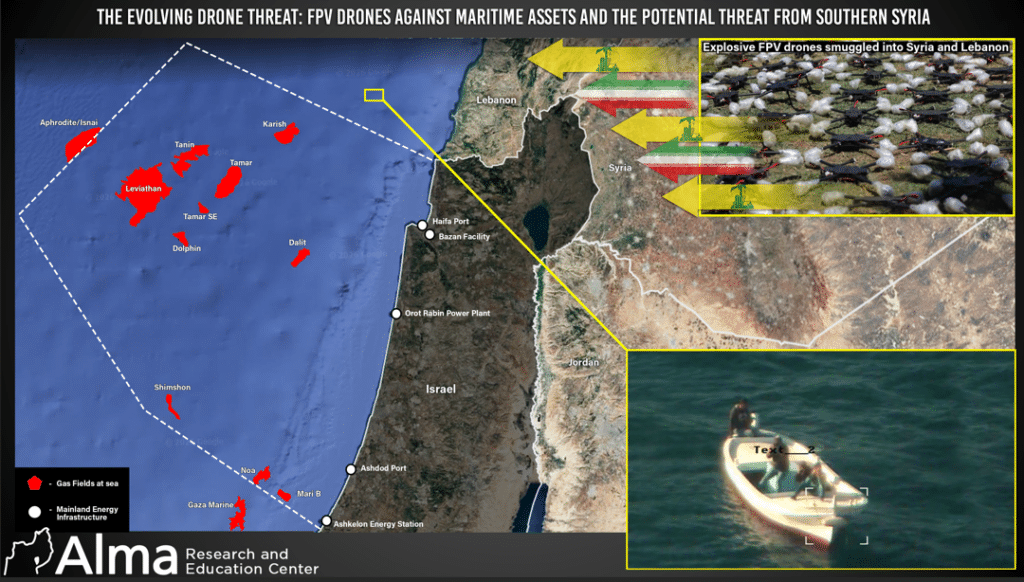
This scenario is highly relevant to the Israeli arena: Hezbollah, as detailed in the document we published on the security of Israel’s ports and maritime energy assets against the Iranian threat, operates, among other things, Unit 1200 (the naval unit) and has already engaged in the covert “maritime file” project (recall: the Imad Amhaz affair).
A similar method of operation against Israel’s Karish and Leviathan platforms in the Mediterranean Sea was apparently already planned by Hezbollah as part of the ‘maritime file,’ and could be implemented in the future as well.
In recent months, the threat from Hezbollah’s fiber-optic-based FPV drones has risen significantly, a subject on which we have published several articles. Dozens of FPV drones have been launched against IDF forces in southern Lebanon, some of which caused fatalities. Hezbollah is clearly imitating and adopting the method that developed in the Russia-Ukraine war, including the use of fiber optics, which rules out any possibility of electronic interception.
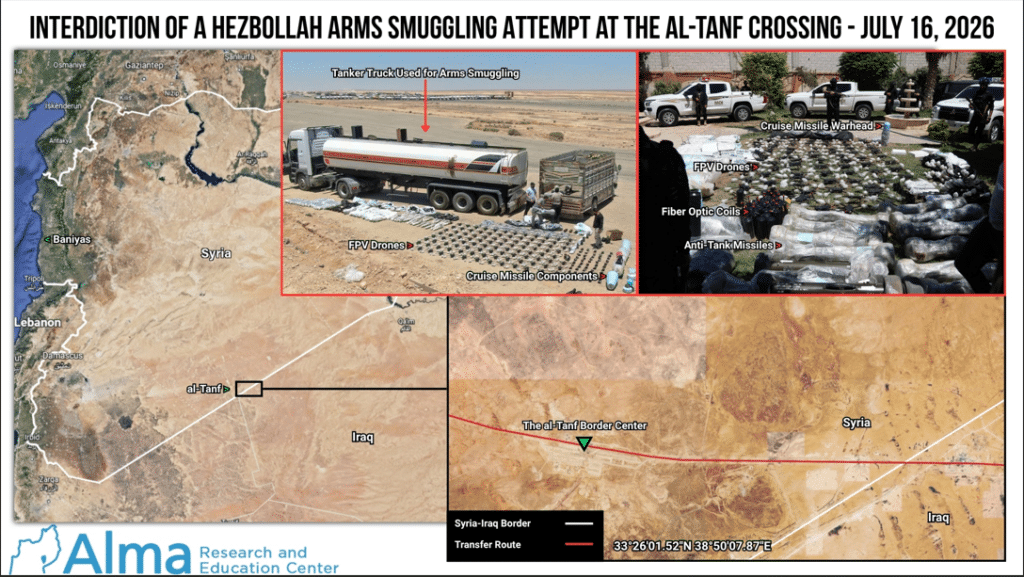
A further significant indication of Hezbollah’s operational potential, and of the fact that Hezbollah has defined the buildup and operation of drone forces as a central effort, is the seizure of a weapons shipment at the al-Tanf crossing, on the Iraq-Syria border, on July 16, 2026.
In the smuggling attempt, more than 100 drones were seized aboard a fuel truck carrying heavy fuel oil to Baniyas in Syria, along with fiber-optic spools, RPG warheads pre-adapted for mounting on drones with dedicated electric release mechanisms (not an improvised adaptation as in the past), guided anti-tank missiles (possibly of the Almas type), and apparently components of “Fahaba”-type cruise missiles.
The scale of the shipment – over 100 FPV drones designed for attack rather than observation, based on the pre-adapted warheads – indicates that Hezbollah continues to build a significant stockpile of this weapon, precisely during the period in which the maritime threat is becoming more relevant, and it may also attempt to expand the potential land corridor for operating these drones against Israel to the southern Syria region in general and the border area with Israel in particular.
It should be noted that, according to local reports, this is not the first weapons-smuggling attempt via the al-Tanf land corridor, and several previous smuggling attempts succeeded. One unverified local report describes the success of six previous smuggling operations using a similar method.
The Ukrainian Scenario and Its Implications for the Mediterranean
The HUR documentation from July 29, 2025 describes a Ukrainian naval commando unit that launched FPV drones from boats on the open sea toward the Petro Hodovanets platform, which Russia turned into an observation post and military logistics hub since 2022. According to HUR, the drones helped neutralize Russian firepower on the platform and caused unspecified losses in personnel and equipment. This was a sea-borne attack launched from boats rather than from land, which reduces warning time and the ability to mount an early defense.
The direct implication for the Israeli arena concerns the Karish and Leviathan platforms, located about 90 km northwest of Haifa and about 10 km from the coast, respectively. Hezbollah possesses a considerable quantity of fiber-optic-based FPV drones. Hezbollah does not necessarily need a technological breakthrough to repeat the Ukrainian scenario – only the “adoption” of an existing method of operation: operating FPV drones from a fishing boat, a civilian deck, or even larger UAVs used as a “carrier platform” for small FPV drones, as was also documented in the Russia-Ukraine war.
Regarding the launching of drones from civilian vessels, we recall the case of Imad Amhaz, who played a central role in Hezbollah’s “maritime file,” one of the organization’s most secret and sensitive projects: the organization’s plan under the “maritime file” was to establish organized infrastructure under civilian cover in order to attack Israeli and international targets at sea through various methods.
Over the past several years, we have learned of reports of various civilian vessels allegedly purchased by Hezbollah through intermediaries, or reports of vessels used by Hezbollah under the cover of shell companies linked to large business enterprises owned by various businesspeople.
Amhaz, who was also a senior operative in Unit 7900 (Hezbollah’s coastal-missile unit), underwent several maritime training courses and held a Lebanese civilian shipping license as well as a maritime crew certificate (third mate). He was captured and arrested by the IDF on October 31, 2024, in the town of Batroun in northern Lebanon, about 140 km from the border with Israel (see the report we published on his arrest from November 2024).

In addition, in a potential scenario, Hezbollah could adopt a ‘shepherd and flock’ model, in which small FPV drones are controlled by a central relay drone.
Such a model, when implemented in a maritime environment and not only on land, could allow Hezbollah to launch several FPV drones simultaneously from different points at sea or from the Lebanese coast, with the aim of overwhelming the detection and defense systems around the platforms.
The Threat Is Also Relevant to Southern Syria in General and the Border Area with Israel in Particular
Southern Syria in general, and the Golan Heights region in particular, could become the next drone front against Israel in the coming years, similar to the model that developed in Lebanon. The threat does not stem only from potential access to drones, but also from the accumulation of several conditions:
- Iranian terror infrastructure established over the years.
- Activity by Hezbollah and Palestinian organizations.
- The weakness of the new Syrian regime in the south of the country and its difficulty in preventing terrorism from this area.
- The ability to smuggle advanced weaponry.
- Geographic proximity to Israel – the Golan Heights.
The southern Syria region is highly suited to the operational model of the Shi’ite axis, in terms of recruitment, establishing local infrastructure, and smuggling weaponry, with an emphasis on low-cost drones that are relatively simple to operate from almost anywhere.
The seizure of the weapons shipment at al-Tanf on July 16, 2026, illustrates the scale of the FPV drone threat and Hezbollah’s reliance on these drones as a central weapon and offensive effort. The shipment aligns with Hezbollah’s current force-buildup priorities, particularly the strengthening of Unit 127 (the aerial unit) alongside the Radwan force and its production, logistics, and supply networks.
The al-Tanf crossing constitutes the shortest and fastest land route from Iran, through Iraq, to Syria and from there to Lebanon, and Iran has apparently renewed its smuggling efforts along this route even after the fall of the Assad regime and the establishment of governance led by Ahmad al-Sharaa.
Iran’s smuggling efforts through the al-Tanf crossing exploit the large commercial traffic of thousands of trucks from Iraq to Syria (see our article on the subject: The New Oil Route from Iraq to Syria: An Economic Corridor Turning into an Operational Opportunity for Iran).
The scale of the al-Tanf smuggling attempt – more than 100 drones in a single shipment – shows that even if some shipments are foiled, Iran continues in a consistent attempt to replenish Hezbollah’s stockpile of these weapons, leaving open the question of the total scope of the arsenal that has already successfully crossed in the past.
According to local reports, this is not the first weapons-smuggling attempt via the al-Tanf land corridor, and several previous smuggling attempts succeeded. One unverified local report describes the success of six previous smuggling operations using a similar method.
It cannot be ruled out that some of the drones were intended to remain within Syria’s borders, to reach the existing terror infrastructure of the Shi’ite axis in Syria, and to be operated against IDF forces in southern Syria and/or against Israeli territory. Drones constitute a central component of the Shi’ite axis’s future warfighting concept in this arena, and the appearance of fiber-optic drones and dedicated attack kits indicates an escalation in expected capabilities.
We recall that on June 28, two Syrian Shi’ite operatives were eliminated in the area of the village of Hader in southern Syria; they had come to the southern Syria area from northern Syria in order to carry out terror activity against Israel under the direction of the Shi’ite axis. The new Syrian regime is struggling to prevent the infiltration of operatives and weaponry into the south of the country.
The Mount Hermon Area
There is a question regarding the technical feasibility of operating FPV drones in the geographic context of Mount Hermon (Jabal al-Sheikh). Technically, most commercial drones are limited in flight ceiling by software locks, so reaching significant altitudes requires bypassing this lock (a limitation of a 500-meter flight altitude above the takeoff point).
If the drone is operated from the slope of Mount Hermon itself, its effective flight ceiling is measured relative to the operator’s altitude – meaning that the higher the operator’s physical location, the higher the drone can actually reach, and very high absolute altitudes can be attained even without bypassing the software limitation.
Another practical limitation, and perhaps the more significant one, is wind. The thin air at high altitude is not necessarily the main obstacle, but winds at altitude, particularly in the Hermon area, can pose a severe operational challenge. Common civilian FPV drone models are generally designed to withstand winds of about 35 to 50 km/h, depending on the model. At the Hermon summit, where average wind speeds often approach or even exceed the capability limit of commercial FPV drones, wind conditions can constitute a significant operational limitation.
In a situation where the wind exceeds the drone’s capacity to withstand it, the drone struggles to maintain a fixed position, drains its battery at an extremely rapid rate in an effort to stabilize itself, and in extreme cases may drift and lose control completely.
The wind limitation is relevant to assessing the practical feasibility of launching FPV drones to the altitude of the Hermon, as well as other high-altitude sectors along the northern and Syrian border.
Conclusion
The video published by Ukraine’s military intelligence agency (HUR), documenting the strike on a Black Sea gas platform using FPV drones launched from boats, marks an operational development with direct implications for the Israeli arena as well. It publicly reveals an operational model of using FPV drones against maritime energy infrastructure, expanding the range of threats beyond missiles and long-range UAVs.
In our assessment, Hezbollah does not need a technological breakthrough to adopt this method of operation. The organization already operates FPV drones, is rapidly investing in force buildup in this area, and, in our assessment, still maintains dedicated maritime infrastructure under Unit 1200, even though its “maritime file” project has been severely disrupted by Israel. A model of launching drones from civilian boats, ships, or airborne carrier platforms could become a real threat to the Karish and Leviathan platforms and to Israel’s energy assets in the Mediterranean Sea.
The seizure of the weapons shipment at the al-Tanf crossing in July 2026, which included more than 100 FPV drones, fiber-optic spools, and warheads pre-adapted for drone deployment, indicates that Hezbollah continues to build a significant stockpile of these weapons as part of a central offensive effort. It should be noted that, according to local reports, this is not the first weapons-smuggling attempt via the al-Tanf land corridor, and several previous smuggling attempts succeeded. At the same time, Hezbollah is adopting the lessons of the Russia-Ukraine war, including the use of fiber-optic drones that are immune to electronic warfare.
The threat is not limited to the maritime arena alone. The southern Syria region could become, in the coming years, an additional front for the use of FPV drones against Israel, owing to a combination of pro-Iranian axis infrastructure, active smuggling routes, the weakness of the new Syrian regime, and proximity to the Israeli border. The smuggling efforts through the al-Tanf crossing and the continued activity of Hezbollah and the Shi’ite axis in the area indicate that Iran continues to invest in drone force buildup even after the change of regime in Syria.
The bottom line is that the FPV drone threat is undergoing a transition: from a tactical threat to forces on the battlefield to a strategic threat to energy assets, national infrastructure, and Israel’s maritime space, while also potentially expanding to the southern Syria arena. Recent developments require adapting defense and warning concepts to the evolving threat, which relies on weapons that are cheap, precise, and increasingly difficult to intercept.
Israel continues to expand its kinetic interception capabilities, but the time gap between the pace of threat development and the pace of finding a response remains a key question for continued monitoring.
Sources:
https://www.israeldefense.co.il/en/node/69080
https://www.israeldefense.co.il/node/69079






One Response
Dear Tal and Yaakov,
Good reporting. The entire IRGC/ayatollah axis of resistance with all proxies must be confronted and defeated to unconditional surrender or death ASAP. We are also engaged in a global conflict with the CRINK axis of evil along with the erred-again muslim brotherhood axis of evil. All these evil oppressors seek to dominate the world under tyranny for their delusions of empires. The LIGHT of LIBERTY will prevail!
“Proclaim Liberty Throughout All the Land unto All the Inhabitants Thereof. “